
User:Martina/T6 Assessment
This is a lot of copy and pasting!!!! everything is in progress
Archiving
We ask that you prepare no later than Friday 12 June:
- (at least a preliminary draft of) your presentation using the wiki link above
- your page(s) on the project site
- any additional/external files to the onedrive/archive
This gives assessors and external examiner time to look through your presentation and project before the assessment.
The Assessment
- 20 minutes: Your presentation (see below)
- 10 minutes: the panel can ask questions regarding what you presented
- 10 Minutes: we ask you to leave, so the panel can discuss, once we're done talking, we'll call you back in
- 5 minutes: Discussion and feedback
The Presentation
We will be evaluating your 2 years at XPUB, the presentation should reflect this.
A useful structure for the presentation:
- your individual contributions to the special issues (where relevant to your final project),
- the development of your reading/writing practice across the 2 years,
- the development of your prototyping practice across the 2 years,
- your thesis (only a brief overview for context, as this has been assessed separately in depth),
- your final work and research in the second year,
- plans for final publication and grad show (with the understanding that you will continue to work on this after the assessment)
Remember: you have just 20 minutes for the presentation, so be selective rather than exhaustive. Use highlights from the first year that support your final project. Please run through / rehearse your presentation, with others if possible so that you can get feedback, and ensure that you are able to fit the time limit. Ask your tutors to have a look at your presentation outline if possible in case you need some help/editorial feedback.
Add you presentation to the wiki link next to your name in the schedule above.
Assessment Criteria for a Graduation Project
(from the course handbook, page 28)
The graduation project should result in a presentation of new work, that combined with the thesis demonstrates the student’s attainment of the agreed learning outcomes (as laid out in the Course hand book Section 3.2 ). In this way the programmes’ agreed Final Competencies form the basis of the Assessment Criteria for a Graduation Project at a Master level.
- Creative ability: They have developed the independent learning ability required to create innovative, challenging, significant, and coherent projects that are based on clearly articulated approaches and intention.
- Capacity to conduct self-directed research: They can identify relevant subject matter, questions, and formulate distinct areas of research.
- Research methodologies: They can harness skills of research, analysis and synthesis to the development of creative projects.
- Technical fluency: They can demonstrate an analytical grasp of the underlying technical and conceptual principles of practices relevant to their field and work.
- Organisational skills: They have the capacity to design, manage and execute effectively, complex and creative projects on their own or in collaboration with others, which bring together original combinations of media forms.
- Capacity for innovation: They have developed flexible work practices that can be employed in a wide variety of production contexts and have the technical conceptual skills for dealing with new forms and unforeseen challenges.
- Critical reflection and awareness of context: They can critically reflect on relevant issues related to a larger social context and make informed decisions about the positioning of their work and methods of production. This critical reflection should be expressed through both practice, and verbal analysis of intention: reflections on process and creative output.
- Communication skills: They can communicate their intention, context, process and perceived results– with clear written and oral descriptions to both experts and general audiences.
Relation to a previous practice
Special Issue #26
Together with Sevgi, we explored the relations between physical quilting and its digital translation. Through our research, we track back into the history of quilting, understanding its archival function of inheriting scraps and how we also inherit and collect digital scraps through no-longer-inspected bookmarks, scrapped HTML projects, and screenshots of the forgotten. The physical quilt exhibited translations of websites made during our quilting workshop. We gathered together and asked participants to think of a website that they wanted to recreate with fabric scraps.
Reflections
- Starting off with web extentions- imagining that altered webpages looked like weaving patterns.
- Applying physical mediums like quilting, to the web.
- Using my previous practice in traditional mediums (textiles) and exploring ways to translate them into the digital.


Special Issue #27
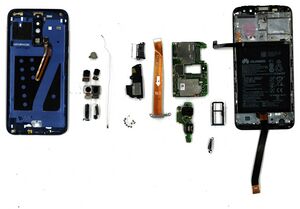
A session in class with Martino and Imane - I opened a broken phone and explored its many layers. This was a time where my interest in hardware rekindled.
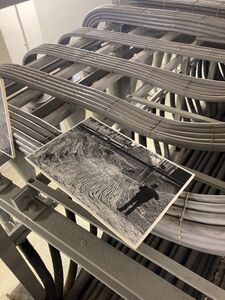
The visit to the Telecom museum was extremely inspiring, especially looking at the massive cabling infrastructure they had set up in the basement. What also intrigued me was the chronology of the communication narrative and see it change in materiality (cabling methods, using paper, tin can methods, telcom services, telephones, mobile phones.)


Outside of XPUB
Residency: Beyond What Drifts Us Apart (sept-oct 2025)
My residency project 'Fieldnotes on Unmaking' reframed fieldwork as an open practice shaped by uncertainty and encounter. At Għajn Tuffieħa watchtower, where the landscape is in constant flux, the project questioned what can be recorded when a site resists stable preservation.
A key part of the process involved introducing participants to unconventional DIY tools for field research. In a workshop titled 'Sonic Artifacts', sound walks and handmade contact microphones captured fleeting, hidden noises in the environment. In 'Tactile and Visual Tracing' (second workshop), co-led with archaeologist Erika Ellul, participants built speculative tools from recycled materials and used them to trace visual and tactile fragments of the site. These tool-making experiments turned observation into a collective act of unlearning and reimagining.
The project’s outcomes formed into a speculative map, digital repository and collective sound piece, forming a porous, evolving archive that mirrored the instability of the landscape itself.


Project proposal

‘A Familiar Materiality’ is a project centered on researching, prototyping, and experimenting with multiple versions of a radio that blend handcrafted materials, electronic parts, and everyday objects. I imagine radios with outer shells made of clay, recycled cables, copper-coil weavings, and integrated hardware, following the principles of a crystal radio and emphasizing a DIY, resourceful use of everyday materials. Experiments and failed attempts will be kept to show the process of finding a binding point between handcrafted materials, electronics, and ordinary objects. Ultimately, the goal is to craft a series of radios that visitors can directly interact with during the exhibition.

I want to immerse myself more deeply in DIY practices, exploring the potential that emerges from crafting and repairing things by hand. My aim is to investigate how materials merge, especially the parallels between the self-sustaining nature of craft traditions like ceramics and the resourceful practice of building a crystal radio. This project will be both practical and personal- an opportunity to engage with making processes while expanding my understanding of electronics on a material level, grounded in my craft knowledge.
Part of my motivation comes from my upbringing. My father, a licensed radio amateur, spent much of his free time making radios, leaving cut cables in the kitchen and the smell of melting solder in the background. Somewhere in the living room, my mother would be knitting or painting a terracotta pot. Growing up with these two opposing hobbyists led me to embrace both “crafts,” recognizing connections between their practices. This project uses familiarity as a foundation, as a starting point.
Thesis outline
I am interested in the everyday objects that shape our lives, be it a ceramic mug, laptop, pen or phone. After researching ceramics and their impact on daily experiences, I am now curious how technological devices have become similarly integral and whether these two material worlds can merge.

By understanding these steps, I hope to explore new possibilities for DIY thinking and critical engagement with technology- asking myself; could the introduction of a crafting material like clay inspire more resourceful and thoughtful approaches to designing and manufacturing electronic devices?

As the project explores the making of a physical radio, the thesis will begin by:

1) Examining how our need for communication originated in ways similar to craftsmanship- as a means of self-sustenance through making and connecting, focusing in particular on the story of Lucretia Walker, the wife of Samuel Morse.

  2) The second chapter will observe craft as both a self-sustaining practice and a means to critically examine the material used in everyday electronic technology.

  3) The final chapter will explore crafting techniques and various modes of hardware production, identifying parallels between the manufacturing processes of clay and electronic hardware. Given that this thesis focuses on materiality, my research will remain attentive to the origins and implications of materials, highlighting the shared concerns between craft and electronic production through their material choices.
Workflow and current references
Reflection and next steps:
Try out night
- It was a good opportunity to visualise and test out what I have in mind with an audience. I received insights into peoples knowledge about crystal radios and positive feedback about the setup. I picked out a shelf from the fourth floor of the university- I like the idea of a working shelf, showing the prototypes, having a space to read through and try out the radio. It felt like an ideal set up to display a work in progress, or a working lab situation.
- I also left a feedback form, asking viewers to briefly narrate the first time they encountered a radio. The form also contained some info about a workshop I would like to organise for the beginning of next year, it was great to see people sign up and get an idea for an audience.


☆I am also keeping a log of notes, inspirations, work progress and general remarks about my project on the wiki.☆
Next steps
- Workshops: In the beginning of next year, I would like to host collective walks with participants who would like to test out my DIY radios. I'm interested to hear feedback, observe how other people would use these radios and how these devices could be adopted in certain contexts and settings.
- Making a prototyping plan, to keep myself in the rythm of making (trying to motivate myself by going to the interaction station bin and picking out devices/ taking them apart and searching what certain pieces do/ function as). I am currently in contact with Yoana Buzova, she works in the interaction station and has experience with making DIY hardware (she was also present at the PCB clay workshop and told me all about it! It was fascinating to hear how long this process was, sharing her insights on how this whole workshop functioned and its many steps.)
- Learning through other projects:
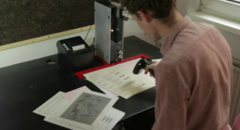
Brendan Howell - the screenless office (rethinking electronics by altering their interfaces, affecting habits and daily life). His interview that mentions Digital Slöjd has been a helpful read.
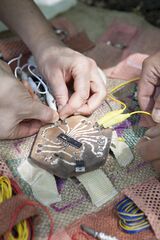
Feminist Hardware: Making Printed Circuit Boards With Natural Clay by Patrícia J. Reis and Stefanie Wuschitz.
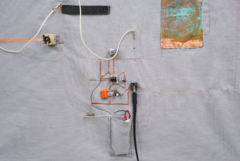
Claire Williams - Psychic Radio (creates electronics through crafts)


