✍️ assessment2
Introduction
Before joining XPUB, I worked as an editor for a government-funded art curation agency in Southern China. My role spanned branding, copywriting, and radio show planning. This experience made me deeply reflective about the relationship between systems, body, collectivity, and individuality.
Throughout my time at XPUB, I've explored one recurring theme across all three Special Issues: how the body is disciplined by systems, and how we react.
SI25
Broadcast: Underwater Exploration
In SI25, We used sound as a tool to explore invisible discipline. Sound, like call center scripts, is repetitive and systemic—it shapes behavior in ways we don't always recognize. By editing and transforming these soundscapes, I aimed to create moments of agency.
We produced collaborative radio shows exploring themes like water, protocols, and customer service systems, using various research methods, like collecting open-source sound files online, reading and rewriting scripts, creating set-up scenes to express ourselves. Also, we experimented with different roles: Writing, VJs, message readers, sound editors, VCV Rack etc.
Broadcast 3: Underwater Exploration curated a sonic collection of diverse water-related audio samples to investigate the textures of aquatic environments.
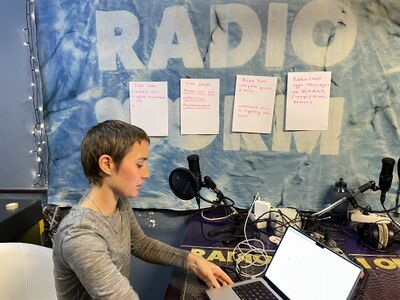
Collaborative script reading session

Live radio performance with VJ and message reading
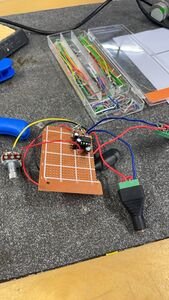


Broadcast:Protocols For Bad Customer Service
Developed a script exploring the potential of customer service protocols as an unconventional narrative space. This project investigated how the rigid scripts of service labor can be subverted to tell personal stories.
File:Week5_BadCustomerService_SCRIPTS8.jpg
A Radio Prototype: The guiline to shadows' mindscape


After this exploration, I created a radio show prototype examining Chinese artistic labor—the intersection of creative work and systemic pressure. This piece was broadcast on Worm Radio, questioning: how do artists survive when their labor is both creative and constrained?
It explored themes of algorithmic intrusion and the laborer's escape from high-pressure artistic environments.
SI26
Face Notation

Face Notation is an interactive website inspired by Chinese physiognomy (face-reading) and web design. I noticed how CSS elements move and shift when you resize a browser window—just like how facial features supposedly determine destiny in traditional face-reading logic.
The project allows users to compose music with their own faces: a way of reclaiming the body from systemic definition. By turning the face into a musical instrument, I question: who has the power to define what our bodies mean?
In Chinese physiognomy, every mole, every line, every feature carries meaning assigned by tradition. But what if we could reassign that meaning? What if the system of interpretation became playful, collaborative, musical?

SI27
Observer Clock
Observer Clock is an installation that links blinking to the flow of time.
"Every blink counts. The more you blink, the faster the clock runs."
This work reflects my experience in service jobs where attention itself becomes labor. When your job is to watch, to monitor, to pay attention—your body's unconscious actions become part of the work.
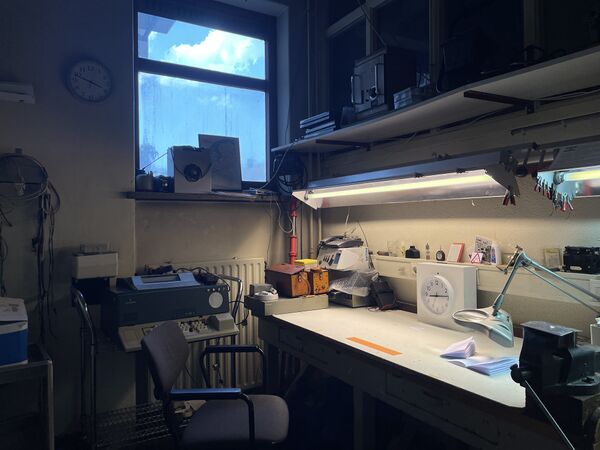
Observer Clock: Installation view showing the clock interface
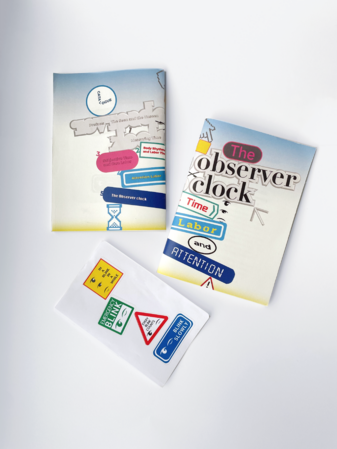
Documentation booklet explaining the concept
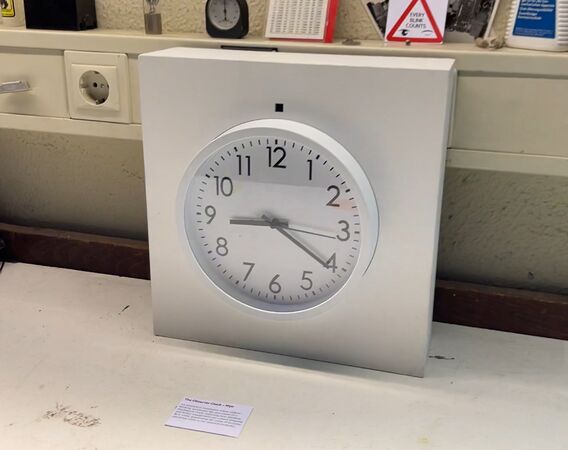
Detail: Eye-tracking mechanism and clock display


The central question: If attention creates value and shifts time, what do we truly desire from our bodies and technologies? Are we observers of time, or is time observing us?
External work
Drifting Down to the Nearby
Co-authored a writing project documenting the nuanced life experiences and the concept of the "nearby" through the lens of an immigrant in the Netherlands. This text work serves as a reflection on displacement and connection in a new environment.
Workshops
- Instant Faith Workshop: Invited participants to design "faith systems" to examine belief formation mechanisms and exhaustion-driven narratives.
- Language(s) :KABK x PZI Alumni Exhibition at Garage Rotterdam:
Showcasing explorations of body, language, and technology in local art spaces.
Presenting Workshop: "Face Notation / From Face-Reading to Personal Soundscapes"
In this 90-minute workshop, participants used Chinese mole-reading traditions to create music. By translating ancient bodily "readings" into sound, we challenged historical interpretations of the body through collective sound-making. Each person's face became a score, each feature a note—reclaiming the body from predetermined meanings.

Graduation proposal
My creative practice is evolving toward more participatory performance and interactive workshops. I aim to deepen the intersection of programming, sound, and body while exploring new modes of engagement with audiences as active co-creators.
Prototype
- Bladder Runner Field Diary: Created a visual and textual field diary that employs the bladder as a metaphor to translate visceral bodily experiences from field research in Shenzhen.
- Mundane Spiritual Interface Mapping: Designed an interactive survey website to collect and map individual "spiritual geographies," visualizing the mundane technologies people utilize during states of exhaustion.
Plans ahead:
- Expand into interactive art projects that invite audiences to actively participate in shaping the experience.
- Develop participatory art performances where the audience is no longer passive but becomes an active participant.
- Continue exploring how bodily actions and creative inputs can co-author artistic experiences.
,_in_use_probably_in_Paris_in_the_early_1970s._Rubber_bands._Courtesy_%E2%80%9CThe_World_of_Lygia_Clark%E2%80%9D_Cultural_Association,_Rio_de_Janeiro.jpg)
Clark’s proposition Estruturas vivas (Live structures, 1969), in use probably in Paris in the early 1970s. Rubber bands. Courtesy “The World of Lygia Clark” Cultural Association, Rio de Janeiro
Conclusion
My work reflects the complex relationships between technology, labor, and the body. I create spaces where people can reconsider their role in the systems that govern their lives and explore new possibilities for agency and self-expression.
Through sound, code, and interactive installations, I ask:
How do we resist the systems that discipline us?
What new forms of being become possible when we reclaim our bodies from systemic definition?
In each project—from the repetitive sounds of labor to the reading of faces, from the counting of blinks to the making of radio—I trace a line of inquiry: where do we find agency within systems that seem total? The answer, I believe, lies not in escaping systems entirely, but in finding the cracks, the glitches, the moments where we can insert our own meanings, our own rhythms, our own resistance.