User:Queenfeline/WhatWillBeDone
< User:Queenfeline
Revision as of 17:06, 5 December 2025 by Queenfeline (talk | contribs)
What will be done eventually definitely soon hopefully
see Project – see Thesis
I like thinking about words and what they actually mean.


- This obsession already started during my bachelor in a course lead by Oswald Egger, a german author, where we took texts apart and talked about words and what they mean for hours. Later he was my bachelor project adviser, as I made a book filled with texts where I played with the german language.
 I took words literally and thus elicited a meaning that is inherently in them but deviates from linguistic usage. As an example: The main text plays with the words Ordnung which means order/tidiness but you can also use it so it means that everything's alright and the word Verrücktheit which means madness but if you take it literally verrückt means something displaced. So I play with ordered madness and the acceptance of displacement and asked if being organized means being alright, and if you're called crazy because you're out of order. I really enjoy finding those differences myself, thus my urge to help other people see them as well.
- This obsession already started during my bachelor in a course lead by Oswald Egger, a german author, where we took texts apart and talked about words and what they mean for hours. Later he was my bachelor project adviser, as I made a book filled with texts where I played with the german language.
- Starting XPUB we created a class-glossary. We called ours Alphabet Soup.
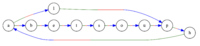 Here Lidia introduced us to pay attention that we, as a class, can have different understandings of words, as we all have different (cultural) backgrounds. So it is important to speak about the concepts and understandings that we have connected to certain words, as they might not be the same for everyone. This and the experimental glossary writing sessions really fascinated me. I like that we are free to give words our own XPUB meaning, that we as a class agreed on.
- Starting XPUB we created a class-glossary. We called ours Alphabet Soup.
- This heavily inspired me to start my own glossary. I refused to call it dictionary as this has a man-made and dictating connotation for me, so that I called it Idioticon
 which means 'a reference book listing alphabetically terms or names important to a particular subject or activity along with discussion of their meanings and applications.' which sounds way more fitting for what I was, and still am, doing. Here i collected words and concepts that I encountered over the year. I researched meaning and added my own thought. What felt like a fun little side project actually turned into the thing that I spent a lot of time with.
 - During the Special Issues this interest never really made it into the projects and always stayed something I additionally did on the side. During SI 26 I had a lot of fun with the email subjects that I collected and made a little booklet out of. During SI 27 I thought a lot about the concept of time and how that word, and concept as we know it today, only exists rather recent as ancient societies had other standards of measuring what we, now, can compare to time. So I'm so looking forward to actually making a project that makes words and language the subject of the discussion.
- This heavily inspired me to start my own glossary. I refused to call it dictionary as this has a man-made and dictating connotation for me, so that I called it Idioticon
- Why is language that important you may ask? In her book "Feminism and Linguistic Theory" Deborah Cameron states , "Language is a weapon, used by the powerful to oppress their subordinates." Words hold power. Words help us validate and make sense of our experiences. Words make our experiences communicable. I think Language is not just a list of words but a system of power that we uphold and reinforce everyday through speaking. The words we use shape us and our experiences (Cameron, 1990) but that mechanism also works the other way around, we can adjust our language to shape the world around us.
- A side from all that feminism plays a big part in my life. As a woman I constantly experience sexism in this world which acts as a big motivator to research it, try to understand it and find ways to fight it. Recently it became clear to me that sexism is so intertwined with society and behavior/speech patters that I, as a woman, behave and speak in ways that are sexist and therefor oppress women. So as I speak I oppress myself. This realization left me feeling icky to my core and alienated from language. Sexism feels so inescapable. It hides in every corner and behind every word we say. It's costume is so concealing I didn't even noticed it myself. To me all this shows so clearly that we need to talk about the hidden sexism in language more. We need to become more aware of the things we actually reinforce when speaking patriarchal language. We must check our language to uncover if it conveys what we believe. We need to expose the sexism in our socially trained and inherited language and adjust our speech behavior to match our convictions.


- Therefore I want to host group meetings where we collectively try to discover all the meanings a word carries and check them on sexism. Along side these meetings I will create a website that documents these meetings in the form of a glossary, since each meeting will revolve around a word, term or sentence.
- A website is great for easy sharing and accessibility. During the try-outs I noticed that many people favored the idea of additionally having a printed version of the glossary, to have something more present that doesn't get lost so easily in the vastness of the internet. A printed physical book would make the project and subject matter more tangible, persistent and concrete. (And it could be something that each participant could get at the end (graduation) to reinforce the feeling of a thing created together.)
- Therefore I want to host group meetings where we collectively try to discover all the meanings a word carries and check them on sexism. Along side these meetings I will create a website that documents these meetings in the form of a glossary, since each meeting will revolve around a word, term or sentence.
- The goal of this project is to spark curiosity and discourse around language and words, to see language as a powerful tool that can be worked with, shifted and shaped. I wish for the meetings and the glossary to become a critical and self-reflective tool to expose hidden bias in our vernacular and make people feel empowered to start a shift in meaning. I don't want to dictate meaning or force people to say or not-say certain words! Taking the consciousness-raising groups from the 60's and 70's Women's Liberation Movement as a role model, I want to break silence(ing) as a political act. Just like these 'Speak-out' meetings I want to open a space to share personal experiences, discuss and erupt taboos. I hope to create a sense of community and solidarity.
- There will be monthly public gatherings in Rotterdam with whoever is interested and wants to join. I would describe my target group, realistically, as people who I speak to in my day to day life and, ideally, as people that differ in age and cultural upbringing to enable greater diversity and multiple perspectives. For each meeting we will talk about a word, phrase or term that holds (more or less hidden) sexism (e.g. bitch, bossy, to have the balls to do smth., feisty, hey guys, 'it's probably a stupid idea but...'). Words that I encounter in books or in other ways that I first didn't see a problem in. I will focus on the oppression of sexism, while still acknowledging that systems of oppression are built upon each other and you cannot extract one and cut loose from the others. The participants will discuss different understandings of, and unpack the sexism in words. Prepared theoretical texts (excerpts)
 from feminist linguists (like Dale Spender, Robin Lakoff, Deborah Cameron) will help us open new perspectives and widen our knowledge. This research will also feed my theory where I will answer the question on How do participatory speech practices about sexist language become a feminist method of unlearning and redefining?
- There will be monthly public gatherings in Rotterdam with whoever is interested and wants to join. I would describe my target group, realistically, as people who I speak to in my day to day life and, ideally, as people that differ in age and cultural upbringing to enable greater diversity and multiple perspectives. For each meeting we will talk about a word, phrase or term that holds (more or less hidden) sexism (e.g. bitch, bossy, to have the balls to do smth., feisty, hey guys, 'it's probably a stupid idea but...'). Words that I encounter in books or in other ways that I first didn't see a problem in. I will focus on the oppression of sexism, while still acknowledging that systems of oppression are built upon each other and you cannot extract one and cut loose from the others. The participants will discuss different understandings of, and unpack the sexism in words. Prepared theoretical texts (excerpts)
- During the try-outs it became clear to me that participants like to write the entries collectively.
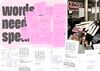 I worked out a structure of questions that will guide through the meetings and function as the organization of the glossary. We will discuss a question and after collectively work on the answer (entry). With that I will also ensure the consent of all regarding publishing the results. As it became clear that recording the meetings in any form will only hinder the needed openness to unlearn. Each entry will contain what the specific group discussed on that specific day. So it's rather a capture of a moment in time and an invitation to rethink and reflect, as I don't intend to dictate meaning in any way. I want to raise awareness and invite others into the process of unlearning, questioning, and rewriting. I see myself very much as part of the group that is still learning everyday.
- During the try-outs it became clear to me that participants like to write the entries collectively.
- I'm very aware that speaking habits are closely connected to ones identity and that these words can be triggering. Uncomfortable feelings will arise, but I think they should not stop us from speaking about this topic. Because the same argument also speaks in favor of this, the connection of speaking habits and identity makes sexism has (negative) effects on our self-perception.
- So there will be a code of conduct that the participants will agree on at the beginning of the meetings to make sure the meetings will happen in a safe(r) environment that allows space for realization and unlearning.