User:Charlie/Protocols for Magic
✧ Protocols for Magic ✧
Description

It positions Magic and Art as concepts in flux, inherently personal, yet always shaped by the larger systems they exist in. Whether implicit or explicit. As such, Art as the conduit to Magic, "magical Art", is always subjective but never neutral. In other words, my thesis does not aim to find a pseudo-universal framework for the interpretation of Magic, but rather, investigate varying possibilities for practicing art-based Magic through personal creative expression. Leaving the necessary space to incorporate personal belief and symbolic systems when engaging with Magic.
Current points of research
✧ Creative/artistic expression as a personal conduit to Magic ✧
✧ Active protocols - Learning through making ✧
✧ The intersection of Art and Magic in practice✧
✧ Differing/opposing definitions and understandings of Magic ✧
Prototyping Workshop ✧ 03/11/25
Workshop Goals
The main goal of this workshop is to investigate how to introduce people to different Magic practices/concept through descriptions, examples, analogies and most importantly: Active protocols for individual and collective experimentation. This workshop therefore includes a variety of prototypes ideas for Magic protocols.
Introduction
Before proceeding, here's a question to the group:
And how would you define it in your own terms?
Existing definitions...
① Dictionary definitions usually describe Magic as a force, or the employing of a force outside of the bounds of current scientific understanding or measurable natural laws, able to affect reality, attributes of reality or someone's perception there of. With the "force", i.e. the (supernatural) source of magic depending on cultural, historical and religious context and believes. (position: neutral to skeptic)
② The academic approach to defining Magic tends to frame Magic as a “mode-of-thinking”, the lens through which one may perceive, makes sense of and engage with the world. Through this view, the idea of Magic (as described in ❶) becomes an analytical framework, a human phenomenon based in Magical Thinking. (position: skeptic)
③ A third but less common approach (including academic sources) may attempt to form a synthesis of the two former perspectives. Magic both as a mode-of-thinking and a force. In this view, the force is conceptualized as the relational connection of the human and the material world/the universe/reality. In this view, Magic lays in the understanding that the human (in body and consciousness) is part of a greater system. And can therefore be influenced by and effect influence on "it". Magic is enacted through the seeking of knowledge, observation and engaging with the world with intention and purpose. (position: agnostic)
Part One ✧ Materials..
For every definition and theory on Magic exist even more ways in which different forms of Magic (practices) may be categorized.
A common yet maybe outdated perspective, is the use of terms such as white vs. black Magic, also referred to as benign vs. malign Magic (Gosden), which usually refers to the moral intent ascribed to certain forms of Magic (i.e. healing spells are seen as benevolent and good, whereas curses are often seen as harmful and bad). Propagated by religion (i.e. Christianity and Islam) and popularized through media, this binary categorization has been used and abused to target and persecute minority groups and cultural practices, throughout history.
Looking at other examples, ancient and contemporary societies that practice Magic (i.e. as an integral part of their culture and religion) may make the distinction between high and low Magic (in varying terms). This distinction usually denotes the forms of Magic and their practitioners' position and function within a societal structure. "High" forms of Magic may be practiced by priests/priestesses, shamans, oracles or others in elite positions. This may include ceremonial and ritual magic, complex divination methods and other more "scholarly"/learned forms of Magic. "Low" magic, also referred to as folk-magic or natural Magic, usually includes Magic employed by the commoners within a society. These "more accessible" forms of Magic can be simpler divination methods, charms and spells and/or other folkloric practices and traditions.
There exist many more ways with which to categorize Magic practices.
However, the categorization we will be using today will incorporate aspects of folk magic and elements of Sympathetic Magic, more specifically, the "Law of Similarity" within Sympathetic Magic.
Sympathetic Magic is an umbrella-term that is sometimes used to categorize magical believes (ranging from primitive, ancient to contemporary examples) which are based on the concept of "like produces like, or that an effect resembles its cause"[1] — The Law of Similarity. In other words, the believe that one may effect Magic onto an object, person or state by invoking its resemblance through imitation (visual/aesthetic representation) or correspondence (symbolic representation/association).
Today's Protocols for Magic:
❶ Spells: Verbalizing an intention
❷ Sigils: Interpreting through abstraction
❸ Correspondences: Creating collective associations
❹ Talismans: Crafting with visual symbols
Spells
A spell is a set of words or formulaic sentence(s) believed to hold magical power and/or be used to verbalize an intent with which to enact Magic. It can either be expressed orally through speech, song or chant, or sometimes work in written form on a amulet, talisman or other magical objects. Spells, also referred to as incantation or charm, can be an integral part of many different forms of Magic, such as rituals and prayers. The ways in which to compose/construct a spell can vary drastically. I.e. How concise or elaborate, simple or rhyming, direct or metaphorical a spell is and how it is performed may depend on context and purpose, or the preference of individual practitioners. In written form, spells may take on an additional visual aspect. The text may form a specific shape or compositional structure.
Example: One of the most well known magical spells is "Abracadabra". Although its exact origin is unknown and it is mostly known as a gibberish word spoken by stage magicians, today, archeological finds date it back to Roman times as an incantation written on amulets and talismans. Many different theories on its meaning exist, including that it was believed to have healing/medical powers if worn on the body.
The power of spells lay in the almost universal believe that language holds power itself (spoken, written and signed, magical or otherwise). Words carry meaning as the basis for connecting with each other, verbalize ideas, emotions and values.
Analogies..
The easiest analogy for spells and charms can be found in everyday language and forms of speech. Whose origins often lay in the folkloric traditions of wishing someone good fortune through common greetings, expression and song:
"Good morning"
"Good luck"
"Knock on wood"
"Happy Birthday to you, happy birthday to you.."
✧ Protocol for Spell-Writing ✧
① In one short sentence:
Write a spell reflecting an intention/wish/hope for this coming graduation year.
② Time: < 5min
Sigils
Sigils are pictorial images/drawings used to visually represent ideas and intentions for magical use. Sigils range from simple symbols to elaborately composed signs. They may be constructed following strict codes and logic (formulas) or be drawn intuitively, depending on the Magical practice. Sigils are used in ritual magic to invoke spirits or entities, are put on all kinds of objects as symbols of protection or enchantment, or can follow other uses. Sigils can also be used as the pictorial/visual representation of a spell or used as the symbolic representation of magical components/materials/ideas.
The Magic of sigils as a (creative) tool lays in its abstraction, and subsequent obstruction of the magical intent. The process of abstraction can force the maker/practitioner to deconstruct and reinterpret an idea through a simplified visual code. Breaking down ideas into its most crucial components. The element of obstruction sigils add can be two-fold. Working with secret/abstract symbols may enable someone to hide meaning/intention/magic from an onlooker, which can have its advantages. It can also be an exercise in visual communication. How can I formulate a specific idea through symbolic composition? The intention may dictate someone's personal approach to sigil Magic.
Examples..
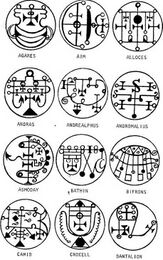
Goetia, sigils of demons and angels
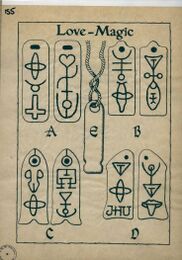
Sigils for love magic talismans
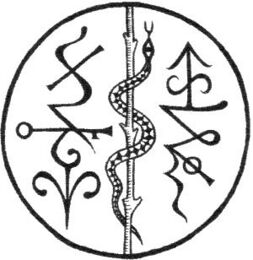
"Snake of the East" by Gemma Gary
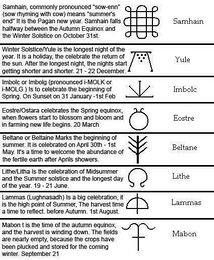
Sigils representing wiccan/neo-pagan holidays
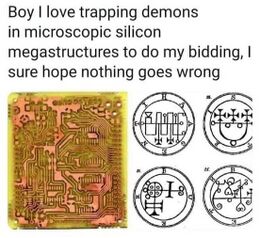
Are there demons trapped beneath the hull?
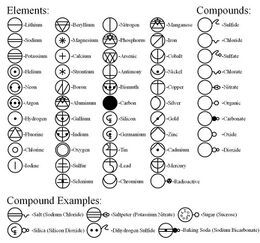
Alchemical symbols/sigils


Analogies..

We interact and use simplified signs and symbols to convey and invoke ideas, emotions and underlying messages, everyday.
Punctuation in the alphabet
! -> exclamation mark -> draw attention, mark importance, covey concern, etc
? -> question mark -> state uncertainty, confusion, etc
... -> triple dots -> unstated information, something is left unsaid, etc
❤️🔥🍀✨🌀💯👀🙏💀🎯✊💦⛓️💥💸 ->Some modern Magic practitioners may use emojis
as a digital equivalent to sigil-magic.
Graphs and charts
Sigils (in its more elaborate forms) could also be compared as the magical equivalent to graphs and charts. A compact visual aid to conveying information, structures, connections etc.


✧ Protocol for Pictorial Interpretation ✧

⚠ Feel free to use the given symbols as a template, as well as incorporate your own symbols, merge symbols, elaborate on them or create compositions, etc. Just make sure to choose at least 3 to 6 "symbolic terms" to interpret your spell, as they will become relevant later.
② Time: < 5min
Correspondences

In magical terms, correspondences is used to mean the symbolic associations we give to particular objects or ideas. Magic that aims to target, speak or invoke aspects of a certain object, person or state may use the given correspondences of a target, when constructing a Magic ritual, spell or artifact. It's concept lays in the basic idea of "like-is-like", creating a "magical link" with an object by employing its representative form (like in the Law of Similarity of Sympathetic Magic). This can be done through the more direct visual representation, or attributes of a thing (likeness, shape, color, material, etc). Or more abstract representations (i.e. ideas, symbols and metaphors, like emotions, plants, animals, etc).
Example: The sun may be visually represented through the color yellow or white, a round shape or a visual depiction of sun rays. It may also be associated with more abstract symbolic interpretations, such as the passing of time, giver of life, the lion or gods/God.
The concept of correspondences has its origins in many ancient cultures and practices. Some archeologist believe ancient cave paintings may depict primitive forms of correspondence magic. Invoking animal spirits for a successful hunt by painting them.
One of the most well-known and popular forms of correspondence magic may be found in Astrology, where each zodiac sign has its associated planet, color, number, stone and more. Similarly, tarot cards (and other forms of divination) also use correspondences. (See picture)
Its important to keep in mind that correspondences/symbolic associations are not universal, but are ever-evolving signifiers that reflect the cultural, religious, material and historical contexts in which they emerge and exist in.
Many belief systems and practices may incorporate and work with a defined set of symbolic associations. However, correspondences can also be personal and informed by an individuals, or group’s lived experiences, believes and own symbolic associations.
Analogies..
To make a simple contemporary analogy for correspondences as symbolic associations;
In marketing and design, certain colors may be used to signify and convey underlying ideas based on people's/society's preconceived associations:
Red -> passionate, sensual, aggressive..
Orange -> warm, fun, utilitarian..
Yellow -> soft, light, friendly..
Green -> natural, organic, healthy..
Blue -> medical, clean, official..
Purple -> mystical, luxurious, emotional..
Pink -> bodily, feminine, playful..
✧ Protocol for Collective Correspondences ✧
① Together create an archive of collective color correspondences.
By assigning each symbol on the table to a spot on the color spectrum:

② Time: < 10min
Part Two ✧ Crafting with Magic!
After having looked at different Magic concepts and practices, we will be incorporating all these components into the crafting of a Magic Artifact — A Talisman.
Talismans
Talismans are one of the most ancient and cross-cultural example of magical artifacts. Either worn on the body as jewelry, a brooch or pendant, or placed in a space as an object, statue or wall-hanging, for example — Talismans are usually characterized as small(ish) material objects made for the purpose of casting Magic on a person or surrounding. Although talismans are sometimes referred to as amulets or charms (object) interchangeably, the latter two are usually objects used for the purpose of general protection or good luck magic. Talismans may incorporate more specific/elaborate magical purposes (including protection and luck). Like the protection from specific influences, good fortune in a specific field or as the surface material to inscribe specific spells and incantations.
Talismans can be made of all kinds of materials: Stone, clay, paper, wood, glass, metal, plastic, textile and more. Or a combination there of. And they usually represent or bear their magical intention/purpose through visual and material symbols, text (spells, prayers, sigils..) or other forms of magical and folkloric associations.
Examples..
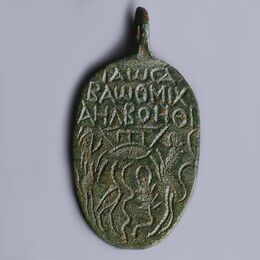
Ancient Byzantin talisman
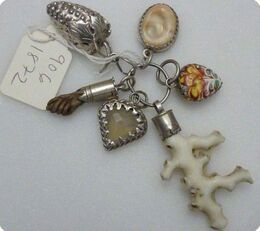
Freiskette: " (..) or convulsion chain combining amuletic beads and other items of religious and folk medicine origin, a tradition dating from the 18th and 19th century." [1] (Origin: Austria-Bavaria)
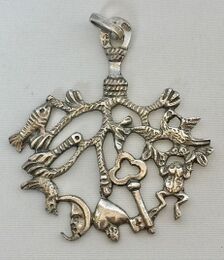
Cimaruta: "(..) Worn around the neck or hung above an infant's bed to ward off the evil eye. (..) supposed to represent a branch of rue—the flowering medicinal herb."[2] From Italian cima di ruta meaning "sprig of rue". (Origin: Southern Italy, neo-pagan practice)
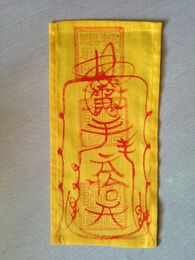
Fulu: "(..)asemic Taoist magic symbols and incantations, translatable into English as 'talismanic script', which are written or painted on talismans by Taoist practitioners."[3] (Origin: China, Taoism)
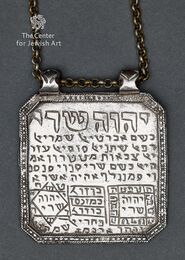
Kurdish Jewish talisman/amulet
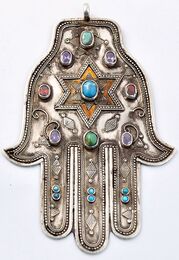
Hamsa: "(..)used as a sign of protection in many times throughout history, the hamsa is believed to provide defense against the evil eye." [4] (Origin: North-Africa, Middle East, Mediterranean, Mespotemia. Islam, Judaism and other religions)


✧ Protocol for Talismans ✧
① Create a talisman Using the previously crafted sigil(s) and correspondences, and by incorporating your found materials.
As you craft, you may think of each component as representing a different aspect to your Magic:
- Found object -> Past/Offering
- Correspondences -> Present/Collective
- Spell/Sigil -> Future/Intention
③ Present it to the group & hang it on the talisman tree
② Time: < 30min
✧ Post-Workshop ✧
How it went..
(..)
Feedback
(..)


References
- C. Gosden (2020), “Magic: A History: From Alchemy to Witchcraft, from the Ice Age to the Present”
- L. Williams (2025), "Compendium Of The Occult - Arcane Artefacts, Magic Rituals and Sacred Symbolism"
- DK (2020), “A History of Magic, Witchcraft and the Occult”
- L. O., Haute (2023), ' Talismans pour celles qui ne savent pas de quoi ils parlent' ("Talismans for those who don't know what they are saying")
- P. E. Moore (2019), "Art and Magick in the 21st Century; Reflections of a Neophyte", TULCA Festival Of Visual Arts, TULCA, Galway, IE. (link)
- ↑ Sympathetic magic (2025) Wikipedia. Available at: https://en.wikipedia.org/wiki/Sympathetic_magic (Accessed: 01 November 2025).