
User:Wyn/T6 Assessment: Difference between revisions
| Line 78: | Line 78: | ||
My project takes this meeting point as its working ground. | My project takes this meeting point as its working ground. | ||
Revision as of 12:53, 23 June 2026
When I entered XPUB two years ago, I came with an interest in practices that face the public, but only with a vague subject. I have never imagined that two years later, I modified two chanting machines and made a web-based story built from its archive.
What led to the final work
Special Issues 25

Protocol for Bad Customer Service (Call Center).
A broadcast working with the language of call centers. My contribution focused on turning a systematic, institutional script — the kind that's normally read mechanically — into something with narrative weight. It was my first time treating found, instrumental language as material to be rewritten.
Work with: fred, charilie, zuhui, claudio, elini
Using water related sound as a metaphor to explore systems. Collaging diverse audio samples to investigate the textures of aquatic environments, finding the materialization, fluidity and resistance of the sound.
Work with imre, matina, claudio, chrissy
Special Issues 26
Face_Notation — an interactive website I built with CSS Grid and Web Audio that turned the bodily markers of Chinese face reading into a sound system. I treated a cultural reading of the body as data, and translated that data into another medium.
Special Issues 27
The Observer Clock — an installation where blinking accelerates time, as a symbol of invisible labour. It came out of site research and out of my own lived experience, and was documented with weasyprint. It was my first installation, and the first time invisible labour appeared as a theme in my work.
What did I learn through those practices
Reading/Writing
- Treating found texts as material to be rewritten — from call-center scripts, to physiognomy text, to the recitation I later wrote for the chanting machine.
- Tracing found objects' circulation historically — following where things come from, who made them, and how they move from hand to hand.
- Connecting personal experience to larger systems and infrastructures.
- An object-facing writing voice, with a non-linear point of entry.
Prototyping
- Letting the object's origin drive the form of the prototype.
- Repurposing existing devices.
- Taking text-based methods into another medium.
What leads me to the project
The thesis takes the nianfoji as its subject. The framework details are already assessed separately, so here I'll stay with one question: how does a mass-produced commodity, made inside a strong cultural context, keep being given meaning and losing meaning as it circulates?
Prototyping of it
The project moved through several material stages: from field notes written on the road, to physical mock-ups of the modified machine.
Bladder Runner is a diary format that came out of the fieldwork trip back to China, where the text adventure story began. I takes my house as the backstage of the project.
Side Notes of Buddha Machine(s) came out of a parallel internet archive and scavenging work — part of my Digital Scavenger practice. It pulls together the original buddha machine, factory's self-narration, buyer reviews, and aesthetic variations across decades.

The chanting machine prototype was built in Decker, coming out of testing how the game could live inside the original housing.

A text adventure in Decker

Side Notes of Buddha Machine(s)
Why the nianfoji

The nianfoji and I come from the same city. Shenzhen built itself for speed — and the same factories that produced the radios, DVD players, and cassette players of the 1990s also produced this object: an electronic chanting machine sold as a sacred product. My mother worked on one of those production lines in 1980s.
So this object holds two things that are usually kept apart: a city built for fast manufacturing, and the spiritual goods that came out of it. The nianfoji is where my mother's labour, the city I grew up in, and a global circulating production all meet.
My project takes this meeting point as its working ground.
What did I find

Two findings during the research changed the form of the final work.
Pun Ngai's writing on women workers on Shenzhen production lines and the Stuart hall the encoding/decoding theory gave me frameworks.
I started to hear another layer in the machine's sound: its spiritual side and its material side both rest on women's labour that goes unnoticed.
In the interviews with people, I saw that each of them was retranslating the machine through their own position. With every replacement, a new meaning appears, and the meaning before it disappears.
Mechanics of the game

A text adventure game with the thesis as its backbone and sound as its main thread.
The story begins with a daughter coming home to fix her mother's broken chanting machine. While repairing it, she becomes familiar again with the environment she grew up in, and through material clues she pieces together a story of the family, the city, and the machine.
Three nested archival voices
Inside the game, three nested archival voices come from a Japanese collector, a Taiwanese sound artist, and a Chinese designer.
These voices come directly from my own first-hand correspondence and interviews with Kaori Sumiyoshi, Lu Yi, and Mogu.
They map onto the three naming mechanisms in the thesi: positional blindness, technical lock-out, and frame absorption.
Sound design
Two layers of sound run at the same time — one follows the player's action, the other follows the machine's state.
Interaction sounds.
- Object — a whisper, close, as if spoken to the object.
- Scene — warmer, with the texture of memory.
- Perspective shift (into the mother's factory / Kaori's collection / Lu Yi's modification / Mogu as a reflection) — underwater, exploratory.
Machine sounds.
- Outside the door — full Amitabha chant.
- Inside the house — the chant begins to fail, broken underneath every room.
- Factory layer — broken chant replaced by 1980s Cantonese pop on the factory radio + production-line noise.
- Ending — both routes completed, machine repaired, full chant returns.
Text layer
Three layers, each one requiring an action to open:
- L1 — observable clues. Flat, restrained.
- L2 — sensory inference, opened on selecting an object.
- L3 — archival text, opened through [read more]. Each archive voice keeps its original language.
The language of L1 came directly from the fieldwork trip recorded in Bladder Runner. Together, text and sound enact encoding and decoding: text encodes what's observable, sound carries what cannot be.
Spatial writing
The house is written as a sequence of rooms, each one functioning as both a physical space and a narrative unit. The structure below shows how the player moves through the house — from the door, into the living room as the hub, branching into the surrounding rooms, and eventually returning to the living room for the ending.

[PROLOGUE: outside the door]
      │
      ▼
┌───────────────────────┐
│ STAGE 1: Living Room  │
└───────────────────────┘
      │
      ├───► [worship cabinet] ──► [Guanyin] ──► [incense burner] ──► [fruit offering]
      │         │                                                              │
      │         │                               ◣──────────────────────────────┘
      │         └──► [nianfoji (Silent Phase 1 & 2)]
      │
      ├───► [tea table] ──► [porcelain cup] / [prayer beads]
      │         │
      │         └──► [medicine bottles]
      │
      └───► [old stereo] ──► [calendar]
                │
                ▼
┌───────────────────────────────────────┐
│ STAGE 2: Exploration & puzzle spaces  │
└───────────────────────────────────────┘
      │
      ├───► 【Toward: Mother's Room】
      │         │
      │         ├──► [bed] ──► [bedside table] ──► [mini scripture book]
      │         │
      │         └──► [drawer]
      │                   │
      │                   ├──► [nianfoji packaging box] ──► [song index] (Kaori entry point)
      │                   │
      │                   └──► [old work badge] ──► 【Enter: 1990s Shenzhen factory】
      │                                                         │
      │                                                         └──► [conveyor belt casing]
      │                                                                  │
      │                                                                  └──► [window sill] ──► [radio]
      │
      ├───► 【Toward: My Room】
      │         │
      │         ├──► [luggage]
      │         │
      │         ├──► [medical report]
      │         │         │
      │         │         ├──► [results / data list]
      │         │         │
      │         │         └──► [processed label]
      │         │
      │         ├──► [laptop]
      │         │         │
      │         │         ├──► [misprinted text]
      │         │         │         │
      │         │         │         └──► [loose internal structure]
      │         │         │
      │         │         └──► [the boss and the workers]
      │         │                   │
      │         │                   └──► [worldly benefit]
      │         │
      │         └──► [iPad] ──► [circuit board, main view]
      │                   │
      │                   ├──► [exposed pins]
      │                   │         │
      │                   │         └──► [photoresistor]
      │                   │
      │                   └──► [single chip]
      │                             │
      │                             └──► [no way in / sealed seam]
      │
      └───► 【Toward: Kitchen & Balcony】
                │
                ├──► [kitchen] ──► [cold stove] / [assorted thermos flasks]
                │
                ├──► [bathroom]
                │
                └──► [balcony] ──► [tropical plants] / [drying rack]
                          │
                          └──► [neighbour's lotus-shaped player]
                              (Mogu entry point: hardware disassembly & contest over naming)
                                    │
                                    └──► [modified MP3 module] ──► [mirrored installation]
                │
                ▼ (Any 2 of the factory, laptop, iPad and balcony paths unlocked)
┌───────────────────────────────────┐
│ STAGE 3: Back to the Living Room  │
└───────────────────────────────────┘
      │
      └───► [the broken nianfoji]
                │
                ▼
            【THE FINALE】 (Original chant returns)
The chanting machine's sound is always present in the living room, anchoring the player back to the central object. The three stages — Living Room → Exploration → Living Room — mirror the sound arc: the broken chant of Stage 1 and 2, and the full chant returning in Stage 3.
Buttons / Keyboard
On the website, the game can be played with cursor and keyboard — only simple up / down / confirm.
On the physical machine, the player interacts with six physical buttons mounted on the chanting machine shell: Up, Down, Confirm, Refresh, Volume +, Volume −. There is also a touch screen.
The interaction vocabulary is deliberately small: closer to operating a radio than playing a game.


Two machines, one decision
Replacement as a method.
The shell stays, the content is replaced, the previous voice falls silent.
This sentence describes both the thesis argument and the two objects in front of you.
Two machines, two replacements:
- Text adventure machine: original electronics out, Raspberry Pi + 480×480 circular screen + six buttons in. The monk's chant becomes sound effect; the game's sound and three archival texts take its place.
- Solar powered chanting machine: The monk's recording is replaced by a text I wrote and recorded myself, voiced as a two-voice piece. I take on the machine's voice and speak the machine's own story. My live voice answers it — as if the machine and I are mirror conditions of each other. I give a speech to the machine on the city's infrastructure, on materiality, on the systems that hold both of us.
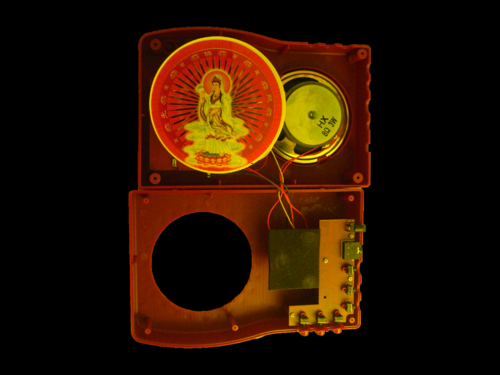
The chanting machine disassembled
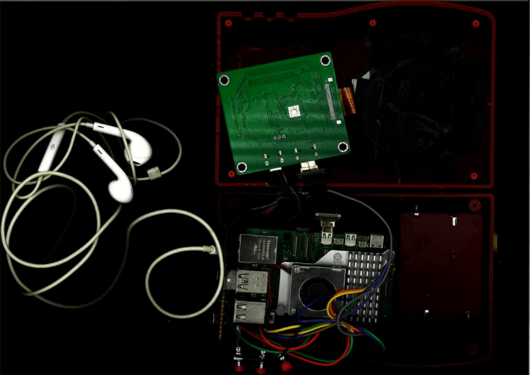
Inside the Buddha machine
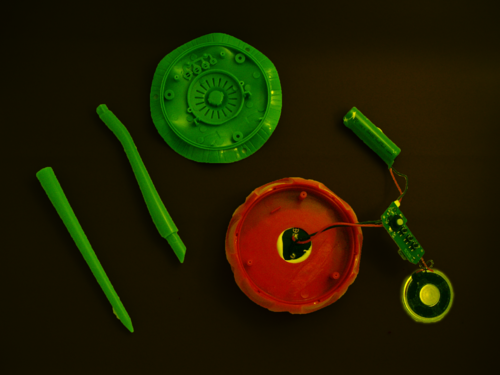
Original solar Buddha machine
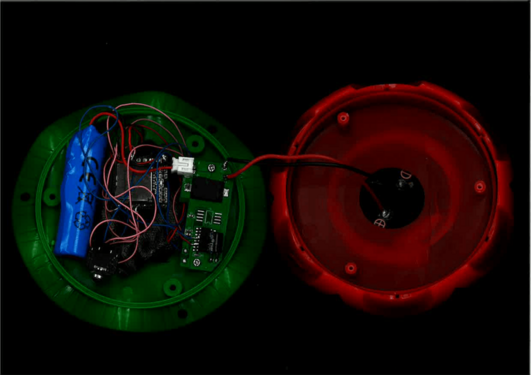
Modified solar Buddha machine


Making it public
The chanting machine

For the graduation show, I'm building a simplified domestic altar scene with secondhand furniture.
Visitors will seat besides it and take the chanting machine from the top of the alter, interacting with the chanting machine that holds the text adventure inside it.
The other one will be insert into soil. Soild will be placed in the drawer beneath the cabinet: a meeting ground for the solar-powered chanting machine that lives next to it.
Web
On the website, the game is played with cursor and keyboard — only simple up / down / confirm. The interaction is lighter than the physical machine, but the spatial and narrative structure stays the same.

Performance
The recitation is performed once, live, inside the same altar space during the graduation show — I speak over and around the solar-powered machine while it runs its replaced loop.
A monologue would let me speak about the machine, keeping me outside it as commentator. A chorus would dissolve the asymmetry between human and machine. The two-voice form keeps that asymmetry visible: the machine carries on without pausing; I speak over and around it — never replacing it, never merging with it.
The machine voice performs the labour. My voice performs the naming.
Solar power ties the recitation to an external condition: daylight in the room. The work runs as long as the room is lit, and falls silent in darkness. The duration isn't authored — it's environmental.
Publication
AAlongside the installation, the web archive, and the performance, the project also exists as a box set of three independent booklets: Bladder Runner (field diary), Side Notes of Buddha Machine(s) (internet archive and scavenging), and The Chanting Machine (the thesis).
A first prototype will be ready before graduation show.
I had never imagined that I could write a story into an interactive form, or modify hardware, in the two years before.

And I did not expect that variations of the same theme could reach different people, with very different backgrounds.

I learned many different skills here, not only basic coding, but also a way of thinking about social structures and infrastructures.

All of those concepts could be linked to my lived experience, helping me observe myself and my background from a different position, and helping me understand others.

Thanks!