
User:C3/XPUB2/T4 Assessment: Difference between revisions
mNo edit summary |
mNo edit summary |
||
| Line 180: | Line 180: | ||
<div style="margin:25em 5em;"> | <div style="margin:25em 5em;"> | ||
[[File:Cheatsheets-diagram.png|thumb|center]] | [[File:Cheatsheets-diagram.png|thumb|center]] | ||
</div> | |||
<div style="text-align:center; margin:"> | |||
All drawings and pictures shown were made by myself, [[User:C3|@c3]] unless stated otherwise. | |||
<br> | |||
The font used is .... | |||
</div> | </div> | ||
Revision as of 11:03, 15 June 2026
INTRO
During my first year I practiced repurposing of old tech devices and coding.
XPUB1
Some selected worksSI26
- web making as a craft
- outdated webstandards to hide or show information
- a game playable from one device
- situating our work within outdated webstandards, working withing limits limits.
- the game is the result of a learning and exploration process that did not find place into the final event.
SI26 with Doriane with the declarations project.
Exploring web making and web standards.
"SI26 3DS zine" A web game publication tailored to be played with the Nintendo 3DS game console.
We (Charlie, Tessa, Eleni and I) took advantage of the hardware specificity of the device (ex. 3D effect) together with the outdated web-standards of its browser (Netfront, ex. opacity in % does not work while on the rest of the browser it does) to show/hide information from other devices, making our puzzle game solvable only through the use of the Nintendo 3DS.
It was a project about working withing the limits and showing the possibilities that lie within them.


Throught trial and error we noted a collection of strategies we used to make our project work. Something that got a bit lost in the final outcome.
SI27
- on the use of a server as a collective space.
- published on a server as a terminal publication
SI27 w/ Martino and Imane, researching the relationship between technological devices and time representation within them.
"SI27 Terms of servers" is a terminal based publication that runs on our server "cerealbox".
In this project, together with Kim, we considered our server as a temporal object. After working with it for a year (in classes, for the SIs projects and websites and for individual learning) we wrote a text that questions our use of it, its reliability and its materiality.
The text is then presented inside of the terminal with the use of a python program, intermitted by the use of live commands that output a partial answer of these questions inside of our publication. (like hardware compontents, uptime, to see how long the server has been running for, etc.)


XTRA
Some other threads that ran parallel to classes and Special Issues:
- hardware maintenance.
- scripting (especially python and bash).
- reading technical manuals like they were adventure books.
- finding playful ways of doing all of these things.


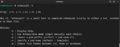
The help section of a script I made.
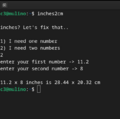
A small program to convert inches into cm.
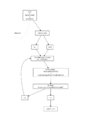
the etherpull program documentation
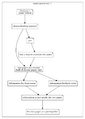
a script to make book covers
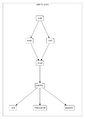
wiki2print workflow
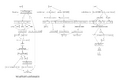
some concept programs from the first year

my bin folder with some of the scripts I wrote

some exercises


So, while learning new things, last year I documented these processes and, once I read through most of my notes, I noted an occasional playful spin in my writing, in general not only grouping relevant information to get back to, but also making the iterative and repetitive part fun, the fun is the learning process anyways for me, it really speaks to my exploration senses.
XPUB2

At the beginnning of the second year I was looking for an intersection between these 3 topics.
I learned because I did go through a stack of manuals and technical documentation.
(ex. 3DS hardware and software manual, computer maintenance manuals, manuals of bash peculiarities)
But my notes showed me that I processed this information in other ways than learning from the manuals, I was playing while I was learning (cracking jokes).
But this was mostly a solitary process, looking back I was thinking of how I could find a way to focus more on the learning processes, highlighting alternative ways than the "dry" ones.
I wanted to welcome others into these different forms of learning.
I ran into the opposite of the manuals, the cheatsheet, which is something that got interesting because it is more frequently used than a 300 page manual, and it has a bigger distribution too (it gets duplicated, rewritten, redesigned etc.)
So I started to play with the form of the cheatsheet, tying to take my notes and to "cheatify" them. By doing this I started developing different exercises (my learning methods riconverted for others to try).
The main difference between the cheatsheet as an existing object and what I am trying to do would be that I don't want to frame them mine as an external object to solve a problem fast (shortcut, skip button).
I want to use this form as a learning device, to support a learning process.


On parallel of rewriting my notes into cheatsheets, I started to think of activities that make use of them, to try them out. With the goal of using the form of the workshop as a way to open up spaces of play where people ideally can explore these topics in a "safe" way.
An example: "Lost in Terminal" workshop.
Lost in terminal was the first experiment that took place during prototyping classes. It is an exercise that consists in using the terminal as a creative tool to create and describe spaces. Mapping the folders as rooms and files as objects I asked the participants to connect to cerealbox and making common spaces where we could hang out with eachother.
At the end we took a moment to walk trough our creations, moving around by entering the rooms and moving objects.

THE 100th TIME (GRAD PROJECT)
During this year I see my self developing an iterative process of making cheatsheets, testing them by organizing workshops, making new cheatsheets, testing them at the next workshop... and repeat.
"The 100th time" is a project that consists in:
- a collection of cheatsheets (that I write from my notes)
- a series of workshops (that make use of the cheatsheets)
THESIS
I want to use the Thesis to unpack the process loop of my project (looking at the pedagogical side of my workshops and cheatsheets) using as a reference some historical tech pedagogical projects of the past (ex. Smalltalk, Turtle).

All drawings and pictures shown were made by myself, @c3 unless stated otherwise.
The font used is ....