
User:LEa/SI28: Difference between revisions
(→Week 1) |
No edit summary |
||
| (67 intermediate revisions by the same user not shown) | |||
| Line 5: | Line 5: | ||
'''Special Issue #28: [[Writing Machines–Protocols–Feedback]]''' | '''Special Issue #28: [[Writing Machines–Protocols–Feedback]]''' | ||
''A_Mazing_Machine[s]: Wordscapes To Liberate Language'' | |||
September—December 2025 | September—December 2025 | ||
Outputs: radio show, live event (exhibition & performances), website, printed publication (web2print zine) | |||
[https://pzwiki.wdka.nl/mediadesign/User:LEa/notes1 Notes from Class: SI28] | |||
==<span style="letter-spacing: -0.1em;">Worm Radio Shows</span>== | |||
For 8 weeks, we had the opportunity to make an hour long radio show every Monday morning and try very different things. | |||
==Week 1== | ===Week 1=== | ||
[[File:Signal-2025-09-23-174946 003.jpg|thumb|alt=snippets of text on a table in the worm radio studio. they read for example "project", "between", "plants".]] | [[File:Signal-2025-09-23-174946 003.jpg|thumb|alt=snippets of text on a table in the worm radio studio. they read for example "project", "between", "plants".]] | ||
[https://pzwiki.wdka.nl/mediadesign/SI28-Radio-Worm/Week1 '''Overview of the whole show'''] | |||
'''Hosts''' | '''Hosts''' | ||
| Line 42: | Line 51: | ||
''And your role is the garden, composting computers, and everything'' | ''And your role is the garden, composting computers, and everything'' | ||
[https://pzwiki.wdka.nl/mediadesign/SI28-Radio-Worm | ===Week 5=== | ||
[https://pzwiki.wdka.nl/mediadesign/SI28-Radio-Worm/Week5 '''Overview of the whole show'''] | |||
'''Hosts''' | |||
[[User:Daanprincen|Daan]], [[User:SHRED|Ema]], [[User:Lucatorsera|Luca]], [[User:Robin|Robin]], [[User:Tommi|Tommi]], Lea (me) | |||
'''A Jam | Lea's preparations''' | |||
For the 5th episode of our radio show, aired on 25-09-22, we got together as a group that was interested in doing a live jam with a range of instruments and tools. Daan wished to explore the equipment in the studio some more and brought selected records, CDs and cassettes with him. Robin and Ema carried parts of the upcoming "typewriter ensemble" to the worm studio to play on—a dot matrix printer and a typewriter. Luca and me tried our hands at live coding with Strudel, bringing samples and field recordings to cut, loop and distort. Tommi joined in with his voice and system sounds from his computer. | |||
Being totally inexperienced with both jamming and live coding, I was very nervous and prepared myself for an hour of making just noise. I was positively surprised by how well it worked and how much fun it was. Much love to the team—would totally do it again! | |||
'''Input''' | |||
I prepared a small collection of audio files to play during the show, including sound samples from various sources that meant something to me, either personally or in the context of SI28. From: [https://www.youtube.com/watch?v=tK1B5dLGigY Going Out] (Timothy Leary), [https://open.spotify.com/artist/3CUh8276o3kWZEy7PfNmQI Lost for Words: The Ghost of Arthur Rimbaud] (Paul Morley), [https://www.youtube.com/watch?v=cFwVCHkL-JU The Medium Is the Massage] (Marshall McLuhan), Der Räuber Hotzenplotz (written by Ottfried Preußler, read by ?), [https://www.youtube.com/watch?v=Ck8qKo7AE1o&list=OLAK5uy_kUJ8Qe08njSyeuQkmiZD8CpTVRACToYdo Club d'Essai]. | |||
Driven by my desire to go for walks, I also collected field recordings from my neighborhood. I recorded the sound of a street sign pole being pulled over concrete, children talking and yelling while cleaning up the street, construction material getting thrown into a container, and more. My recordings can be found on radio aporee under [https://aporee.org/maps/work/user.php?u=3894 my user]. | |||
To make the experience more enjoyable for listeners and also give us some time to breath, we played some songs in between our jamming. I brought these: [https://www.youtube.com/watch?v=nq4JqU5fkLs Achtung! Wir schalten Um] (Felix Kubin), [https://open.spotify.com/track/6rUDmFgzkvTN0RpN2xiU2Q The Rules] (David Shrigley), [https://www.youtube.com/watch?v=zq4dAkE4N14 Eat That Phone Book Coda] (Gong) | |||
'''Script Snippets''' | |||
Strudel is very new to me and by Monday morning, my ability to use it was still super limited. I resorted to playing a few sounds in VLC and looping in Tenacity. These are snippets I had prepared and used during the show: | |||
<syntaxhighlight lang="javascript" line="1" start="1"> | |||
$: n("2 3").s("penplotter").gain(3) | |||
$: n("[0 <1 2>]*8").s("construction").palindrome() | |||
$: n("1 - - - - - 0 <1 2>").s("morley").iter(4) | |||
$: n("4 [- 3]").s("morley") | |||
$: n("1").s("children") | |||
</syntaxhighlight><syntaxhighlight lang="javascript" line="1" start="6"> | |||
$: n("[<0*2 1*2> 2*4]*2").s("construction") | |||
$: n("3 - - 0 - 1 2").s("penplotter").gain(2) | |||
$: n("2").s("hotzenplotz") | |||
$: n("0 <0 - - ->").s("essai") | |||
$: n("0 - - - - - - - - - 0 <0 0>").s("downbylaw") | |||
$: n("2").s("children") | |||
</syntaxhighlight>'''Output''' | |||
These snippets on their own (without the other participants of the jam) sound like this: | |||
[https://pzwiki.wdka.nl/mw-mediadesign/images/0/0d/Strudel-audio-1.mp3 🔊 Output 1] | |||
[https://pzwiki.wdka.nl/mw-mediadesign/images/8/8a/Strudel-audio-2.mp3 🔊 Output 2] | |||
= | ===Week 6=== | ||
[https://pzwiki.wdka.nl/mediadesign/SI28-Radio-Worm/Week6 '''Overview of the whole show'''] | |||
'''Hosts''' | |||
[[User:Daanprincen|Daan]], [[User:SHRED|Ema]], [[User:Valentin97|Valentin]], Lea (me) | |||
'''A Set''' | |||
Coming up to this week, everybody in XPUB1 was very busy with the preparation for the event. We didn't have a group meting scheduled and forgot to discuss who would be on air for the sixth episode on 25-09-22. On Friday evening, Daan suggested to do a chill music session and Ema, Valentin and I decided to join. Ema built the Death Core Writing Machine. The rest of us brought music related to sampling, writing machines and musique concrete. | |||
===[[Writing Machine | '''Input''' | ||
These are the songs and sound snippets I brought, from which I played about half. | |||
* Bruce Haack - Epilogue | |||
* Deep Space Network - Psyphonic | |||
* Dwig - Superunke | |||
* Four Tet - Chia | |||
* Four Tet - Watersynth | |||
* Gray - Cut It Up High Priest | |||
* Gray - Doctor Dhoom | |||
* Gray - The Mysterious Ashley Bickerton | |||
* Having Been built On Sand - Song 2 | |||
* Herbie Hancock - Chameleon | |||
* Intersystems - Changing Colours (They Go For A Walk) | |||
* Michael James - Guatamalan Strange | |||
* Monolake - Mobile | |||
* Pole - Fohlenfurz | |||
* Sun Ra - Interplanetary Music | |||
* Sun Ra - Rocket Number Nine Take Off For The Planet Venus | |||
* The BBC Radiophonic Workshop - Talk Out | |||
* The BBC Radiophonic Workshop - The Chem Lab Mystery | |||
* The BBC Radiophonic Workshop - Time Beat | |||
* Uncle Meat - Film Excerpt Part II (cut) | |||
* Uncle Meat - The Voice Of Cheese | |||
* William S. Burroughs - The Exterminator | |||
===Week 8=== | |||
[[SI28-Radio-Worm/Week8|'''Overview of the whole show''']] | |||
'''Hosts''' | |||
[[User:Tommi|Tommi]], [[User:Valentin97|Valentin]] | |||
'''A Glossary''' | |||
The last episode, aired on 25-11-24, was a retrospective view on Special Issue #28. Everyone choose a word related to our discussions from the past three months, and wrote a definition for it. We also brought a song each, possibly related to the word. Tommi and Valentin hosted the show, asking pairs of two to discuss the words. I could not be there, but my glossary entry was still presented. | |||
'''Input''' | |||
''Beat Generation'': The Beat Generation refers to a movement in American literature that emerged in the 1950s – the core group consisting of authors Jack Kerouac, Allen Ginsberg, and William S. Burroughs. Central elements of Beat culture include the rejection of materialism and conventional narrative values, explicit depictions of human existence, the search for spirituality, experimentation with psychedelic drugs, and sexual liberation. The soundtrack of the Beat Generation was modern jazz, in particular the energetic sound of bebop and hard bop. | |||
🔊 [https://www.youtube.com/watch?v=3rfFLC5AfcY The Drum Thunder Suite] (Art Blakey And The Jazz Messengers) | |||
📎 [[SI28-Glossary|Complete glossary wiki page]] | |||
==<span style="letter-spacing: -0.1em;">Writing Machines</span>== | |||
===Made in class=== | |||
====[[Writing_Machine_Directory/25-09-15#Writing_Machine_Group_1:_Multinational_Poetry_Remix|Multinational Poetry Remix]]==== | |||
====[[Writing_Machine_Directory/statemachines#Nod-Blink-Yawn_State_Machine|Nod-Blink-Yawn State Machine]]==== | |||
====[[User:LEa/SI28#Outer_Part|The Calm Machine: Walking Protocol]]==== | |||
===Made elsewhere=== | |||
====[[Writing_Machine_Directory/mudcellpoem|Mud-cell Poem]]==== | |||
====[[Writing_Machine_Directory/glyphica|Glyphica Text Machine]]==== | |||
====[[Writing_Machine_Directory/walking|Psychogeographic Writing Machine]]==== | |||
====[[Writing_Machine_Directory/poetrygenerator|Poetry Generator (@ CCU)]]==== | |||
===Found in the wild=== | |||
====[[User:LEa/blog/2025-10-30#M%C3%BCnzfernsprecher_Recordings|Münzfernsprecher Recordings]]==== | |||
==<span style="letter-spacing: -0.1em;">Live @ WORM UBIK: The Calm Machine</span>== | |||
On November 19, we exhibited "A_Mazing_Machine[s]: Wordscapes to Liberate Language" publicly in the space of UBIK. I worked with Sibyl to present ''The Calm Machine''. | |||
''The Calm Machine'' is a quiet and cozy island in the buzzing and bustling of the event. Behind a curtain—hidden away from the other stations—, it provides privacy and a moment of peace. A cozy environment with couches, warm lightning and plants invites the audience to come in, sit down and relax. We view the visitors as an essential part of our machine: they are gear in the mechanics of ''The Calm Machine''. By engaging with it, they make it come to life. | |||
<div style="display:flex;"> | |||
[[File:Screenshot 20251124 234423.png|thumb|left|360px]] | |||
[[File:Calm-machine-protocol.jpg|thumb|left|200px]] | |||
[[File:Calm-machine-scanner.jpg|thumb|left|200px]] | |||
</div> | |||
===Inner Part=== | |||
Sibyl prepared the "inner" part of the machine: an interactive installation revolving around home and safety. She set up various personal objects—a bamboo steamer, a ball of wool and knitting, a house plant, and a toy, gifted to her by a friend. By touching these objects, visitors could trigger different light and sound outputs. The act of touching and then carefully watching and listening to the results should ideally contribute to a feeling of belonging, as well as initiate thoughts about the visitors own relation to home and their immediate environment. | |||
===Outer Part=== | |||
After interacting with the objects, visitor were then led to the "outer" part of the machine, which consisted of a walking protocol I had worked on. My thoughts leading up to this event were similar to Sibyls. I, too, wanted to give visitors the opportunity to ground themselves and reflect on their surroundings. For me, going for a walk is always a great way to calm any anxiety, focus my thoughts and gather new energy. The walking protocol consisted of instructions to walk around the block one or more times. Through answering questions, blanks in a story on the back could be filled in. I am very interested in how people perceive the same urban spaces, in this case the streets around UBIK, differently—compared to others or compared to a version of themselves at another time. For this reason, I set up a scanner and asked people to document their results. | |||
'''Input''' | |||
<div style="display:flex;"> | |||
[[File:Walking-012513.png|thumb|left|200px]] | |||
* Can you spot an object that reminds you of home? | |||
* Is there something curious to observe? | |||
* Look at someone or something active to your left. What are they doing? | |||
* What do you see when you look up? | |||
* How did this walk make you feel? | |||
</div> | |||
'''Output''' | |||
<div style="display:flex;"> | |||
[[File:Walking-183115.png|thumb|left|200px]] | |||
[[File:Walking-234048.png|thumb|left|200px]] | |||
[[File:Walking-014207.png|thumb|left|200px]] | |||
[[File:Walking-235026.png|thumb|left|200px]] | |||
</div> | |||
This is a detailed description of the project: | |||
{{:Projects_SI_28/The-Calm-Machine}} | |||
== | ==<span style="letter-spacing: -0.1em;">Production Teams</span>== | ||
=== | === Editorial === | ||
Editorial team: Robin, Valentin, Lea (me) | |||
Tasks: Writing promotional texts, writing the intro to our zine, making templates on the wiki, reminding people to document on the wiki and keep track of deadlines | |||
=== Website === | |||
Website team: Youjung, Tommi, Robin, Lea (me) | |||
Tasks: Building a website | |||
Kim shared with us how to fetch data from the wiki to use in an html page. See more: [[User:LEa/workshops/MediaWiki|Mediawiki API Workshop]] We decided to use this, and 11ty. Tommi set up a base structure. | |||
=== Web2Print Zine === | |||
Zine team: all of us | |||
Making a printed publication with Manetta! | |||
Latest revision as of 16:33, 15 April 2026
Special Issue #28: Writing Machines–Protocols–Feedback
A_Mazing_Machine[s]: Wordscapes To Liberate Language
September—December 2025
Outputs: radio show, live event (exhibition & performances), website, printed publication (web2print zine)
Worm Radio Shows
For 8 weeks, we had the opportunity to make an hour long radio show every Monday morning and try very different things.
Week 1

Hosts
Luca, Robin, Valentin, Lea (me)
Session 3 | Lea
As part of the first episode of our Special Issue #28, aired on 25-09-22, I brought a cut-up text to perform together with the group. The concept follows the surrealist idea of latent news, but can also be traced to Tristan Tzaras text To Make A Dadaist Poem or the cut-up technique used by William Burroughs and Brion Gysin.
Input
The input consisted of the principles of permacomputing and Sunjoo Lee's descriptions of her artistic research project Electric Garden, as well as the articles How to Mount a Balcony Awning by Dmitriy Kurochkin and Building a slow web by Greg Sarjeant. As I did not have enough time to cut up everything I brought, not every input text made it in to the final output. Each of us took a few snippets of text (single words or phrases) and rearranged them into longer phrases or sentences. We then went around in a circle and read them out loud.
Output
All hardware especially the internet as chips to be fed
Flexible electricity built on radio signal are the principles of permacomputing
Never stops pushing. Is an ongoing electric garden
Artistic research powered by the early internet consider carefully insects

The best I remember showing the electric garden
The worst relational process explores the garden
Flowing and it is still making control the feed integrate coming to bathe never stops
Interaction between hope for but the feed is flourishing

Living you don't
Simplicity, complexity and almost biological and renewable one year old
A place solid ground electricity that algae now
And your role is the garden, composting computers, and everything
Week 5
Hosts
Daan, Ema, Luca, Robin, Tommi, Lea (me)
A Jam | Lea's preparations
For the 5th episode of our radio show, aired on 25-09-22, we got together as a group that was interested in doing a live jam with a range of instruments and tools. Daan wished to explore the equipment in the studio some more and brought selected records, CDs and cassettes with him. Robin and Ema carried parts of the upcoming "typewriter ensemble" to the worm studio to play on—a dot matrix printer and a typewriter. Luca and me tried our hands at live coding with Strudel, bringing samples and field recordings to cut, loop and distort. Tommi joined in with his voice and system sounds from his computer.
Being totally inexperienced with both jamming and live coding, I was very nervous and prepared myself for an hour of making just noise. I was positively surprised by how well it worked and how much fun it was. Much love to the team—would totally do it again!
Input
I prepared a small collection of audio files to play during the show, including sound samples from various sources that meant something to me, either personally or in the context of SI28. From: Going Out (Timothy Leary), Lost for Words: The Ghost of Arthur Rimbaud (Paul Morley), The Medium Is the Massage (Marshall McLuhan), Der Räuber Hotzenplotz (written by Ottfried Preußler, read by ?), Club d'Essai.
Driven by my desire to go for walks, I also collected field recordings from my neighborhood. I recorded the sound of a street sign pole being pulled over concrete, children talking and yelling while cleaning up the street, construction material getting thrown into a container, and more. My recordings can be found on radio aporee under my user.
To make the experience more enjoyable for listeners and also give us some time to breath, we played some songs in between our jamming. I brought these: Achtung! Wir schalten Um (Felix Kubin), The Rules (David Shrigley), Eat That Phone Book Coda (Gong)
Script Snippets
Strudel is very new to me and by Monday morning, my ability to use it was still super limited. I resorted to playing a few sounds in VLC and looping in Tenacity. These are snippets I had prepared and used during the show:
$: n("2 3").s("penplotter").gain(3)
$: n("[0 <1 2>]*8").s("construction").palindrome()
$: n("1 - - - - - 0 <1 2>").s("morley").iter(4)
$: n("4 [- 3]").s("morley")
$: n("1").s("children")
$: n("[<0*2 1*2> 2*4]*2").s("construction")
$: n("3 - - 0 - 1 2").s("penplotter").gain(2)
$: n("2").s("hotzenplotz")
$: n("0 <0 - - ->").s("essai")
$: n("0 - - - - - - - - - 0 <0 0>").s("downbylaw")
$: n("2").s("children")
These snippets on their own (without the other participants of the jam) sound like this:
Week 6
Hosts
A Set
Coming up to this week, everybody in XPUB1 was very busy with the preparation for the event. We didn't have a group meting scheduled and forgot to discuss who would be on air for the sixth episode on 25-09-22. On Friday evening, Daan suggested to do a chill music session and Ema, Valentin and I decided to join. Ema built the Death Core Writing Machine. The rest of us brought music related to sampling, writing machines and musique concrete.
Input
These are the songs and sound snippets I brought, from which I played about half.
- Bruce Haack - Epilogue
- Deep Space Network - Psyphonic
- Dwig - Superunke
- Four Tet - Chia
- Four Tet - Watersynth
- Gray - Cut It Up High Priest
- Gray - Doctor Dhoom
- Gray - The Mysterious Ashley Bickerton
- Having Been built On Sand - Song 2
- Herbie Hancock - Chameleon
- Intersystems - Changing Colours (They Go For A Walk)
- Michael James - Guatamalan Strange
- Monolake - Mobile
- Pole - Fohlenfurz
- Sun Ra - Interplanetary Music
- Sun Ra - Rocket Number Nine Take Off For The Planet Venus
- The BBC Radiophonic Workshop - Talk Out
- The BBC Radiophonic Workshop - The Chem Lab Mystery
- The BBC Radiophonic Workshop - Time Beat
- Uncle Meat - Film Excerpt Part II (cut)
- Uncle Meat - The Voice Of Cheese
- William S. Burroughs - The Exterminator
Week 8
Hosts
A Glossary
The last episode, aired on 25-11-24, was a retrospective view on Special Issue #28. Everyone choose a word related to our discussions from the past three months, and wrote a definition for it. We also brought a song each, possibly related to the word. Tommi and Valentin hosted the show, asking pairs of two to discuss the words. I could not be there, but my glossary entry was still presented.
Input
Beat Generation: The Beat Generation refers to a movement in American literature that emerged in the 1950s – the core group consisting of authors Jack Kerouac, Allen Ginsberg, and William S. Burroughs. Central elements of Beat culture include the rejection of materialism and conventional narrative values, explicit depictions of human existence, the search for spirituality, experimentation with psychedelic drugs, and sexual liberation. The soundtrack of the Beat Generation was modern jazz, in particular the energetic sound of bebop and hard bop.
🔊 The Drum Thunder Suite (Art Blakey And The Jazz Messengers)
Writing Machines
Made in class
Multinational Poetry Remix
Nod-Blink-Yawn State Machine
The Calm Machine: Walking Protocol
Made elsewhere
Mud-cell Poem
Glyphica Text Machine
Psychogeographic Writing Machine
Poetry Generator (@ CCU)
Found in the wild
Münzfernsprecher Recordings
Live @ WORM UBIK: The Calm Machine
On November 19, we exhibited "A_Mazing_Machine[s]: Wordscapes to Liberate Language" publicly in the space of UBIK. I worked with Sibyl to present The Calm Machine.
The Calm Machine is a quiet and cozy island in the buzzing and bustling of the event. Behind a curtain—hidden away from the other stations—, it provides privacy and a moment of peace. A cozy environment with couches, warm lightning and plants invites the audience to come in, sit down and relax. We view the visitors as an essential part of our machine: they are gear in the mechanics of The Calm Machine. By engaging with it, they make it come to life.


Inner Part
Sibyl prepared the "inner" part of the machine: an interactive installation revolving around home and safety. She set up various personal objects—a bamboo steamer, a ball of wool and knitting, a house plant, and a toy, gifted to her by a friend. By touching these objects, visitors could trigger different light and sound outputs. The act of touching and then carefully watching and listening to the results should ideally contribute to a feeling of belonging, as well as initiate thoughts about the visitors own relation to home and their immediate environment.
Outer Part
After interacting with the objects, visitor were then led to the "outer" part of the machine, which consisted of a walking protocol I had worked on. My thoughts leading up to this event were similar to Sibyls. I, too, wanted to give visitors the opportunity to ground themselves and reflect on their surroundings. For me, going for a walk is always a great way to calm any anxiety, focus my thoughts and gather new energy. The walking protocol consisted of instructions to walk around the block one or more times. Through answering questions, blanks in a story on the back could be filled in. I am very interested in how people perceive the same urban spaces, in this case the streets around UBIK, differently—compared to others or compared to a version of themselves at another time. For this reason, I set up a scanner and asked people to document their results.
Input

* Can you spot an object that reminds you of home?
* Is there something curious to observe?
* Look at someone or something active to your left. What are they doing?
* What do you see when you look up?
* How did this walk make you feel?
Output


This is a detailed description of the project:
Projects SI 28/The-Calm-Machine
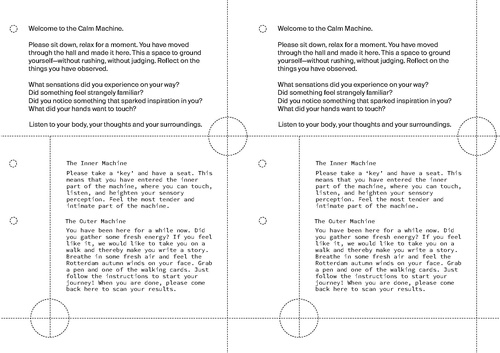
Welcome to the Calm Machine.
Please sit down, relax for a moment. You have moved through the hall and made it here. This a space to ground yourself—without rushing, without judging. Reflect on the things you have observed.
What sensations did you experience on your way? Did something feel strangely familiar? Did you notice something that sparked inspiration in you? What did your hands want to touch? Listen to your body, your thoughts and your surroundings.
The Inner Machine Please take a 'key', open it and have a seat. You have entered the inner part of the machine, where you can touch, listen, and heighten your sensory perception. Feel the most tender and intimate part of the machine.
The Outer Machine
You have been here for a while now. Did you gather some fresh energy? If you feel like it, we would like to take you on a walk and thereby make you write a story. Breathe in some fresh air and feel the Rotterdam autumn winds on your face. Grab a pen and one of the walking cards. Just follow the instructions to start your journey! When you are done, please come back here to scan your results.The Calm Machine
Idea
Both of us have been thinking about belonging, the meaning of home and ways to counteract anxiety in the context of living in a big city surrounded by many people. We have different approaches on how to deal with these feelings. In our machine, we are bringing them together, but in two different parts: the "inner", and the "outer".
For the event, we wanted to make a cozy corner in the space of UBIK to rest and relax. Sibyl worked on an interactive light and sound installation, that invites the audience to be more aware of their senses and surroundings. Lea's walking algorithm printed on postcards then takes the visitors on a walk, to further connect with the immediate space around them. A narrative text guides them through the whole machine, trying to invoke a feeling of calmness and belonging as well as reflective thoughts on the experience of the whole event.
Description
The Calm Machine is a quiet and cozy island in the buzzing and bustling of this event. Hidden away from the other stations, it provides privacy and a moment of peace. Come in, sit down, touch, listen and observe. We then invite you to go for a psychogeographic walk. Walking is a form of reading. Through the act of walking, you interpret and rewrite the city. You are a gear in the mechanics of the Calm Machine—by interacting, you make it come to life! Connect with your senses and surroundings, and perhaps generate a new sensation.
Process

Sibyl: The Inner Part
My inner journey moves from insecurity to security.
Why sound?
Each object carries a personal meaning for me.
Sound becomes the way I translate these meanings outward — a language that allows my emotions to be heard rather than explained.
Why lighting?
Lighting shapes the atmosphere. It creates an immersive experience, like an emotional wave that softens the surroundings and mirrors my inner state.
Process
- making audios for four light bulbs:
|
🧶 Yarn
|
♨️ Steamer
|
|
🌿 Plants
|
🫂 Friends
|
- confirming every step is working

If you want to use the bulb to connect the dimmer, you probably have to confirm the bulb should be the halogen or incandescent light.


If you want to use a simple touch sensor, you can borrow the touch board from the school rental shop.

I borrowed it from Worm.

I bought some cables from school shops and tried to connect the touch board and the stuff together and using TouchDesigner to connect all the stuff together, including touch board, dimmer, audios and bulbs.


I invite the audience to enter my inner space through touch, listening, and immersion. By physically interacting with the objects and listening to the meanings behind them, everyone can experience the stories carried by each item.
Touching:
I used Touch Board to connect four things, including Yarn, Steamer, Plants and Friends.When people touch the object, it will play the audio.
Lighting:
I use TouchDesigner to connect the touch board. By touching objects, sounds are generated, which then trigger light signals to control the flickering frequency of the lamp.
NOTE:I used four desk lamps as lighting output. Due to limitations of the DMX equipment, standard bulbs commonly found on the market are incompatible. It is advisable to use either halogen bulbs or incandescent bulbs.

Print matters
I make a Teller for explanation these for audios.


Lea: The Outer Part
Protocol
I went through several iterations of the walking protocol: It is based on Wilfried Hou Je Bek's walking algorithms. My first machine coming out of this idea is the Psychogeographic Walking Machine, which outputs a poem. It can be found in the Writing Machine Directory. I wrote several other walking protocols, for example based on vision, smell or hearing. I considered offering all these different options to the audience—then they could compare how they experience the city while focusing on different senses. In the end, I decided to make just one protocol. I am very curious how different people perceive the same (urban) space, and one protocol for all makes a comparison possible.
Then, I worked on different instructions for the walking itself, but quickly settled on five right turns—thereby walking out of the door and once around the block. This is the shortest possible path without going backwards, thus it takes little time and is accessible to many people. First, I tried to draw the diagrams with Graphvis, but I couldn't control them in detail and switched over to Inkscape.


Copying
To actually be able to see the results, I had to think of a way to safe them. I wanted people be able to take their outputs home, so I discarded the idea of a letterbox "void" to drop the cards into. In the end, I set up a scanner. Steve gave me a book scanner of his to use, but its software only runs on MacOs and Windows. Instead, I used a small flatbed document scanner from the XML. I set up a raspberry pie—that way, I didn't have to use my laptop during the event. The evening before, Michael helped me write a python script to scan on pressing enter, and a bash script to start the python script. Since I did not want to bring a display, I had to run it blindly on the day of the exhibition. I was very surprised to see it working on the first try!
#!/bin/bash
cd /home/xpub/walking
python3 scanning.py
import os

while True:
	input("press enter to scan")
	# first scan a page
	# scanning = "scanimage --resolution 300 -o walking.png"
	scanning = "scanimage --resolution 300 -o  walking-$(date +%H%M%S).png"
	print("scanning")
	os.system(scanning)
	# os.system("echo $(date +%H%M%S).png")
Writing
A big part of the process for me had been writing: I started with the narration to welcome the visitors into our machine. I felt it was necessary to provide a form of guidance, as we essentially were presenting two very different installations physically very close to each other. Our goal was to spread calmness and offer a moment for reflection to the audience, so this is what we tried to reflect in the narration.
For the output, I wrote a framework for a short story (not a poem as in the Psychogeographic Walking Machine), that I tested multiple times. It is hard to always make it fit semantically and grammatically. I talked to Thjis about good story writing and gentle narration. Barbara's note "how to write a story softly" really stuck with me. My aim was to fit all the different pieces of writing (the welcome note, the instructions and questions from the protocol, and the output story) into one cohesive experience.
* Can you spot an object that reminds you of home?
* Is there something curious to observe?
* Look at someone or something active to your left. What are they doing?
* What do you see when you look up?
* How did this walk make you feel?
Imagine this: [A] is drifting through the city… Roaming the streets, opening their eyes, then opening them again. Drafting stories in their mind. There are not many others around. A few people, high up on the rooftops, are [C]. [A] feels [E] by them, but not uncomfortably so. On the way, [A] spots
[B] under hovering [D]. Is this still real?

[F] is drifting through the city… Walking faster to get warm, to catch a green light, to get out of someones way. Walking slower to cool down, to look at something more closely, to get out of someones way. Drafting stories in their mind. Seeing [G] in the clouds—higher up than [I] . Watching the ants, [H] . They always seem to be so [J] . [F], too, is [J]. Finally, still on their feet, [F] catches [G] falling into their arms, growing larger by the second. Is this a message?

[K] is drifting through the city… One street at a time, all the ways at once. Crawling and jumping, drafting stories in their mind. Thinking third thoughts about scarecrows and rats, [M]. At the crossroads, [L] is looking down from [N], watching over the city. [K] blinks twice—[O], as usual. Is this the  end?
Results


Narration for the audience

Welcome to the Calm Machine.
Please sit down, relax for a moment. You have moved through the hall and made it here. This a space to ground yourself—without rushing, without judging. Reflect on the things you have observed.
What sensations did you experience on your way? Did something feel strangely familiar? Did you notice something that sparked inspiration in you? What did your hands want to touch? Listen to your body, your thoughts and your surroundings.

The Inner Machine
Please take a 'key', open it and have a seat. You have entered the inner part of the machine, where you can touch, listen, and heighten your sensory perception. Feel the most tender and intimate part of the machine.

The Outer Machine
You have been here for a while now. Did you gather some fresh energy? If you feel like it, we would like to take you on a walk and thereby make you write a story. Breathe in some fresh air and feel the Rotterdam autumn winds on your face. Grab a pen and one of the walking cards. Just follow the instructions to start your journey! When you are done, please come back here to scan your results.
Reflection
Sibyl
First, the space was pretty dark, so it was hard for people to read the exhibition notes, and it was a bit risky in terms of safety. Also, because of the location, some visitors thought it was backstage and didn’t realize it was part of the exhibition. But interestingly, some people said that the surprise of discovering it as an exhibition space actually made them feel delighted.
Second, I think I didn’t manage my time very well while preparing the work. I was constantly anxious, knowing that the piece would end up showing a pretty unstable state. But one visitor told me that the way I kept repairing and restarting the machine made it feel like we were actually inside the machine. Coming into the space, we had to “restart” and adapt, and in that way, every visitor became part of the machine. That really put me at ease.
This is also one of the reasons I like making interactive work — because through interacting with the audience, I can constantly get new perspectives and feedback.
Lea
It was positively surprising how many people turned up to the event, and even more so that many did the protocol—despite the inclement weather and the gloom of a November afternoon. The feedback that I received was lovely: People generally enjoyed the walk and the questions on the cards seemed to be resonating with them. My intention was to make people reflect on their surroundings and think about things that otherwise would not cross their minds during a busy event, and this worked out nicely.One drawback: There were many visitors and the space for our machine was smaller than I had in mind from the first visit at UBIK. Therefore it was quite crowded and "The Calm Machine" was not very calm at all.
During Special Issue #28, I thought again and again about how to make writing machines meaningful. The output of several machines I worked on was fun, but often not more than that. In conversations with different people, I collected ideas around assigning meaning to an output text.
Talking to Steve, I realised that context is very important. Having a poem, a story, or even a non textual output relate to a person or a specific moment in time can be meaningful. It is also interesting to think about the act of performing the protocol as the most substantial part of a writing machine, and not expecting the output to go further than that. This feels especially relevant to me if the protocol is executed in a collective effort of a group. It also resonated with me in the context of The Calm Machine. I chose the act of walking as part of my protocol, because it means something to me, and I hoped that others would feel the same way. I carefully considered the questions asked, because I wanted to spark meaningful thoughts in my audience.
It also helps to play around with the character of an output text. Thijs gave valuable input on writing: use repetition, contradictions and purposeful vagueness. I was initially not satisfied with my story framework, because it felt very random. But by leaning into the randomness, I was surprised to find it more cohesive than before. Manetta was insistent about the intent of my work. What do I want to achieve? I found it interesting to have results from different people next to each other to compare, thereby getting a sneak peak into their perception of their surrounding. This, I would like to explore further, possibly in a workshop setting or group walks.
Production Teams
Editorial
Editorial team: Robin, Valentin, Lea (me)
Tasks: Writing promotional texts, writing the intro to our zine, making templates on the wiki, reminding people to document on the wiki and keep track of deadlines
Website
Website team: Youjung, Tommi, Robin, Lea (me)
Tasks: Building a website
Kim shared with us how to fetch data from the wiki to use in an html page. See more: Mediawiki API Workshop We decided to use this, and 11ty. Tommi set up a base structure.
Web2Print Zine
Zine team: all of us
Making a printed publication with Manetta!