
User:Queenfeline/IDIOTICON: Difference between revisions
Queenfeline (talk | contribs) |
Queenfeline (talk | contribs) (→M) |
||
| (138 intermediate revisions by the same user not shown) | |||
| Line 1: | Line 1: | ||
[[File:Idioticon.png|frameless|center|1000px]] | |||
A reference book listing alphabetically terms or names important to a particular subject or activity along with discussion of their meanings and applications. [https://www.merriam-webster.com/dictionary/dictionary []] | |||
=A= | =A= | ||
==API== | ===A slip of the tongue=== | ||
Something that you say by accident when you intended to say something else. A mistake made when what someone says is different from what was meant [https://dictionary.cambridge.org/dictionary/english/slip-of-the-tongue []] | |||
::::This is the perfect name for [[User:Queenfeline/ASlipOfTheTongue|my project]], because it exactly names the phenomenon I try to highlight. Sometimes you say something that you truly believe is true, but it has a different meaning that you are not aware of and that meaning definitely gets transported through speaking. I want to uncover those hidden "false" meanings that just slip out easily. | |||
===abundance=== | |||
the situation in which there is more than enough of something / A great or plentiful amount / The condition of being in rich supply [https://dictionary.cambridge.org/dictionary/english/abundance []][https://www.thefreedictionary.com/abundance []] | |||
===(re)action=== | |||
action: a thing done [https://www.merriam-webster.com/dictionary/action []] / doing</br> | |||
reaction: the act or process or an instance of reacting [https://www.merriam-webster.com/dictionary/reaction []] </br> | |||
::::Is there such thing as an action out of nowhere? Isn't everything a reaction to something else? The urge to do something must come from something else, right? There is always something that pushes you to do something as a reaction to that... if everything would be acceptable at all times – you wouldn't do anything. Maybe the discomfort is very much necessary to make us move, to keep us going and changing. There is a lot of motivation in avoiding the discomfort. So is everything we do just a backlash against discomfort and with that a reaction to it? | |||
===amelioration=== | |||
to make better or more tolerable [https://www.merriam-webster.com/dictionary/ameliorate []]</br> | |||
Do feminine terms ever ameliorate? They do, but it’s often because women actively reclaim them [Montell, Amanda (2019) wordslut] | |||
::''see [[User:Queenfeline/IDIOTICON#prjoration|prjoration]] | |||
=== A part of / apart from=== | |||
::::spoken kinda the same – but totally different meaning | |||
===API=== | |||
API stands for '''Application Programming Interface'''. It's an interface for two computers to communicate in order to carry out tasks on the internet. The application can be any software that performs a specific task and the interface is a point where two applications communicate. | API stands for '''Application Programming Interface'''. It's an interface for two computers to communicate in order to carry out tasks on the internet. The application can be any software that performs a specific task and the interface is a point where two applications communicate. | ||
One application acts as a client and the other acts as a server. A client asks for some resource, say for example a photo, and the server sends that photo to the client. | One application acts as a client and the other acts as a server. A client asks for some resource, say for example a photo, and the server sends that photo to the client. | ||
| Line 12: | Line 32: | ||
Different methods exist to perform different tasks and numerous status codes are available that indicate whether the request is successful, declined, or in a pending state. | Different methods exist to perform different tasks and numerous status codes are available that indicate whether the request is successful, declined, or in a pending state. | ||
==apricity== | ===apricity=== | ||
the warmth of the sun in winter [https://www.merriam-webster.com/wordplay/winter-words source] | the warmth of the sun in winter [[https://www.merriam-webster.com/wordplay/winter-words source]] </br> | ||
:::: I like how weirdly specific that is. One word for this exact feeling. | |||
===arbitrary=== | |||
existing or coming about seemingly at random or by chance or as a capricious and unreasonable act of will | |||
Arbitrary comes from Latin arbiter, which means "judge" and is the source of the English arbiter. In English, arbitrary first meant "depending upon choice or discretion" and was specifically used to indicate the sort of decision (as for punishment) left up to the expert determination of a judge rather than defined by law. Today, it can also be used for anything determined by or as if by a personal choice or whim. [https://www.merriam-webster.com/dictionary/arbitrary []] | |||
<div style="float:right; font-size:20px;">[[:#top|⇧]]</div> | |||
=B= | =B= | ||
==benevolence== | ===benevolence=== | ||
disposition to do good, the quality of being kind and helpful [https://dictionary.cambridge.org/dictionary/english/benevolence source] | disposition to do good, the quality of being kind and helpful [https://dictionary.cambridge.org/dictionary/english/benevolence [source]], good will, charitableness, love of mankind, accompanied with a desire to promote their happiness. [https://www.wordnik.com/words/benevolence []] </br> | ||
::::I'd like to thing that everything we do is an act of kindness. Motivated by something good and to do good. Unfortunately, I don't think that corresponds to reality. What makes people act out of malice? Why does that seems to be a greater motivator than benevolence? Is that "in the nature" of a human? I dare to doubt that. Is that socially trained? maybe. | |||
===Bitch=== | |||
Bitches are aggressive, assertive, domineering, overbearing, strong-minded, spiteful, hostile, direct, blunt, candid, obnoxious, thick-skinned, hard-headed, vicious, dogmatic, competent, competitive, pushy, loud-mouthed, independent, stubborn, demanding, manipulative, egoistic, driven, achieving, overwhelming, threatening, scary, ambitious, tough, brassy, masculine, boisterous, and turbulent. Among other things. A Bitch occupies a lot of psychological space. You always know she is around. A Bitch takes shit from no one. You may not like her, but you cannot ignore her. Bitches are big, tall, strong, large, loud, brash, harsh, awkward, clumsy, sprawling, strident, ugly. Bitches move their bodies freely rather than restrain, refine and confine their motions in the proper feminine manner. They clomp up stairs, stride when they walk and don't worry about where they put their legs when they sit. They have loud voices and often use them. Bitches are not pretty. Bitches seek their identity strictly thru themselves and what they do. They are subjects, not objects. They may have a relationship with a person or organization, but they never marry anyone or anything; man, mansion, or movement. Thus Bitches prefer to plan their own lives rather than live from day to day, action to action, or person to person. They are independent cusses and believe they are capable of doing anything they damn well want to. If something gets in their way; well, that's why they become Bitches. If they are professionally inclined, they will seek careers and have no fear of competing with anyone. If not professionally inclined, they still seek self-expression and self-actualization. Whatever they do, they want an active role and are frequently perceived as domineering. Often they do dominate other people when roles are not available to them which more creatively sublimate their energies and utilize their capabilities. More often they are accused of domineering when doing what would be considered natural by a man. [https://www.jofreeman.com/joreen/bitch.htm []] | |||
::::linguists postulate that this word derived from the ancient Sanskrit word ''bhagas'', meaning "genitals," then later found its way (in various forms) into Latin, French, and Old English, eventually coming to refer to a creature with exposed genitals, aka an animal. After that, the word narrowed to female animal, and within a few centuries, we landed on female dog. The first shift in meaning from beast to human wasn’t recorded until around 1400 AD, when bitch surfaced in writing to describe a promiscuous woman or prostitute (which is still one of its primary meanings in British English). From there, the word evolved to describe a sort of weakling or servant (“Go fetch me my tea, bitch”); a stuck-up, mean, unpleasant woman; and finally a verb meaning “to complain.” [Montell, Amanda (2019) wordslut s.30] | |||
===bropropriating=== | |||
The tendency for men to take credit for an idea put forth by a woman. [https://www.weforum.org/stories/2015/02/how-to-stop-the-silencing-of-women-in-the-workplace/ []] | |||
===boundary objects=== | |||
"Boundary objects" is a term that Susan Leigh Star works with, which she described in the text Misplaced Concretism and Concrete Situations. "Boundary objects are those scientific objects which both inhabit several communities of practice and satisfy the informational requirements of each of them. Boundary objects are thus objects which are both plastic enough to adapt to local needs and constraints of the several parties employing them, yet robust enough to maintain a common identity across sites." | |||
::::objects that live in more than one community / travel in between communities of practice. Not only one particular use. | |||
<div style="float:right; font-size:20px;">[[:#top|⇧]]</div> | |||
=C= | =C= | ||
==cascading== | ===cascading=== | ||
'''"To fall quickly and in large amounts"'''. As I understood it: An event in a series of events. Eins stupst das andere an und bildet somit eine kette an events. "to pass on information by giving it to just a few people, who then give it to more people; to be passed on in this way." [https://dictionary.cambridge.org/dictionary/english/cascade | '''"To fall quickly and in large amounts"'''. </br> | ||
:::: As I understood it: An event in a series of events. Eins stupst das andere an und bildet somit eine kette an events. "to pass on information by giving it to just a few people, who then give it to more people; to be passed on in this way." [https://dictionary.cambridge.org/dictionary/english/cascade []] The code gets read like a waterfall, in one direction and everything bevore effects the after. Lol but isn't that the case for everything we read? hmmm | |||
==collaboration== | ===collaboration=== | ||
to work jointly with others or together especially in an intellectual endeavor </br> | to work jointly with others or together especially in an intellectual endeavor </br> | ||
The Latin prefix com-, meaning "with, together, or jointly," is a bit of a chameleon—it has a tricky habit of changing its appearance depending on what it's next to. If the word it precedes begins with l, com- becomes col- (as in colleague, collect, and collide). In the case of collaborate, com- teamed up with laborare ("to labor") to form Late Latin collaborare ("to labor together"). [https://www.merriam-webster.com/dictionary/collaboration source] | The Latin prefix ''com-'', meaning "with, together, or jointly," is a bit of a chameleon—it has a tricky habit of changing its appearance depending on what it's next to. If the word it precedes begins with l, com- becomes col- (as in colleague, collect, and collide). In the case of collaborate, com- teamed up with ''laborare'' ("to labor") to form Late Latin ''collaborare'' ("to labor together"). [https://www.merriam-webster.com/dictionary/collaboration [source]] </br> | ||
:::: "To do labor together" oh that is beautifuuul! Erinnert mich ein bisschen an Mitleid (to feel pity for sb), weil da leidet der eine am Schmerz des anderen mit und nimmt ihm so etwas von Schmerz ab. Thats just cute and beautiful human behavior. I like that thought, that there is help available at any time. | |||
===collective=== | |||
denoting a number of persons or things considered as one group or whole; a cooperative unit or organization; of, relating to, or being a group of individuals; involving all members of a group as distinct from its individuals [https://www.merriam-webster.com/dictionary/collective []] collective refers to a group of individuals coming together as a whole, with a shared identity or purpose. [https://thisvsthat.io/collaborative-vs-collective []] | |||
:::: collective and collaborative are often used interchangeably, but they vary in meaning. a collective is a group of people who share the same values and/or they come together for a specific purpose. Every member stays autonomous and can do whatever, while collaborative work is more goal-oriented and the people don't necessarily need to have the same value or purpose, they just work together for this one specific task. Collaborative efforts often have a more formalized structure, with designated roles and responsibilities for each participant. This structure helps to ensure that tasks are distributed efficiently and that everyone knows their role in achieving the shared goal. In contrast, collectives may have a more fluid structure, with less emphasis on formal roles and hierarchies. Members of a collective may have more freedom to contribute in ways that align with their strengths and interests, without being confined to specific roles. | |||
==copyleft== | ===copyleft=== | ||
Das Copyleft ist eine '''Klausel in urheberrechtlichen Nutzungslizenzen''', die den Lizenznehmer verpflichtet, jegliche Bearbeitung des Werks unter die Lizenz des ursprünglichen Werks zu stellen. Die Copyleft-Klausel soll verhindern, dass veränderte Fassungen des Werks mit Nutzungseinschränkungen weitergegeben werden, die das Original nicht hat. Das Copyleft setzt voraus, dass Vervielfältigungen und Bearbeitungen in irgendeiner Weise erlaubt sind. | Das Copyleft ist eine '''Klausel in urheberrechtlichen Nutzungslizenzen''', die den Lizenznehmer verpflichtet, jegliche Bearbeitung des Werks unter die Lizenz des ursprünglichen Werks zu stellen. Die Copyleft-Klausel soll verhindern, dass veränderte Fassungen des Werks mit Nutzungseinschränkungen weitergegeben werden, die das Original nicht hat. Das Copyleft setzt voraus, dass Vervielfältigungen und Bearbeitungen in irgendeiner Weise erlaubt sind. | ||
===consciousness raising=== | |||
Consciousness raising (also called awareness raising) is a form of activism popularized by United States feminists in the late 1960s. It often takes the form of a group of people attempting to focus the attention of a wider group on some cause or condition. [https://en.wikipedia.org/wiki/Consciousness_raising []] | |||
This process of sharing experiences enabled women to see beyond the narrative of self-failure and individual pathology (that was often ascribed them by their husbands or psychiatrists) and to reframe their experiences as social and political issues. From a consciousness-raising perspective, this reframing was the starting point for generating collective actions that targeted social and systemic change, where the articulation of individual discontent engendered collective dissent. [https://feministtherapynetwork.org/a-brief-introduction-to-consciousness-raising-groups/ []] | |||
===cunt=== | |||
What is largely considered the English language’s most offensive term for women didn’t actually start as an insult at all. Cunt’s roots are also up for debate, but most sources agree they can be traced back to the Proto-Indo-European word | |||
sound "cu," which indicated femininity (this same "cu" is also related to the modern words ''cow'' and ''queen''). The Latin term ''cuneus'', meaning "wedge," is also connected to cunt, as is the Old Dutch word ''kunte'', which gives the word its dramatic final ''t''. For centuries, cunt was used to refer to women’s external genitalia without any negative nuances whatsoever; but, like so many other terms referencing femaleness, it didn’t stay that way. What’s | |||
particularly interesting about cunt’s pejoration is that it is directly linked to human history itself. Ten thousand years ago, when Homo sapiens lived nomadic lifestyles, wandering from place to place, men and women all had multiple sexual partners and female sexuality was considered totally normal and great. It wasn’t until human beings stopped moving that women with sexual independence started gaining a bad rap, because once owning land became desirable, people wanted to be able to pass it down to their children, and in order for men to know who their children were, female monogamy became a must. To create a system of inheritance, societies became patriarchal, and any remaining notions of goddess-like sexual liberation went kaput. With the end of women’s sexual liberation came a general disgust for female sexuality, dooming words like cunt forever. (Or until the end of patriarchy, at least.) [Montell, s 31] | |||
===critical practice=== | |||
Critical practice is the methodology used by a critic or observer to understand and evaluate a field of knowledge. Critical practice is grounded in the concepts of critical theory. Consultants employing critical practice skills aim to help people improve outcomes. Critical practice aims to develop the ability and skill to see beyond the usual concerns of any given profession, into its unintended side effects, causes and consequences, and to do so from a critical and evaluative perspective. [https://en.wikipedia.org/wiki/Critical_practice []] </br> | |||
:::: So i understand it as questioning the obvious. If i like to do that in a philosophical way, does that make philosophy a critical practice? | |||
<div style="float:right; font-size:20px;">[[:#top|⇧]]</div> | |||
=D= | =D= | ||
==declaration== | ===declaration=== | ||
something that is declared: to make known formally, officially, or explicitly. the act of declaring : announcement, [https://www.merriam-webster.com/dictionary/declaration | something that is declared: to make known formally, officially, or explicitly. the act of declaring : announcement, [https://www.merriam-webster.com/dictionary/declaration []] </br> | ||
==digression== | :::: CSS is a declarative programming language, meaning it "expresses the logic of a computation without describing its control flow". Programming languages that we most often use and quote aren't declarative, but imperative: we precise explicit steps for the program to execute, called algorithms - like a recipe. Here we don't explicit algorithm, but we declare (or describe) the outcome directly. Declarations think of declarativeness as something fundamental yet complex about the way we dialogue with technologies. We explore how the malleability of this language is used to dialogue with technology. Similarly to choosing words to tell a story, designing with declarations means we state our intentions and encode narrations into the things we make. [https://declarations.style/pages/about.html#shift-to-language-and-declarativeness []] | ||
the action of moving away from the main subject you are writing or talking about and writing or talking about something else [https://dictionary.cambridge.org/dictionary/english/digression?q=Digressions+ | |||
===devotion=== | |||
an act of prayer or private worship or the act of dedicating something to a cause, enterprise, or activity : the act of devoting </br> | |||
Devotion and the verb devote come from the act of taking a vow (the Latin verb ''vovēre'' means "to vow"). Devote was once used as an adjective that could mean either "devout" or "devoted." While devout implies faithfulness of a religious nature ("a devout parishioner), devoted refers to one's commitment to another through love and loyalty ("a singer's devoted fans"). [https://www.merriam-webster.com/dictionary/devotion []] | |||
===digression=== | |||
the action of moving away from the main subject you are writing or talking about and writing or talking about something else [https://dictionary.cambridge.org/dictionary/english/digression?q=Digressions+ []] | |||
===Diva=== | |||
a usually glamorous and successful female performer or personality – also Prima Donna: a principal female singer in an opera or concert organization – a vain or undisciplined person who finds it difficult to work under direction or as part of a team [https://www.merriam-webster.com/dictionary/diva []] </br> | |||
1864, from Italian ''diva'' "goddess, fine lady," from Latin ''diva'' "goddess," fem. of ''divus'' "a god, divine (one)," related to ''deus'' "god, deity" (from PIE root dyeu- "to shine," in derivatives "sky, heaven, god"). [https://www.etymonline.com/word/diva []] </br> | |||
in slang still an ambiguous word: 1. A diva is a woman who has self-confidence, self-respect, and hella swagger. She knows who she is and exactly where she is going. Her style and attitude are on point even when she is not trying. People typically gravitate to her because they respect her swagger. [https://www.urbandictionary.com/define.php?term=diva&page=48 []], 2. a polite way of calling a self absorbed narcissistic woman a bitch [https://www.urbandictionary.com/define.php?term=diva&page=1 []] | |||
::::According to Beyonce: Na, na, na, diva is a female version of a hustla of a, of a hutlaaa | |||
::::''diva down'' this is another great example of semantic degradation | |||
::::I thinks its crazy that the word comes from meaning goddess to mean a demanding woman. The fact that every man who is demanding and goes after what he wants is first of all nothing special and secondly seen as something great and strong. But when a woman goes after what she wants and doesn't let anything stop her, she's feisty and mean ans self absorbed... I don't get it | |||
===double bind=== | |||
The essence of a double bind is two conflicting demands, each on a different logical level, neither of which can be ignored or escaped. This leaves the subject torn both ways, so that whichever demand they try to meet, the other demand cannot be met. Unlike the usual no-win situation, the subject has difficulty in defining the exact nature of the paradoxical situation in which they are caught. The contradiction may be unexpressed in its immediate context and therefore invisible to external observers, only becoming evident when a prior communication is considered. [https://en.wikipedia.org/wiki/Double_bind []] | |||
<div style="float:right; font-size:20px;">[[:#top|⇧]]</div> | |||
=E= | =E= | ||
==eccentric== | ===eager=== | ||
strange or unusual, sometimes in a humorous way [https://dictionary.cambridge.org/dictionary/english/eccentric source] | marked by enthusiastic or impatient desire or interest [https://www.merriam-webster.com/dictionary/eagerness []] | ||
===eccentric=== | |||
strange or unusual, sometimes in a humorous way [https://dictionary.cambridge.org/dictionary/english/eccentric [source]] | |||
===edgelessness=== | |||
Edgelessness (noun) describes the absence of a distinct boundary or end point. [https://dictionary.cambridge.org/dictionary/english/edgeless []] </br> | |||
::::Frank Chimero defines Edgelessness as core of the webs structure: made of single pages, everything can possibly be linked to everything else. But Chimero sees this condition not only reflected in Links but also in the way we layout content for unknown screen sizes and presents it as a paradigm for work disciplines. [https://frankchimero.com/blog/2015/the-webs-grain/ []] However I (kim) find it important to also mention that to some extends the web has very real boundaries, for example regarding physical resources [https://solar.lowtechmagazine.com/ []] it uses as much as (politically) enforced limits that ban access to specific pages or keywords. | |||
===elicit=== | |||
to call forth or draw out (something, such as information or a response); to draw forth or bring out (something latent or potential) [https://www.merriam-webster.com/dictionary/elicited []] | |||
===entity=== | |||
something that exists apart from other things, having its own independent existence [https://dictionary.cambridge.org/us/dictionary/english/entity []] | |||
== | ===endeavor=== | ||
something | to attempt (something, such as the fulfillment of an obligation) by exertion of effort, to strive to achieve or reach [https://www.merriam-webster.com/dictionary/endeavor []] | ||
== | ===ephemeral=== | ||
to | lasting a very short time; When ephemeral (from the Greek word ''ephēmeros'', meaning "lasting a day") first appeared in print in English in the late 16th century, it was a scientific term applied to short-term fevers, and later, to organisms (such as insects and flowers) with very short life spans. Soon after that, it acquired an extended sense referring to anything fleeting and short-lived, as in "ephemeral pleasures." [https://www.merriam-webster.com/dictionary/ephemeral []] | ||
===exertion=== | |||
the act or an instance of exerting – especially : a laborious or perceptible effort, to put forth (strength, effort, etc.), to put (oneself) into action or to tiring effort, to bring to bear especially with sustained effort or lasting effect [https://www.merriam-webster.com/dictionary/exerting []] | |||
== | ===Extensibility=== | ||
the | Extensibility (Dehnbarkeit) is a software engineering and systems design principle that provides for future growth. Extensibility is a measure of the ability to extend a system and the level of effort required to implement the extension. Extensions can be through the addition of new functionality or through modification of existing functionality. The principle provides for enhancements without impairing existing system functions. [https://en.wikipedia.org/wiki/Extensibility []] | ||
= | <div style="float:right; font-size:20px;">[[:#top|⇧]]</div> | ||
=F= | =F= | ||
===false consciousness=== | |||
The notion that members of the proletariat unwittingly misperceive their real position in society and systematically misunderstand their genuine interests within the social relations of production under capitalism. False consciousness denotes people’s inability to recognize inequality, oppression, and exploitation in a capitalist society because of the prevalence within it of views that naturalize and legitimize the existence of social classes. [https://www.britannica.com/topic/false-consciousness []] | |||
:::: | |||
===female=== | |||
The word ''female'' comes from the Latin ''femella'', the diminutive form of ''femina'', meaning "woman", by way of the Old French ''femelle''. It is not etymologically related to the word ''male'', but in the late 14th century the English spelling was altered to parallel that of male. It has been used as both noun and adjective since the 14th century. Originally, from its first appearance in the 1300s, ''female'' exclusively referred to humans and always indicated that the speaker spoke of a woman or a girl. A century later, the meaning was expanded to include non-human female organisms.</br> | |||
For several centuries, using the word female as a noun was considered more respectful than calling her a ''woman'' or a ''lady'' and was preferred for that reason; however, by 1895, the linguistic fashion had changed, and female was often considered disparaging, usually on the grounds that it grouped humans with other animals. In the 21st century, the noun female is primarily used to describe non-human animals, to refer to biologically female humans in an impersonal technical context (e.g., "Females were more likely than males to develop an autoimmune disease"), or to impartially include a range of people without reference to age (e.g., girls) or social status (e.g., lady). As an adjective, ''female'' is still used in some contexts, particularly when the sex of the person is relevant, such as ''female athletes'' or to distinguish a male nurse from a female one. | |||
</br> | |||
Biological sex is conceptually distinct from gender, although they are often used interchangeably. The adjective ''female'' can describe a person's sex or gender identity. | |||
::::Firstly we need to raise the question of what even is a woman? The dictionaries say men are the whole of humanity and women are described as "the other" that doesn't need to be mentioned but is implied. [[User:Queenfeline/IDIOTICON#gender|(see also: gender)]] (What do you mean you want to be addressed? Come on don't be so nitpicky, just think that you women are also included in that!) LOL ... | |||
::::– so if a woman is a female and a female has a very bodily description ("of, relating to, or being the sex that typically has the capacity to bear young or produce eggs" [https://www.merriam-webster.com/dictionary/female []]) then what about women* who cannot "bear offspring", who are born without ovaries, what about intersex people? | |||
::::– female often used by internet incels who want to insult women. And that kinda works, cause they objectify her with that as is is merely used to describe animals. yay. So they literally deny women humanity as they make her an animal. | |||
===fidelity=== | |||
the quality or state of being faithful | |||
::::Fidelity came to English by way of French in the 15th century, and can ultimately be traced back to the Latin fidēlis, meaning "faithful, loyal, trustworthy." While fidelity was originally exclusively about loyalty, it has for centuries also been used to refer to accuracy, as in “questions about the fidelity of the translation.” Nowadays fidelity is often used in reference to recording and broadcast devices, conveying the idea that a broadcast or recording is "faithful" to the live sound or picture that it reproduces. [https://www.merriam-webster.com/dictionary/fidelity []] | |||
===[[Fediverse]]=== | |||
Fediverse as an alternative to corporate social media platforms.‘'''Fediverse'''’, a portmanteau of ‘'''federation'''’ and ‘'''universe'''’ [https://monoskop.org/images/c/cc/Mansoux_Aymeric_Abbing_Roel_Roscam_2020_Seven_Theses_on_the_Fediverse_and_the_Becoming_of_FLOSS.pdf 1] </br> | |||
'''Federation''' is a concept derived from political theory in which various actors that constitute a network decide to cooperate collectively. Power and responsibility are distributed as they do so. In the context of social media, federated networks exist as different communities on different servers that can interoperate with each other, rather than existing as a single software or single platform. </br> | |||
– different levels of decentralization and interoperability in terms of network architectures and data circulation – the Fediverse is comprised of more than 3.5 million accounts distributed over almost 5,000 servers, referred to as ‘instances’ – Every instance is independent, and can set its own rules and expectations.</br> | |||
Most of these instances can be interconnected and are often focused on a specific practice, ideology, or professional activity </br> | |||
– It started with/from the Free/Libre and Open Source Software (FLOSS) communities. These projects were originally promoted as similar in function to the corporate platforms but made with FLOSS. These software platforms catered to a limited audience of users and software developers, who were largely concerned with issues typical of FLOSS culture. But that changed 2016 with the introduction of mastodon </br> | |||
– The majority of Fediverse platforms are based on free and open-source software, and create connections between servers using the ActivityPub protocol. [https://en.wikipedia.org/wiki/Fediverse 2] | |||
===feisty=== | |||
full of animation, energy, or courage [https://www.dictionary.com/browse/feisty []] | |||
::::a women who speaks up and doesn't hesitate to take what she wants. she will not let a man interrupt her and will call him out on his sexist bullshit! (also see ''Bitch'') | |||
===folkloric=== | |||
Relating to the verbally passed down communal knowledge, which includes, yet is not limited to tales, beliefs, rules, ideas, legends and values. [https://www.thefreedictionary.com/folkloric []] Folklore as an academic practice is the study of collective inventiveness between members of distinct sociocultural settings, as well as the relationships these instances share with different manifestations of shared identity. [https://www.library.illinois.edu/sshel/specialcollections/folklore/definition/ []] </br> | |||
cultural ways in which a group maintains and passes on a shared way of life. [https://computer.howstuffworks.com/internet/basics/internet-folklore.htm []] | |||
:::: folklore in modern times are kinda conspiracy theories. happening in (facebook) groups / forums. </br> | |||
:::: The need for the existence of this word only happend because people started to write things down and marked them as science. Before that, it was just the normal knowledge but then (maybe because it was "just" orally transmitted) it experienced a devaluation and became a lore and stories. [https://digmedia.lucdh.nl/2021/10/25/tradition-in-the-modern-world-internet-folklore/ []] | |||
<div style="float:right; font-size:20px;">[[:#top|⇧]]</div> | |||
=G= | =G= | ||
===gender=== | |||
<gallery> | |||
File:MerriamWebster Woman.png|Merriam Webster ''Woman'' (visited 06.11.2025) | |||
File:MerriamWebster Men.png|Merriam Webster ''Man'' (visited 06.11.2025) | |||
</gallery> | |||
"The body, sexuality irrationality: a phenomenon in which women are identifies with sex, body, passion while men are identified with reason and the mind. De Beauvior explicitly rejected the idea that rationality and everything else our culture values were inherently masculine: she said they were human, universal, but dishonestly claimed by the patriarchs for themselves." (Cameron, 1990) | |||
::::Literally WTF... of course a man is a human and a woman is a female servant. A man is a strong, confident human and a woman likes to eat sweet treats OMGGG.... | |||
Ann Oakley: "The distinction between sex and gender does not call into question how society constructs the natural body itself." Oakley suggests that to question how gender is constructed without questioning sex itself does not go far enough, given that gender helps to create the naturalness of sex. Or take the work of historical materialist Christine Delphy, who argues that 'gender precedes sex'. She explains:'We have continued to think of gender in terms of sex: to see it ad a social dichotomy determined by a natural dichotomy'. If gender creates the effect of two distinct and immutable biological sexes, to make that effect our cause would reproduce the system we are trying to dismantle.[...]The transformation of gender into the stranger allows sex to be positioned as ''nature'' or ''natal'' or even as ''native'', as if all these categories are not themselves the product of labour, as if we do not have a hand in making and shaping them. [Sara Ahmet (2024)] | |||
===gender performativity=== | |||
a concept by Judith Butler (gender Trouble) | |||
<div style="float:right; font-size:20px;">[[:#top|⇧]]</div> | |||
=H= | =H= | ||
===hag=== | |||
Radical feminist Mary Daly defines the hag as 'an intractable person, especially: a woman reluctant to yield to wooing'. You become a hag by not yielding, whether to a sexual advance or another kind of advance [...] [Sara Ahmet (2024) The feminist Killjoy Handbook] | |||
===Hegemony=== | |||
preponderant influence or authority over others : domination; the social, cultural, ideological, or economic influence exerted by a dominant group </br> | |||
Hegemony refers to a kind of domination. It was borrowed in the mid-16th century from the Greek word ''hēgemonia'', a noun formed from the verb ''hēgeisthai'', “to lead.” At first hegemony was used specifically to refer to the control once wielded by ancient Greek states; later it was applied to domination by other political actors. By the 19th century, the word had acquired a second sense referring to the social or cultural influence wielded by a dominant entity over others of its kind, a sense employed by design scholar Joshua Langman when describing the use of found objects by French artist Marcel Duchamp (he of notorious readymade Fountain fame) as a means “to question and criticize the values of the artistic hegemony by eschewing craft entirely.” [https://www.merriam-webster.com/dictionary/hegemony [source]] | |||
<div style="float:right; font-size:20px;">[[:#top|⇧]]</div> | |||
=I= | =I= | ||
==indeterminate== | ===indeterminate=== | ||
not known in advance, not leading to a definite end or result </br> | not known in advance, not leading to a definite end or result </br> | ||
When you determine something, you decide on what it is, which means you put limits or boundaries on its identity. So something indeterminate lacks identifying limits | When you determine something, you decide on what it is, which means you put limits or boundaries on its identity. So something indeterminate lacks identifying limits. A painting of indeterminate origins is normally less valued than one with the painter's name on it. And if negotiations are left in an indeterminate state, nothing has been decided. [https://www.merriam-webster.com/dictionary/indeterminate [source]] | ||
:::: to define is to limit, i once read somewhere. But a definition also contains all the things that are not the case. A thing is not only what it is, but also what it is not. We cannot totally say what a thing is, we can only list all the things it is not and with that narrow it down to what it may be. | |||
===insurrection=== | |||
an act or instance of revolting against civil authority or an established government [https://www.merriam-webster.com/dictionary/insurrection []] | |||
===intellectual mystification=== | |||
intellectual mystification occurs when a writer, to put herself in a position of authority, denies the reader sufficient resources to understand and dispute what s/he says. It can be done in many ways: For example, the writer may leave unexplained and taken for granted the conceptual framework s/he is working in, or may present it as a given rather than something open to question. Or s/he may depersonalise herself, hiding behind the spurious authority of an 'objective commentator' by not making it clear where she stands, politically and intellectually, in relation to the ideas she discusses. [https://archive.org/details/feminismlinguist00came/page/n9/mode/2up []] | |||
===inter-action=== | |||
an occasion when two or more people or things communicate with or react to each other [https://dictionary.cambridge.org/dictionary/english/interaction []] | |||
===intra-action=== | |||
Intra-action is a Baradian term used to replace ‘interaction,’ which necessitates pre-established bodies that then participate in action with each other. Intra-action understands agency as not an inherent property of an individual or human to be exercised, but as a dynamism of forces in which all designated ‘things’ are constantly exchanging and diffracting, influencing and working inseparably. Intra-action also acknowledges the impossibility of an absolute separation or classically understood objectivity, in which an apparatus (a technology or medium used to measure a property) or a person using an apparatus are not considered to be part of the process that allows for specifically located ‘outcomes’ or measurement. [https://newmaterialism.eu/almanac/i/intra-action.html []] | |||
===intersectionality=== | |||
Black feminist scholar Kimberlé Crenshaw introduced the concept of intersectionality in a pair of essays published in 1989 and 1991 in the field of legal studies. She describes how interlocking systems of power affect those who are most marginalized in society. It is an analytical framework for understanding how groups' and individuals' social and political identities result in unique combinations of discrimination and privilege. Examples of these intersecting and overlapping factors include gender, caste, sex, race, ethnicity, class, sexuality, religion, disability, physical appearance, and age. These factors can lead to both empowerment and oppression.[https://en.wikipedia.org/wiki/Intersectionality []] | |||
===interoperability=== | |||
from a single user account you can follow and interact with different "social network applications" | |||
::mastodon, pixelfed and peertube as if instgram, twitter and youtube would all be connectable from one account | |||
<div style="float:right; font-size:20px;">[[:#top|⇧]]</div> | |||
=J= | =J= | ||
==jurisdiction== | ===jurisdiction=== | ||
the power, right, or authority to interpret and apply the law, the authority of a sovereign power to govern or legislate, the power or right to exercise authority : control </br> | the power, right, or authority to interpret and apply the law, the authority of a sovereign power to govern or legislate, the power or right to exercise authority : control </br> | ||
Questions of jurisdiction are generally technical legal matters. The most important ones include which court will hear a given case and which law-enforcement agency can get involved. But although they may seem like mere technicalities, jurisdictional matters sometimes turn out to be all-important in the final outcome. Jurisdiction may depend on where you are (for example, in which state), on who you are (if you're a juvenile, for example, you may only be tried in juvenile court), and on what the subject is (for example, cases involving the estate left by someone who has died are dealt with in probate court). [https://www.merriam-webster.com/dictionary/jurisdiction source] | Questions of jurisdiction are generally technical legal matters. The most important ones include which court will hear a given case and which law-enforcement agency can get involved. But although they may seem like mere technicalities, jurisdictional matters sometimes turn out to be all-important in the final outcome. Jurisdiction may depend on where you are (for example, in which state), on who you are (if you're a juvenile, for example, you may only be tried in juvenile court), and on what the subject is (for example, cases involving the estate left by someone who has died are dealt with in probate court). [https://www.merriam-webster.com/dictionary/jurisdiction [source]] | ||
===juvenile=== | |||
physiologically immature or undeveloped : young; of, relating to, characteristic of, or suitable for children or young people; reflecting psychological or intellectual immaturity : childish [https://www.merriam-webster.com/dictionary/juvenile [source]] | |||
<div style="float:right; font-size:20px;">[[:#top|⇧]]</div> | |||
=K= | =K= | ||
<div style="float:right; font-size:20px;">[[:#top|⇧]]</div> | |||
===killjoy=== | |||
A person who is anti-fun, or prevents others from having fun. [https://en.wiktionary.org/wiki/killjoy []] | |||
::::I AM A FEMINIST KILLJOY! | |||
::::Finally a name for what I have been feeling for a while. I'm the killjoy that "forbids" words to others lol. And you know what?! I'm fucking proud of that! Omg she even writes: "To call for change in how people speak or act can be sufficient to be judged as a killjoy. You can be judged as a killjoy, as imposing yourself upon others, stopping them from being free to do what they have always done. | |||
<blockquote> | |||
The word ''killjoy'' has, in fact, been around longer than the word feminism. To giev you a sense of how the ''killjoy'' has come up, I include direct quotes from historical and contemporary sources. The ''Oxford English Dictionary'' gives its first recorded use of the term ''killjoy'' a note in Charles Burney's General ''History of Music'' from 1776, "The Gods were not then, says M. Rousseau, regarded as kill-joys, and shut out of convivial meetings."</br> | |||
This rather curious reference suggests that to be regarded as a ''killjoy'', human or God, would mean to be shut out of meetings to keep them convivial. The second reference listed under ''killjoy'' is to George Eliot's novel ''Romola'', first published in 1863. One character, Savonarola, is described as 'the killjoy of Florence', and is set apart from a city, a party, a meeting, restraining those who find, in joy, their freedom. [...] The killjoys kill the joy of others, not their own joy, perhaps because they do not have their own joy to kill. Synonyms. for killjoy are buzzkill, miserabilist, party pooper, wet blanket, dampener and spoilsport. </br> | |||
[...] For Edmund Bergler the killjoy is 'popularly regarded as a person who gloates over the fact that he spoils other people's pleasure'. In other words, 'his revenge is the killjoy attitude'. In this account, the killjoy is in self-denial; he does not recognize himself as a killjoy but is judged to be so by others. [...] The killjoy is presented as a type of person who is removed from the warmth of human sociability, who is powerful and punishing, who, having invented their own misfortune to justify their cruelty, employs a range of methods to spread misery from 'stony silence' to 'biting remarks'. Who would want to be such a person? The point of this picture of the killjoy might be to evoke a person no one else would want to be. </br> | |||
Even to give a brief history of the term killjoy teaches us how it was used to create a picture of those who are 'not us' and who have the power to take from us what we want for ourselves. If the killjoy once functioned to picture a type of person, it is now more often used for a style pf politics. We might call this style of politics ''mean-spirited''. We hear, for instance, about ''politically correct killjoys'', whose concern with correcting what other people do or say is framed as imposing an agenda upon them as well as stealing their enjoyment. | |||
</blockquote> | |||
Sara Ahmet in The feminist Killjoy Handbook | |||
=L= | =L= | ||
===laissez-faire=== | |||
The French phrase laissez faire literally means “allow to do,” with the idea being “let people do as they choose.” The origins of laissez-faire are associated with the Physiocrats, a group of 18th-century French economists who believed that government policy should not interfere with the operation of natural economic laws. (The actual coiner of the phrase may have been French economist Vincent de Gournay, or it may have been François Quesnay, who is considered the group’s founder and leader.) The original phrase was “laissez faire, laissez passer,” with the second part meaning “let (things) pass.” Laissez-faire, which first showed up in an English context in the first half of the 19th century, can still mean “a doctrine opposing governmental interference in economic affairs,” but it is also used in broader contexts in which a “hands-off” or “anything-goes” policy or attitude is adopted. It is frequently used as an adjective meaning “favoring a ‘hands-off’ policy,” as in “laissez-faire economics.” [https://www.merriam-webster.com/dictionary/laissez-faire [source]] | |||
===language=== | |||
the words, their pronunciation, and the methods of combining them used and understood by a community; audible, articulate, meaningful sound as produced by the action of the vocal organs [https://www.merriam-webster.com/dictionary/language []] </br> | |||
::::how do we use words and sentences to express our thoughts and feel connected to others? How do words link to objects, people, or concepts we’re talking about? what exactly are words and sentences? how do they carry such rich and complex meanings? | |||
::::"Perhaps language is assumed not to mean anything at the moment we identify it as problematic: its a metaphor; its a parody; its irony; its style; its art. [Sarah Ahmet (2024) The feminist Killjoy Handbook] | |||
:::::If feminism is to survive as a radical project, a project with a commitment to ending violence, we must refuse to use categories in this way. [Sarah Ahmet (2024) The feminist Killjoy Handbook] | |||
==liaison== | ===liaison=== | ||
a close bond or connection, communication for establishing and maintaining mutual understanding and cooperation, the pronunciation of an otherwise absent consonant sound at the end of the first of two consecutive words the second of which begins with a vowel sound and follows without pause. | a close bond or connection, communication for establishing and maintaining mutual understanding and cooperation, the pronunciation of an otherwise absent consonant sound at the end of the first of two consecutive words the second of which begins with a vowel sound and follows without pause. | ||
Liaison comes from Middle French ''lier'', meaning "to bind or tie." Other English senses of liaison apply it to all kinds of bonds—from people who work to connect different groups to the kind of relationship sometimes entered into by two people who are attracted to one another. [https://www.merriam-webster.com/dictionary/liaison source] | Liaison comes from Middle French ''lier'', meaning "to bind or tie." Other English senses of liaison apply it to all kinds of bonds—from people who work to connect different groups to the kind of relationship sometimes entered into by two people who are attracted to one another. [https://www.merriam-webster.com/dictionary/liaison [source]] | ||
===linguistic alienation=== | |||
Linguistic alienation is an inability to give expression to experience through language or a feeling that language is incomplete or fails to capture experience. The term can be used to describe how language reduces experiences, emotions, feelings, and other indescribable phenomena into a limited and regulatory modality. Linguistic alienation has been described as a pervasive phenomenon, yet has not received sustained consideration. [https://en.wikipedia.org/wiki/Linguistic_alienation []] | |||
::::Issue of racism and feminism! | |||
<div style="float:right; font-size:20px;">[[:#top|⇧]]</div> | |||
=M= | =M= | ||
==meticulous== | ===malleable=== | ||
capable of being altered or controlled by outside forces or influences; having a capacity for adaptive change; capable of being extended or shaped by beating with a hammer or by the pressure of rollers [https://www.merriam-webster.com/dictionary/malleable []] | |||
===manterruptions=== | |||
the unnecessary interruption of a woman by a man [https://www.weforum.org/stories/2015/02/how-to-stop-the-silencing-of-women-in-the-workplace/ []] Jessica Bennett | |||
===meticulous=== | |||
Marked by extreme or excessive care in the consideration or treatment of details. | Marked by extreme or excessive care in the consideration or treatment of details. | ||
'''Etymological news:''' meticulous comes from the Latin word for "fearful"—metīculōsus—and ultimately from the Latin noun metus, meaning "fear." Although meticulous currently has no "fearful" meanings, it was originally used as a synonym of "frightened" and "timid." This sense had fallen into disuse by 1700, and in the 1800s meticulous acquired a new meaning of "overly and timidly careful" (possibly due to the influence of the French word méticuleux). This meaning in turn led to the current one of "painstakingly careful," with no connotations of fear at all. The newest use was controversial for a time, but it is now by far the most common meaning; even the most meticulous (or persnickety, depending on your view) among us consider it perfectly acceptable. [https://www.merriam-webster.com/dictionary/meticulous source] | '''Etymological news:''' meticulous comes from the Latin word for "fearful"—metīculōsus—and ultimately from the Latin noun metus, meaning "fear." Although meticulous currently has no "fearful" meanings, it was originally used as a synonym of "frightened" and "timid." This sense had fallen into disuse by 1700, and in the 1800s meticulous acquired a new meaning of "overly and timidly careful" (possibly due to the influence of the French word méticuleux). This meaning in turn led to the current one of "painstakingly careful," with no connotations of fear at all. The newest use was controversial for a time, but it is now by far the most common meaning; even the most meticulous (or persnickety, depending on your view) among us consider it perfectly acceptable. [https://www.merriam-webster.com/dictionary/meticulous [source]] | ||
===mistress=== | |||
c. 1300, „female teacher, governess; supervisor of novices in a convent,“ from Old French maistresse „mistress (lover); housekeeper; governess, female teacher“ (Modern French maîtresse), fem. of maistre „master,“ from Latin magister „chief, head, director, teacher“. | |||
Sense of „a woman who employs others or has authority over a household and servants“ is from early 15c. Meaning „woman who has mastered an art or branch of study“ is from mid-15c. Sense of „kept woman of a married man“ is from early 15c. As a polite form of address to a woman, mid-15c. Meaning „woman who is beloved and courted, one who has command over a lover‘s heart“ is from c. 1500. | |||
[https://www.etymonline.com/word/mistress[]] | |||
The latin equvalent is Domina, which merriam-webster.com claims is as obsolete word meaning a woman of rank, specifically a woman holding a barony in her own right. | |||
::::– firstly, the etymology is crazy and this intersects with oppression based on class and race! mistress vs. maid; especially in colonial and enslaving contexts, where "mistress" was used in asymmetrical power relations! And here women definitely, undeniably had power over other people in horrible ways! | |||
::::– reduces women to their sexual relationship with men, makes then subordinate which is interesting cause the word technically means having power over someone... also again shames women*s sexual behavior into something immoral...oof also open up the whole marriage thing of the father giving his property to the next man. Women* dont get their own names, they always belong to someone else. | |||
::::– ''A woman* in power? thats impossible, it must be in a sexual context... i cant make sense of it otherwise.'' | |||
::::– A mistress is never defined on her own terms. She is always someone in relation to a man. Lakoff, Cameron: "Women are named relationally; men are named positionally." | |||
::::– proof of symmetry: A man in that position would not be called master, he is having an affair. It is not made into the mode of address and with that not necessarily attached to his character/identity – only a woman get blamed directly | |||
::::– Also the eqivalent "master" is used for so many other things: Master's degree, Masterpiece... but these is no mistress degree is there?! | |||
::::– At what point did authority become unacceptable in women? And why does sexual agency cancels legitimacy for women????? and in men its a status symbol... | |||
This all leads us to... | |||
===mode of address=== | |||
Mr. (Mister), Mrs. (Misses), Ms. (Miss) but also Doctor, Professor, Sir ... </br> | |||
A mode of address does not merely describe someone, it positions them socially. Address is performative as it assigns status, legitimacy, authority, relational position – "We become who we are allowed to be called." (Louis Althusser: Interpellation) | |||
::::– Men are addressed by last name and status (their profession – all leads to them seen as individual personas and in a distant form of authority, we greed them with respect) – Women are addressed by first name or in relation to a man (His wife/sister/mom... – Women’s social identity is linguistically connected/attached to others (men's) and thus appear less authoritative | |||
::::– Why tf do we need to know if a woman is married or not? Is all has to do with property. It is important to know for other man if that woman is already owed by some other man... bah | |||
::::– In women its character (something inherent and intrinsic) in men its behavior (not who is is but what he does) | |||
:::: Cameron (2024) p. 108 "Whether a woman is known as Miss X or Mrs X will in most cases depend on whether she is married. For men that makes no difference: they are Mr X in either case. Feminists in the 1970s found this disparity objectionable, and proposed to eliminate it by replacing Miss and Mrs with a single title, Ms, which would then function simply as the female analogue of Mr. But this proposal was not entirely successful. Rather than replacing the two traditional titles with a single title, Ms, most English speakers treated Ms as an additional option, applying it to women who didn’t fit the prototype for either Miss (a young woman who had not yet married), or Mrs (a married woman of any age). These “anomalous” cases included older unmarried women, divorced women, lesbians and, of course, the “women’s libbers” who had supposedly invented Ms in the first place." | |||
<div style="float:right; font-size:20px;">[[:#top|⇧]]</div> | |||
=N= | =N= | ||
==Notation== | ===Notation=== | ||
Notation ist die Benennung von Gegenständen durch das Festhalten von Dingen und Bewegungsverläufen in schriftlicher Form mit vereinbarten symbolischen Zeichen. | Notation ist die Benennung von Gegenständen durch das Festhalten von Dingen und Bewegungsverläufen in schriftlicher Form mit vereinbarten symbolischen Zeichen. | ||
===notion=== | |||
an individual's conception or impression of something known, experienced, or imagined [https://www.merriam-webster.com/dictionary/notion []] | |||
===notorious=== | |||
generally known and talked of; especially : widely and unfavorably known </br> | |||
For those who don’t give a hang about a bad reputation, being notorious for unpopular behavior is no biggie. (Being notorious for topping the Billboard charts? Now that's a Biggie.) Although notorious (which comes from Latin noscere, "to come to know") can be a synonym of famous, it's more often a synonym of infamous, having long ago developed the additional implication of someone or something disreputable. The Book of Common Prayer of 1549 includes one of the first known uses of the unfavorable meaning in print, referring to "notorious synners." You know what they say: more notorious synners, more problems. [https://www.merriam-webster.com/dictionary/notorious [source]] | |||
<div style="float:right; font-size:20px;">[[:#top|⇧]]</div> | |||
=O= | =O= | ||
===obtuse=== | |||
difficult to comprehend : not clear or precise in thought or expression; not pointed or acute [[https://www.merriam-webster.com/dictionary/obtuse source]] | |||
<div style="float:right; font-size:20px;">[[:#top|⇧]]</div> | |||
=P= | =P= | ||
==peculiar== | ===peculiar=== | ||
characteristic of only one person, group, or thing : distinctive, different from the usual or normal, something exempt from ordinary jurisdiction [https://www.merriam-webster.com/dictionary/peculiar source] | characteristic of only one person, group, or thing : distinctive, different from the usual or normal, something exempt from ordinary jurisdiction [https://www.merriam-webster.com/dictionary/peculiar [source]] | ||
==perceptible== | |||
===pejoration=== | |||
pejoration is where a word starts out with a neutral or positive meaning and eventually devolves to mean something negative. [Montell, Amanda (2019) Wordslut] | |||
a change for the worse, specifically : an historical process by which the semantic and connotative status of a word tends to decline [https://www.merriam-webster.com/dictionary/pejoration []] | |||
::''see opposite [[User:Queenfeline/IDIOTICON#amelioration|amelioration]]'' | |||
::::Nearly every word the English language offers to describe a woman has, at a point during its life span, been colored some shade of obscene. As Schulz writes, “Again and again in the history of the language, one finds that a perfectly innocent term designating a girl or a woman may begin with totally neutral or even positive connotations, but that gradually it acquires negative implications, at first perhaps only slightly disparaging, but after a period of time becoming abusive and ending as a sexual slur.” (s.24/25) | |||
===penetration=== | |||
The term ''penetration'' implies and reinforces the idea that sex is from the male perspective. Like sex is defined as something a man does to a woman. The opposite might be ''envelopment'' or ''enclosure''. Can you imagine how different life would be if that's how we referred to sex? [Montell, Amanda (2019) Wordslut] | |||
===perceptible=== | |||
capable of being perceived especially by the senses. | capable of being perceived especially by the senses. | ||
If something is perceptible, you can perceive it (“to notice or become aware of”) or capture it with your senses. Those who are linguistically perceptive may wonder if perceptible comes to us from Latin. It does indeed. Arriving in English by way of Late Latin perceptibilis, perceptible comes from a form of percipere (“to perceive”), which comes from Latin capere (“to take”) and the prefix per- (“thoroughly”). Perceptible shares the capere part of its ancestry with a number of other English words related to seizing or being seized, including capture, captor, captivate, and even catch. An even closer relation of perceptible is perceptive: while perceptible describes what can be perceived, perceptive describes the one who does the perceiving. Perceptive was formed in English from perception, which is also from percipere. [https://www.merriam-webster.com/dictionary/perceptible source] | If something is perceptible, you can perceive it (“to notice or become aware of”) or capture it with your senses. Those who are linguistically perceptive may wonder if perceptible comes to us from Latin. It does indeed. Arriving in English by way of Late Latin perceptibilis, perceptible comes from a form of percipere (“to perceive”), which comes from Latin capere (“to take”) and the prefix per- (“thoroughly”). Perceptible shares the capere part of its ancestry with a number of other English words related to seizing or being seized, including capture, captor, captivate, and even catch. An even closer relation of perceptible is perceptive: while perceptible describes what can be perceived, perceptive describes the one who does the perceiving. Perceptive was formed in English from perception, which is also from percipere. [https://www.merriam-webster.com/dictionary/perceptible [source]] | ||
===period=== | |||
early 15c., periode, "a course or extent of time; a cycle of recurrence of a disease," directly from Medieval Latin periodus "recurring portion, cycle," from Greek periodos "cycle, circuit, period of time," literally "a going around," from peri "around". Sense of "repeated cycle of events" led to that of "interval of time." From 1712 as "an indefinite part of any continued state or series of events;" by 1727 as "time in which a circuit or revolution (as of a heavenly body) is made." Sense of "episode of menstruation" is by 1829, probably short for period of menstruation (1808), etc. [https://www.etymonline.com/word/period []] | |||
::::as in menstruation: the formal medical term “menstruation” is explicitly linked to monthly regularity. The word is derived from the Latin term mensis, which translates to “month.” This etymological connection highlights the ancient observation that the human reproductive cycle often aligns closely with the lunar cycle. The average length of a healthy cycle remains close to 28 days, reinforcing the “monthly” nomenclature. Medical fields retain “menstruation” because it is precise and descriptive of the monthly, recurring biological function. The shift from the clinical “menstruation” to the common “period” resulted from social dynamics and the need for a less explicit term. “Period” functions as a euphemism, a mild or indirect word substituted for one considered too harsh or suggestive. Using “period” allows speakers to reference the event by its temporal characteristic—the interval of time—rather than its anatomical one.The adoption of shorter, less descriptive language is a historical pattern driven by social taboos. Historically, the subject of menstrual bleeding has often been viewed with discomfort or treated as inappropriate for public discussion. [https://biologyinsights.com/why-do-we-call-it-a-period-the-history-of-the-term/ []] | |||
===Pinko=== | |||
a person who holds advanced liberal or moderately radical political or economic views [https://www.merriam-webster.com/dictionary/pinko [source]] | |||
===practice=== | |||
carry out, apply; to do or perform often, customarily, or habitually; to be professionally engaged in [https://www.merriam-webster.com/dictionary/practice []] </br> | |||
to do, put into action or practice; | |||
===preponderant=== | |||
''(überwiegend)'' having superior weight, force, or influence; having greater prevalence [https://www.merriam-webster.com/dictionary/preponderant [source]] | |||
===prevalent=== | |||
generally or widely accepted, practiced, or favored : widespread [https://www.merriam-webster.com/dictionary/prevalent [source]] | |||
===problem=== | |||
If you expose a problem, you pose a problem; if you pose a problem, you become the problem.</br> | |||
When we become a problem because of what we name, we can give problems their names.</br> | |||
[...], realizing that if we became the problem because of what we exposed, we were not the problem. We problematize who becomes the problem (and who does not). | |||
[Sarah Ahmet (2024) The Feminist Killjoy Handbook] </br> | |||
– Betty Friedan introduced the 'problem without a name' in her book ''The Feminine Mystique'' (1963). She's referring to the wide spread unhappiness of middle class white women being pushed into domestic roles. Very white feminism take but yet, it shows how giving something a name makes something visible. And if something is visible it is fightable. | |||
===property=== | |||
a quality or trait belonging and especially peculiar to an individual or thing, an effect that an object has on another object or on the senses, an attribute common to all members of a class [https://www.merriam-webster.com/dictionary/property [source]] | |||
===pussy=== | |||
they say the primary meaning is "cat" (But who actually uses “pussy” in conversation about a cat? No one.); slang for "female pudenda," by 1879, but probably older; perhaps from Old Norse ''puss'' "pocket, pouch" (compare Low German puse "vulva"), or perhaps instead from the cat word on the notion of "soft, warm, furry thing;" compare French ''le chat'', which also has a double meaning, feline and genital. [https://www.etymonline.com/word/pussy []] | |||
::::The etymology isn't known definitely. Even experts are confused, but makes sense for taboo meanings of words, as they're mostly used in spoken form and never get written down. | |||
::::The word pussy is analogous to sissy, in that it’s a feminine word that was gradually reduced to an insult not only for women but for men. It wasn’t used to describe men until the early twentieth century, when writers began associating it with tame, unaggressive males. (Wordslut, p.26) | |||
::::This horrible thing where men get insulted by everything feminine...Don't be like a woman! Oh you're scared, don't be a pussy! Men are never scared. | |||
:::: | |||
= | <div style="float:right; font-size:20px;">[[:#top|⇧]]</div> | ||
=Q= | =Q= | ||
===query=== | |||
to ask questions about especially in order to resolve a doubt [https://www.merriam-webster.com/dictionary/queries []]</br> | |||
''quaerere'' "to seek, look for; strive, endeavor, strive to gain; ask, require, demand;" figuratively "seek mentally, seek to learn, make inquiry," [https://www.etymonline.com/search?q=query []] | |||
<div style="float:right; font-size:20px;">[[:#top|⇧]]</div> | |||
=R= | =R= | ||
<div style="float:right; font-size:20px;">[[:#top|⇧]]</div> | |||
=S= | =S= | ||
== | ===slut=== | ||
to | Even the word slut used to mean something relatively innocent. The word is so contentious now you'd never guess it came from the comparatively wholesome Middle English term ''slutte'', which merely meant an "untidy" woman. The word was even used for men sometimes (in 1386, Chaucer labeled one slovenly male character as "sluttish"). Soon enough, though, the word extended to mean an immoral, sexually loose woman or prostitute, and as of the late 1990s, this definition has been fortified by its heavy usage in pornography. There is a male equivalent of slut: manslut. However, I think we can all | ||
agree that this word is much sillier in connotation; plus, if slut with no modifier is a default female term, then manslut surely stands to imply that promiscuity is only contemptible when women do it. [Montell, Amanda (2019) wordslut s.29] | |||
==sovereign== | ===structurelessness=== | ||
superlative in quality, possessed of supreme power [https://www.merriam-webster.com/dictionary/sovereign source] | according to jo freeman: a leaderless and structureless group (of white feminists in the 70s) as a reaction of the over-structured society: a way of fighting overstructuredness | ||
===stereotype=== | |||
A stereotype is a repeated utterance, a characterization that in being simplistic as well as flattening is also, in a profound sense, false. I say profound because what makes something a stereotype is about ''what it fails to capture''. [Sara Ahmet (2024) ''The Feminist Killjoy Handbook''] | |||
===superseded=== | |||
to cause to be set aside, to force out of use as inferior, to take the place or position of, to displace in favor of another [https://www.merriam-webster.com/dictionary/superseded [source]] | |||
===sovereign=== | |||
superlative in quality, possessed of supreme power [https://www.merriam-webster.com/dictionary/sovereign [source]] | |||
===syllable=== | |||
<div style="float:right; font-size:20px;">[[:#top|⇧]]</div> | |||
=T= | =T= | ||
===throttling=== | |||
to throttle, a Throttle: the act or an instance of throttling something or someone: such as /a: the suppression or prevention of an activity; /b: a decisive defeat : rout [https://www.merriam-webster.com/dictionary/throttling []] | |||
===time=== | |||
Time is the continuous progression of existence that occurs in an apparently irreversible succession from the past, through the present, and into the future. It is a component quantity of various measurements used to sequence events, to compare the duration of events (or the intervals between them), and to quantify rates of change of quantities in material reality or in the conscious experience. [https://en.wikipedia.org/wiki/Time []] | |||
::::how is time valued? Why does it differ for men and women*? | |||
::::time spend with intention is caring – unpaid carework – invisible women* | |||
<div style="float:right; font-size:20px;">[[:#top|⇧]]</div> | |||
=U= | =U= | ||
==ubiquitous== | ===ubiquitous=== | ||
existing or being everywhere at the same time. | existing or being everywhere at the same time. | ||
Ubiquitous comes from the noun ubiquity, meaning “presence everywhere or in many places simultaneously,” and both words come ultimately from the Latin word ubique, meaning “everywhere.” Ubiquitous, which has often been used with a touch of exaggeration to describe those things that it seems like you can’t go a day without encountering, is the more popular of the two by a parsec. It may not quite be ubiquitous, but if you keep your eyes and ears open, you’re apt to encounter it quite a bit. [https://www.merriam-webster.com/dictionary/ubiquitous source] | Ubiquitous comes from the noun ubiquity, meaning “presence everywhere or in many places simultaneously,” and both words come ultimately from the Latin word ubique, meaning “everywhere.” Ubiquitous, which has often been used with a touch of exaggeration to describe those things that it seems like you can’t go a day without encountering, is the more popular of the two by a parsec. It may not quite be ubiquitous, but if you keep your eyes and ears open, you’re apt to encounter it quite a bit. [[https://www.merriam-webster.com/dictionary/ubiquitous source]] | ||
===understand=== | |||
to grasp the reasonableness of; to accept as a fact or truth or regard as plausible without utter certainty; to believe or infer something to be the case [https://www.merriam-webster.com/dictionary/understand []] | |||
Understanding seems to be different than knowledge in both respects. For one thing, understanding typically seems harder to acquire, and more of an epistemic accomplishment, than knowledge. For another, the objects of understanding seem more structured and interconnected. | |||
[https://plato.stanford.edu/entries/understanding/ []] | |||
<div style="float:right; font-size:20px;">[[:#top|⇧]]</div> | |||
=V= | =V= | ||
===vernacular=== | |||
a vernacular language, expression, or mode of expression : an expression or mode of expression that occurs in ordinary speech rather than formal writing. Using a language or dialect native to a region or country rather than a literary, cultured, or foreign language; of, relating to, or characteristic of a period, place, or group, especially : of, relating to, or being the common building style of a period or place [[https://www.merriam-webster.com/dictionary/vernacular source]] | |||
<div style="float:right; font-size:20px;">[[:#top|⇧]]</div> | |||
=W= | =W= | ||
===witch=== | |||
Middle English ''wicche'', from Old English ''wicce'' "female magician, sorceress," in later use especially "a woman supposed to have dealings with the devil or evil spirits and to be able by their cooperation to perform supernatural acts," fem. of Old English ''wicca'' "sorcerer, wizard, man who practices witchcraft or magic," from verb ''wiccian'' "to practice witchcraft." Compare Low German ''wikken, wicken'' "to use witchcraft," ''wikker, wicker'' "soothsayer." [https://www.etymonline.com/word/witch []] | |||
::::Why do women* who do magic are called witches and possesed by the devil and men who do magic are gods?!?!?!???? | |||
::::They way women* are portrayed in films/media as witches is always old, ugly and evil in character – men are literally jesus with only good intentions... **eyeroll** | |||
::::Also the whole thing with the witch hunts?! what the helly... that all sounds so absurd to me | |||
::::There is (was?) a group called W.I.T.C.H meaning Women's International Terrorist Conspriracy from Hell and they wrote [https://cultpunk.art/2023/06/30/the-w-i-t-c-h-manifesto-1968/ this manifesto], which is so cool imo | |||
::::There also was a clergyman Heinrich Kramer who wrote [https://en.wikipedia.org/wiki/Malleus_Maleficarum "Malleus Maleficarium"] in 1484. Which is literally a book on how to identify a witch and how witches can only be women (ofc) and a 101 on how to burn them ... fucked up | |||
===whore=== | |||
one who desires. [https://www.etymonline.com/word/whore []] | |||
===woman=== | |||
– impossible to define. Every attempt to define some is excluding others. Any simple definition disregards reality. </br> | |||
"Ain't I a woman?" Angela Davis asked at the Woman's Convention in Akron, Ohio, in 1851. Some had to insist that they were women. Some had to insist that they were not women. Monique Wittig, speaking at the Modern Language Association conference in NY in 1978, saying 'Lesbians are not women'. This audacious claim was necessary for Wittig to show how the very category of ''women'' has historically functioned as a hereosexual injunction, how ''women'' came to exist, or were required to exist, in relation to men. </br> | |||
The word woman too can be a bind as well as a bond, a record of who is missing from the conversation. [Sarah Ahmet (2024) The Feminist Killjoy Handbook] | |||
:::: for my thesis: That, to me and in this essay, means people who are victims of gender-based oppression, more specifically trans women, non-binary, inter and genderqueer people who get misgendered as women, and cis-women. I must add that this umbrella term will, in some cases, prove inadequate, as the realities of life and oppression can vary greatly within the groups of people mentioned, yet I believe they’re all affected, in one way or another, by the oppressive linguistic mechanism that I mention. On top of that I want to acknowledge that various factors, such as race, gender, class, ability, and sexuality | |||
<div style="float:right; font-size:20px;">[[:#top|⇧]]</div> | |||
=X= | =X= | ||
<div style="float:right; font-size:20px;">[[:#top|⇧]]</div> | |||
=Y= | =Y= | ||
<div style="float:right; font-size:20px;">[[:#top|⇧]]</div> | |||
=Z= | =Z= | ||
Latest revision as of 16:37, 18 May 2026

A reference book listing alphabetically terms or names important to a particular subject or activity along with discussion of their meanings and applications. []
A
A slip of the tongue
Something that you say by accident when you intended to say something else. A mistake made when what someone says is different from what was meant []
- This is the perfect name for my project, because it exactly names the phenomenon I try to highlight. Sometimes you say something that you truly believe is true, but it has a different meaning that you are not aware of and that meaning definitely gets transported through speaking. I want to uncover those hidden "false" meanings that just slip out easily.
abundance
the situation in which there is more than enough of something / A great or plentiful amount / The condition of being in rich supply [][]
(re)action
action: a thing done [] / doing
reaction: the act or process or an instance of reacting []
- Is there such thing as an action out of nowhere? Isn't everything a reaction to something else? The urge to do something must come from something else, right? There is always something that pushes you to do something as a reaction to that... if everything would be acceptable at all times – you wouldn't do anything. Maybe the discomfort is very much necessary to make us move, to keep us going and changing. There is a lot of motivation in avoiding the discomfort. So is everything we do just a backlash against discomfort and with that a reaction to it?
amelioration
to make better or more tolerable []
Do feminine terms ever ameliorate? They do, but it’s often because women actively reclaim them [Montell, Amanda (2019) wordslut]
- see prjoration
A part of / apart from
- spoken kinda the same – but totally different meaning
API
API stands for Application Programming Interface. It's an interface for two computers to communicate in order to carry out tasks on the internet. The application can be any software that performs a specific task and the interface is a point where two applications communicate. One application acts as a client and the other acts as a server. A client asks for some resource, say for example a photo, and the server sends that photo to the client. The client here can be your mobile phone, desktop or laptop computer, or any device you use to surf the internet. And the server is a bigger computer that stores the data you want (a photo in our case).
APIs follow the HTTP protocol to communicate, which has a specific request and response structure.
Different methods exist to perform different tasks and numerous status codes are available that indicate whether the request is successful, declined, or in a pending state.
apricity
the warmth of the sun in winter [source]
- I like how weirdly specific that is. One word for this exact feeling.
arbitrary
existing or coming about seemingly at random or by chance or as a capricious and unreasonable act of will
Arbitrary comes from Latin arbiter, which means "judge" and is the source of the English arbiter. In English, arbitrary first meant "depending upon choice or discretion" and was specifically used to indicate the sort of decision (as for punishment) left up to the expert determination of a judge rather than defined by law. Today, it can also be used for anything determined by or as if by a personal choice or whim. []
B
benevolence
disposition to do good, the quality of being kind and helpful [source], good will, charitableness, love of mankind, accompanied with a desire to promote their happiness. []
- I'd like to thing that everything we do is an act of kindness. Motivated by something good and to do good. Unfortunately, I don't think that corresponds to reality. What makes people act out of malice? Why does that seems to be a greater motivator than benevolence? Is that "in the nature" of a human? I dare to doubt that. Is that socially trained? maybe.
Bitch
Bitches are aggressive, assertive, domineering, overbearing, strong-minded, spiteful, hostile, direct, blunt, candid, obnoxious, thick-skinned, hard-headed, vicious, dogmatic, competent, competitive, pushy, loud-mouthed, independent, stubborn, demanding, manipulative, egoistic, driven, achieving, overwhelming, threatening, scary, ambitious, tough, brassy, masculine, boisterous, and turbulent. Among other things. A Bitch occupies a lot of psychological space. You always know she is around. A Bitch takes shit from no one. You may not like her, but you cannot ignore her. Bitches are big, tall, strong, large, loud, brash, harsh, awkward, clumsy, sprawling, strident, ugly. Bitches move their bodies freely rather than restrain, refine and confine their motions in the proper feminine manner. They clomp up stairs, stride when they walk and don't worry about where they put their legs when they sit. They have loud voices and often use them. Bitches are not pretty. Bitches seek their identity strictly thru themselves and what they do. They are subjects, not objects. They may have a relationship with a person or organization, but they never marry anyone or anything; man, mansion, or movement. Thus Bitches prefer to plan their own lives rather than live from day to day, action to action, or person to person. They are independent cusses and believe they are capable of doing anything they damn well want to. If something gets in their way; well, that's why they become Bitches. If they are professionally inclined, they will seek careers and have no fear of competing with anyone. If not professionally inclined, they still seek self-expression and self-actualization. Whatever they do, they want an active role and are frequently perceived as domineering. Often they do dominate other people when roles are not available to them which more creatively sublimate their energies and utilize their capabilities. More often they are accused of domineering when doing what would be considered natural by a man. []
- linguists postulate that this word derived from the ancient Sanskrit word bhagas, meaning "genitals," then later found its way (in various forms) into Latin, French, and Old English, eventually coming to refer to a creature with exposed genitals, aka an animal. After that, the word narrowed to female animal, and within a few centuries, we landed on female dog. The first shift in meaning from beast to human wasn’t recorded until around 1400 AD, when bitch surfaced in writing to describe a promiscuous woman or prostitute (which is still one of its primary meanings in British English). From there, the word evolved to describe a sort of weakling or servant (“Go fetch me my tea, bitch”); a stuck-up, mean, unpleasant woman; and finally a verb meaning “to complain.” [Montell, Amanda (2019) wordslut s.30]
bropropriating
The tendency for men to take credit for an idea put forth by a woman. []
boundary objects
"Boundary objects" is a term that Susan Leigh Star works with, which she described in the text Misplaced Concretism and Concrete Situations. "Boundary objects are those scientific objects which both inhabit several communities of practice and satisfy the informational requirements of each of them. Boundary objects are thus objects which are both plastic enough to adapt to local needs and constraints of the several parties employing them, yet robust enough to maintain a common identity across sites."
- objects that live in more than one community / travel in between communities of practice. Not only one particular use.
C
cascading
"To fall quickly and in large amounts".
- As I understood it: An event in a series of events. Eins stupst das andere an und bildet somit eine kette an events. "to pass on information by giving it to just a few people, who then give it to more people; to be passed on in this way." [] The code gets read like a waterfall, in one direction and everything bevore effects the after. Lol but isn't that the case for everything we read? hmmm
collaboration
to work jointly with others or together especially in an intellectual endeavor
The Latin prefix com-, meaning "with, together, or jointly," is a bit of a chameleon—it has a tricky habit of changing its appearance depending on what it's next to. If the word it precedes begins with l, com- becomes col- (as in colleague, collect, and collide). In the case of collaborate, com- teamed up with laborare ("to labor") to form Late Latin collaborare ("to labor together"). [source]
- "To do labor together" oh that is beautifuuul! Erinnert mich ein bisschen an Mitleid (to feel pity for sb), weil da leidet der eine am Schmerz des anderen mit und nimmt ihm so etwas von Schmerz ab. Thats just cute and beautiful human behavior. I like that thought, that there is help available at any time.
collective
denoting a number of persons or things considered as one group or whole; a cooperative unit or organization; of, relating to, or being a group of individuals; involving all members of a group as distinct from its individuals [] collective refers to a group of individuals coming together as a whole, with a shared identity or purpose. []
- collective and collaborative are often used interchangeably, but they vary in meaning. a collective is a group of people who share the same values and/or they come together for a specific purpose. Every member stays autonomous and can do whatever, while collaborative work is more goal-oriented and the people don't necessarily need to have the same value or purpose, they just work together for this one specific task. Collaborative efforts often have a more formalized structure, with designated roles and responsibilities for each participant. This structure helps to ensure that tasks are distributed efficiently and that everyone knows their role in achieving the shared goal. In contrast, collectives may have a more fluid structure, with less emphasis on formal roles and hierarchies. Members of a collective may have more freedom to contribute in ways that align with their strengths and interests, without being confined to specific roles.
copyleft
Das Copyleft ist eine Klausel in urheberrechtlichen Nutzungslizenzen, die den Lizenznehmer verpflichtet, jegliche Bearbeitung des Werks unter die Lizenz des ursprünglichen Werks zu stellen. Die Copyleft-Klausel soll verhindern, dass veränderte Fassungen des Werks mit Nutzungseinschränkungen weitergegeben werden, die das Original nicht hat. Das Copyleft setzt voraus, dass Vervielfältigungen und Bearbeitungen in irgendeiner Weise erlaubt sind.
consciousness raising
Consciousness raising (also called awareness raising) is a form of activism popularized by United States feminists in the late 1960s. It often takes the form of a group of people attempting to focus the attention of a wider group on some cause or condition. [] This process of sharing experiences enabled women to see beyond the narrative of self-failure and individual pathology (that was often ascribed them by their husbands or psychiatrists) and to reframe their experiences as social and political issues. From a consciousness-raising perspective, this reframing was the starting point for generating collective actions that targeted social and systemic change, where the articulation of individual discontent engendered collective dissent. []
cunt
What is largely considered the English language’s most offensive term for women didn’t actually start as an insult at all. Cunt’s roots are also up for debate, but most sources agree they can be traced back to the Proto-Indo-European word sound "cu," which indicated femininity (this same "cu" is also related to the modern words cow and queen). The Latin term cuneus, meaning "wedge," is also connected to cunt, as is the Old Dutch word kunte, which gives the word its dramatic final t. For centuries, cunt was used to refer to women’s external genitalia without any negative nuances whatsoever; but, like so many other terms referencing femaleness, it didn’t stay that way. What’s particularly interesting about cunt’s pejoration is that it is directly linked to human history itself. Ten thousand years ago, when Homo sapiens lived nomadic lifestyles, wandering from place to place, men and women all had multiple sexual partners and female sexuality was considered totally normal and great. It wasn’t until human beings stopped moving that women with sexual independence started gaining a bad rap, because once owning land became desirable, people wanted to be able to pass it down to their children, and in order for men to know who their children were, female monogamy became a must. To create a system of inheritance, societies became patriarchal, and any remaining notions of goddess-like sexual liberation went kaput. With the end of women’s sexual liberation came a general disgust for female sexuality, dooming words like cunt forever. (Or until the end of patriarchy, at least.) [Montell, s 31]
critical practice
Critical practice is the methodology used by a critic or observer to understand and evaluate a field of knowledge. Critical practice is grounded in the concepts of critical theory. Consultants employing critical practice skills aim to help people improve outcomes. Critical practice aims to develop the ability and skill to see beyond the usual concerns of any given profession, into its unintended side effects, causes and consequences, and to do so from a critical and evaluative perspective. []
- So i understand it as questioning the obvious. If i like to do that in a philosophical way, does that make philosophy a critical practice?
D
declaration
something that is declared: to make known formally, officially, or explicitly. the act of declaring : announcement, []
- CSS is a declarative programming language, meaning it "expresses the logic of a computation without describing its control flow". Programming languages that we most often use and quote aren't declarative, but imperative: we precise explicit steps for the program to execute, called algorithms - like a recipe. Here we don't explicit algorithm, but we declare (or describe) the outcome directly. Declarations think of declarativeness as something fundamental yet complex about the way we dialogue with technologies. We explore how the malleability of this language is used to dialogue with technology. Similarly to choosing words to tell a story, designing with declarations means we state our intentions and encode narrations into the things we make. []
devotion
an act of prayer or private worship or the act of dedicating something to a cause, enterprise, or activity : the act of devoting
Devotion and the verb devote come from the act of taking a vow (the Latin verb vovēre means "to vow"). Devote was once used as an adjective that could mean either "devout" or "devoted." While devout implies faithfulness of a religious nature ("a devout parishioner), devoted refers to one's commitment to another through love and loyalty ("a singer's devoted fans"). []
digression
the action of moving away from the main subject you are writing or talking about and writing or talking about something else []
Diva
a usually glamorous and successful female performer or personality – also Prima Donna: a principal female singer in an opera or concert organization – a vain or undisciplined person who finds it difficult to work under direction or as part of a team []
1864, from Italian diva "goddess, fine lady," from Latin diva "goddess," fem. of divus "a god, divine (one)," related to deus "god, deity" (from PIE root dyeu- "to shine," in derivatives "sky, heaven, god"). []
in slang still an ambiguous word: 1. A diva is a woman who has self-confidence, self-respect, and hella swagger. She knows who she is and exactly where she is going. Her style and attitude are on point even when she is not trying. People typically gravitate to her because they respect her swagger. [], 2. a polite way of calling a self absorbed narcissistic woman a bitch []
- According to Beyonce: Na, na, na, diva is a female version of a hustla of a, of a hutlaaa
- diva down this is another great example of semantic degradation
- I thinks its crazy that the word comes from meaning goddess to mean a demanding woman. The fact that every man who is demanding and goes after what he wants is first of all nothing special and secondly seen as something great and strong. But when a woman goes after what she wants and doesn't let anything stop her, she's feisty and mean ans self absorbed... I don't get it
double bind
The essence of a double bind is two conflicting demands, each on a different logical level, neither of which can be ignored or escaped. This leaves the subject torn both ways, so that whichever demand they try to meet, the other demand cannot be met. Unlike the usual no-win situation, the subject has difficulty in defining the exact nature of the paradoxical situation in which they are caught. The contradiction may be unexpressed in its immediate context and therefore invisible to external observers, only becoming evident when a prior communication is considered. []
E
eager
marked by enthusiastic or impatient desire or interest []
eccentric
strange or unusual, sometimes in a humorous way [source]
edgelessness
Edgelessness (noun) describes the absence of a distinct boundary or end point. []
- Frank Chimero defines Edgelessness as core of the webs structure: made of single pages, everything can possibly be linked to everything else. But Chimero sees this condition not only reflected in Links but also in the way we layout content for unknown screen sizes and presents it as a paradigm for work disciplines. [] However I (kim) find it important to also mention that to some extends the web has very real boundaries, for example regarding physical resources [] it uses as much as (politically) enforced limits that ban access to specific pages or keywords.
elicit
to call forth or draw out (something, such as information or a response); to draw forth or bring out (something latent or potential) []
entity
something that exists apart from other things, having its own independent existence []
endeavor
to attempt (something, such as the fulfillment of an obligation) by exertion of effort, to strive to achieve or reach []
ephemeral
lasting a very short time; When ephemeral (from the Greek word ephēmeros, meaning "lasting a day") first appeared in print in English in the late 16th century, it was a scientific term applied to short-term fevers, and later, to organisms (such as insects and flowers) with very short life spans. Soon after that, it acquired an extended sense referring to anything fleeting and short-lived, as in "ephemeral pleasures." []
exertion
the act or an instance of exerting – especially : a laborious or perceptible effort, to put forth (strength, effort, etc.), to put (oneself) into action or to tiring effort, to bring to bear especially with sustained effort or lasting effect []
Extensibility
Extensibility (Dehnbarkeit) is a software engineering and systems design principle that provides for future growth. Extensibility is a measure of the ability to extend a system and the level of effort required to implement the extension. Extensions can be through the addition of new functionality or through modification of existing functionality. The principle provides for enhancements without impairing existing system functions. []
F
false consciousness
The notion that members of the proletariat unwittingly misperceive their real position in society and systematically misunderstand their genuine interests within the social relations of production under capitalism. False consciousness denotes people’s inability to recognize inequality, oppression, and exploitation in a capitalist society because of the prevalence within it of views that naturalize and legitimize the existence of social classes. []
female
The word female comes from the Latin femella, the diminutive form of femina, meaning "woman", by way of the Old French femelle. It is not etymologically related to the word male, but in the late 14th century the English spelling was altered to parallel that of male. It has been used as both noun and adjective since the 14th century. Originally, from its first appearance in the 1300s, female exclusively referred to humans and always indicated that the speaker spoke of a woman or a girl. A century later, the meaning was expanded to include non-human female organisms.
For several centuries, using the word female as a noun was considered more respectful than calling her a woman or a lady and was preferred for that reason; however, by 1895, the linguistic fashion had changed, and female was often considered disparaging, usually on the grounds that it grouped humans with other animals. In the 21st century, the noun female is primarily used to describe non-human animals, to refer to biologically female humans in an impersonal technical context (e.g., "Females were more likely than males to develop an autoimmune disease"), or to impartially include a range of people without reference to age (e.g., girls) or social status (e.g., lady). As an adjective, female is still used in some contexts, particularly when the sex of the person is relevant, such as female athletes or to distinguish a male nurse from a female one.
Biological sex is conceptually distinct from gender, although they are often used interchangeably. The adjective female can describe a person's sex or gender identity.
- Firstly we need to raise the question of what even is a woman? The dictionaries say men are the whole of humanity and women are described as "the other" that doesn't need to be mentioned but is implied. (see also: gender) (What do you mean you want to be addressed? Come on don't be so nitpicky, just think that you women are also included in that!) LOL ...
- – so if a woman is a female and a female has a very bodily description ("of, relating to, or being the sex that typically has the capacity to bear young or produce eggs" []) then what about women* who cannot "bear offspring", who are born without ovaries, what about intersex people?
- – female often used by internet incels who want to insult women. And that kinda works, cause they objectify her with that as is is merely used to describe animals. yay. So they literally deny women humanity as they make her an animal.
fidelity
the quality or state of being faithful
- Fidelity came to English by way of French in the 15th century, and can ultimately be traced back to the Latin fidēlis, meaning "faithful, loyal, trustworthy." While fidelity was originally exclusively about loyalty, it has for centuries also been used to refer to accuracy, as in “questions about the fidelity of the translation.” Nowadays fidelity is often used in reference to recording and broadcast devices, conveying the idea that a broadcast or recording is "faithful" to the live sound or picture that it reproduces. []
Fediverse
Fediverse as an alternative to corporate social media platforms.‘Fediverse’, a portmanteau of ‘federation’ and ‘universe’ 1
Federation is a concept derived from political theory in which various actors that constitute a network decide to cooperate collectively. Power and responsibility are distributed as they do so. In the context of social media, federated networks exist as different communities on different servers that can interoperate with each other, rather than existing as a single software or single platform.
– different levels of decentralization and interoperability in terms of network architectures and data circulation – the Fediverse is comprised of more than 3.5 million accounts distributed over almost 5,000 servers, referred to as ‘instances’ – Every instance is independent, and can set its own rules and expectations.
Most of these instances can be interconnected and are often focused on a specific practice, ideology, or professional activity
– It started with/from the Free/Libre and Open Source Software (FLOSS) communities. These projects were originally promoted as similar in function to the corporate platforms but made with FLOSS. These software platforms catered to a limited audience of users and software developers, who were largely concerned with issues typical of FLOSS culture. But that changed 2016 with the introduction of mastodon
– The majority of Fediverse platforms are based on free and open-source software, and create connections between servers using the ActivityPub protocol. 2
feisty
full of animation, energy, or courage []
- a women who speaks up and doesn't hesitate to take what she wants. she will not let a man interrupt her and will call him out on his sexist bullshit! (also see Bitch)
folkloric
Relating to the verbally passed down communal knowledge, which includes, yet is not limited to tales, beliefs, rules, ideas, legends and values. [] Folklore as an academic practice is the study of collective inventiveness between members of distinct sociocultural settings, as well as the relationships these instances share with different manifestations of shared identity. []
cultural ways in which a group maintains and passes on a shared way of life. []
- folklore in modern times are kinda conspiracy theories. happening in (facebook) groups / forums.
- The need for the existence of this word only happend because people started to write things down and marked them as science. Before that, it was just the normal knowledge but then (maybe because it was "just" orally transmitted) it experienced a devaluation and became a lore and stories. []
- folklore in modern times are kinda conspiracy theories. happening in (facebook) groups / forums.
G
gender
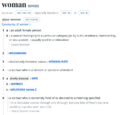
Merriam Webster Woman (visited 06.11.2025)
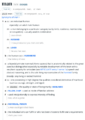
Merriam Webster Man (visited 06.11.2025)


"The body, sexuality irrationality: a phenomenon in which women are identifies with sex, body, passion while men are identified with reason and the mind. De Beauvior explicitly rejected the idea that rationality and everything else our culture values were inherently masculine: she said they were human, universal, but dishonestly claimed by the patriarchs for themselves." (Cameron, 1990)
- Literally WTF... of course a man is a human and a woman is a female servant. A man is a strong, confident human and a woman likes to eat sweet treats OMGGG....
Ann Oakley: "The distinction between sex and gender does not call into question how society constructs the natural body itself." Oakley suggests that to question how gender is constructed without questioning sex itself does not go far enough, given that gender helps to create the naturalness of sex. Or take the work of historical materialist Christine Delphy, who argues that 'gender precedes sex'. She explains:'We have continued to think of gender in terms of sex: to see it ad a social dichotomy determined by a natural dichotomy'. If gender creates the effect of two distinct and immutable biological sexes, to make that effect our cause would reproduce the system we are trying to dismantle.[...]The transformation of gender into the stranger allows sex to be positioned as nature or natal or even as native, as if all these categories are not themselves the product of labour, as if we do not have a hand in making and shaping them. [Sara Ahmet (2024)]
gender performativity
a concept by Judith Butler (gender Trouble)
H
hag
Radical feminist Mary Daly defines the hag as 'an intractable person, especially: a woman reluctant to yield to wooing'. You become a hag by not yielding, whether to a sexual advance or another kind of advance [...] [Sara Ahmet (2024) The feminist Killjoy Handbook]
Hegemony
preponderant influence or authority over others : domination; the social, cultural, ideological, or economic influence exerted by a dominant group
Hegemony refers to a kind of domination. It was borrowed in the mid-16th century from the Greek word hēgemonia, a noun formed from the verb hēgeisthai, “to lead.” At first hegemony was used specifically to refer to the control once wielded by ancient Greek states; later it was applied to domination by other political actors. By the 19th century, the word had acquired a second sense referring to the social or cultural influence wielded by a dominant entity over others of its kind, a sense employed by design scholar Joshua Langman when describing the use of found objects by French artist Marcel Duchamp (he of notorious readymade Fountain fame) as a means “to question and criticize the values of the artistic hegemony by eschewing craft entirely.” [source]
I
indeterminate
not known in advance, not leading to a definite end or result
When you determine something, you decide on what it is, which means you put limits or boundaries on its identity. So something indeterminate lacks identifying limits. A painting of indeterminate origins is normally less valued than one with the painter's name on it. And if negotiations are left in an indeterminate state, nothing has been decided. [source]
- to define is to limit, i once read somewhere. But a definition also contains all the things that are not the case. A thing is not only what it is, but also what it is not. We cannot totally say what a thing is, we can only list all the things it is not and with that narrow it down to what it may be.
insurrection
an act or instance of revolting against civil authority or an established government []
intellectual mystification
intellectual mystification occurs when a writer, to put herself in a position of authority, denies the reader sufficient resources to understand and dispute what s/he says. It can be done in many ways: For example, the writer may leave unexplained and taken for granted the conceptual framework s/he is working in, or may present it as a given rather than something open to question. Or s/he may depersonalise herself, hiding behind the spurious authority of an 'objective commentator' by not making it clear where she stands, politically and intellectually, in relation to the ideas she discusses. []
inter-action
an occasion when two or more people or things communicate with or react to each other []
intra-action
Intra-action is a Baradian term used to replace ‘interaction,’ which necessitates pre-established bodies that then participate in action with each other. Intra-action understands agency as not an inherent property of an individual or human to be exercised, but as a dynamism of forces in which all designated ‘things’ are constantly exchanging and diffracting, influencing and working inseparably. Intra-action also acknowledges the impossibility of an absolute separation or classically understood objectivity, in which an apparatus (a technology or medium used to measure a property) or a person using an apparatus are not considered to be part of the process that allows for specifically located ‘outcomes’ or measurement. []
intersectionality
Black feminist scholar Kimberlé Crenshaw introduced the concept of intersectionality in a pair of essays published in 1989 and 1991 in the field of legal studies. She describes how interlocking systems of power affect those who are most marginalized in society. It is an analytical framework for understanding how groups' and individuals' social and political identities result in unique combinations of discrimination and privilege. Examples of these intersecting and overlapping factors include gender, caste, sex, race, ethnicity, class, sexuality, religion, disability, physical appearance, and age. These factors can lead to both empowerment and oppression.[]
interoperability
from a single user account you can follow and interact with different "social network applications"
- mastodon, pixelfed and peertube as if instgram, twitter and youtube would all be connectable from one account
J
jurisdiction
the power, right, or authority to interpret and apply the law, the authority of a sovereign power to govern or legislate, the power or right to exercise authority : control
Questions of jurisdiction are generally technical legal matters. The most important ones include which court will hear a given case and which law-enforcement agency can get involved. But although they may seem like mere technicalities, jurisdictional matters sometimes turn out to be all-important in the final outcome. Jurisdiction may depend on where you are (for example, in which state), on who you are (if you're a juvenile, for example, you may only be tried in juvenile court), and on what the subject is (for example, cases involving the estate left by someone who has died are dealt with in probate court). [source]
juvenile
physiologically immature or undeveloped : young; of, relating to, characteristic of, or suitable for children or young people; reflecting psychological or intellectual immaturity : childish [source]
K
killjoy
A person who is anti-fun, or prevents others from having fun. []
- I AM A FEMINIST KILLJOY!
- Finally a name for what I have been feeling for a while. I'm the killjoy that "forbids" words to others lol. And you know what?! I'm fucking proud of that! Omg she even writes: "To call for change in how people speak or act can be sufficient to be judged as a killjoy. You can be judged as a killjoy, as imposing yourself upon others, stopping them from being free to do what they have always done.
The word killjoy has, in fact, been around longer than the word feminism. To giev you a sense of how the killjoy has come up, I include direct quotes from historical and contemporary sources. The Oxford English Dictionary gives its first recorded use of the term killjoy a note in Charles Burney's General History of Music from 1776, "The Gods were not then, says M. Rousseau, regarded as kill-joys, and shut out of convivial meetings."
This rather curious reference suggests that to be regarded as a killjoy, human or God, would mean to be shut out of meetings to keep them convivial. The second reference listed under killjoy is to George Eliot's novel Romola, first published in 1863. One character, Savonarola, is described as 'the killjoy of Florence', and is set apart from a city, a party, a meeting, restraining those who find, in joy, their freedom. [...] The killjoys kill the joy of others, not their own joy, perhaps because they do not have their own joy to kill. Synonyms. for killjoy are buzzkill, miserabilist, party pooper, wet blanket, dampener and spoilsport.
[...] For Edmund Bergler the killjoy is 'popularly regarded as a person who gloates over the fact that he spoils other people's pleasure'. In other words, 'his revenge is the killjoy attitude'. In this account, the killjoy is in self-denial; he does not recognize himself as a killjoy but is judged to be so by others. [...] The killjoy is presented as a type of person who is removed from the warmth of human sociability, who is powerful and punishing, who, having invented their own misfortune to justify their cruelty, employs a range of methods to spread misery from 'stony silence' to 'biting remarks'. Who would want to be such a person? The point of this picture of the killjoy might be to evoke a person no one else would want to be.
Even to give a brief history of the term killjoy teaches us how it was used to create a picture of those who are 'not us' and who have the power to take from us what we want for ourselves. If the killjoy once functioned to picture a type of person, it is now more often used for a style pf politics. We might call this style of politics mean-spirited. We hear, for instance, about politically correct killjoys, whose concern with correcting what other people do or say is framed as imposing an agenda upon them as well as stealing their enjoyment.
Sara Ahmet in The feminist Killjoy Handbook
L
laissez-faire
The French phrase laissez faire literally means “allow to do,” with the idea being “let people do as they choose.” The origins of laissez-faire are associated with the Physiocrats, a group of 18th-century French economists who believed that government policy should not interfere with the operation of natural economic laws. (The actual coiner of the phrase may have been French economist Vincent de Gournay, or it may have been François Quesnay, who is considered the group’s founder and leader.) The original phrase was “laissez faire, laissez passer,” with the second part meaning “let (things) pass.” Laissez-faire, which first showed up in an English context in the first half of the 19th century, can still mean “a doctrine opposing governmental interference in economic affairs,” but it is also used in broader contexts in which a “hands-off” or “anything-goes” policy or attitude is adopted. It is frequently used as an adjective meaning “favoring a ‘hands-off’ policy,” as in “laissez-faire economics.” [source]
language
the words, their pronunciation, and the methods of combining them used and understood by a community; audible, articulate, meaningful sound as produced by the action of the vocal organs []
- how do we use words and sentences to express our thoughts and feel connected to others? How do words link to objects, people, or concepts we’re talking about? what exactly are words and sentences? how do they carry such rich and complex meanings?
- "Perhaps language is assumed not to mean anything at the moment we identify it as problematic: its a metaphor; its a parody; its irony; its style; its art. [Sarah Ahmet (2024) The feminist Killjoy Handbook]
- If feminism is to survive as a radical project, a project with a commitment to ending violence, we must refuse to use categories in this way. [Sarah Ahmet (2024) The feminist Killjoy Handbook]
liaison
a close bond or connection, communication for establishing and maintaining mutual understanding and cooperation, the pronunciation of an otherwise absent consonant sound at the end of the first of two consecutive words the second of which begins with a vowel sound and follows without pause.
Liaison comes from Middle French lier, meaning "to bind or tie." Other English senses of liaison apply it to all kinds of bonds—from people who work to connect different groups to the kind of relationship sometimes entered into by two people who are attracted to one another. [source]
linguistic alienation
Linguistic alienation is an inability to give expression to experience through language or a feeling that language is incomplete or fails to capture experience. The term can be used to describe how language reduces experiences, emotions, feelings, and other indescribable phenomena into a limited and regulatory modality. Linguistic alienation has been described as a pervasive phenomenon, yet has not received sustained consideration. []
- Issue of racism and feminism!
M
malleable
capable of being altered or controlled by outside forces or influences; having a capacity for adaptive change; capable of being extended or shaped by beating with a hammer or by the pressure of rollers []
manterruptions
the unnecessary interruption of a woman by a man [] Jessica Bennett
meticulous
Marked by extreme or excessive care in the consideration or treatment of details.
Etymological news: meticulous comes from the Latin word for "fearful"—metīculōsus—and ultimately from the Latin noun metus, meaning "fear." Although meticulous currently has no "fearful" meanings, it was originally used as a synonym of "frightened" and "timid." This sense had fallen into disuse by 1700, and in the 1800s meticulous acquired a new meaning of "overly and timidly careful" (possibly due to the influence of the French word méticuleux). This meaning in turn led to the current one of "painstakingly careful," with no connotations of fear at all. The newest use was controversial for a time, but it is now by far the most common meaning; even the most meticulous (or persnickety, depending on your view) among us consider it perfectly acceptable. [source]
mistress
c. 1300, „female teacher, governess; supervisor of novices in a convent,“ from Old French maistresse „mistress (lover); housekeeper; governess, female teacher“ (Modern French maîtresse), fem. of maistre „master,“ from Latin magister „chief, head, director, teacher“. Sense of „a woman who employs others or has authority over a household and servants“ is from early 15c. Meaning „woman who has mastered an art or branch of study“ is from mid-15c. Sense of „kept woman of a married man“ is from early 15c. As a polite form of address to a woman, mid-15c. Meaning „woman who is beloved and courted, one who has command over a lover‘s heart“ is from c. 1500. []
The latin equvalent is Domina, which merriam-webster.com claims is as obsolete word meaning a woman of rank, specifically a woman holding a barony in her own right.
- – firstly, the etymology is crazy and this intersects with oppression based on class and race! mistress vs. maid; especially in colonial and enslaving contexts, where "mistress" was used in asymmetrical power relations! And here women definitely, undeniably had power over other people in horrible ways!
- – reduces women to their sexual relationship with men, makes then subordinate which is interesting cause the word technically means having power over someone... also again shames women*s sexual behavior into something immoral...oof also open up the whole marriage thing of the father giving his property to the next man. Women* dont get their own names, they always belong to someone else.
- – A woman* in power? thats impossible, it must be in a sexual context... i cant make sense of it otherwise.
- – A mistress is never defined on her own terms. She is always someone in relation to a man. Lakoff, Cameron: "Women are named relationally; men are named positionally."
- – proof of symmetry: A man in that position would not be called master, he is having an affair. It is not made into the mode of address and with that not necessarily attached to his character/identity – only a woman get blamed directly
- – Also the eqivalent "master" is used for so many other things: Master's degree, Masterpiece... but these is no mistress degree is there?!
- – At what point did authority become unacceptable in women? And why does sexual agency cancels legitimacy for women????? and in men its a status symbol...
This all leads us to...
mode of address
Mr. (Mister), Mrs. (Misses), Ms. (Miss) but also Doctor, Professor, Sir ...
A mode of address does not merely describe someone, it positions them socially. Address is performative as it assigns status, legitimacy, authority, relational position – "We become who we are allowed to be called." (Louis Althusser: Interpellation)
- – Men are addressed by last name and status (their profession – all leads to them seen as individual personas and in a distant form of authority, we greed them with respect) – Women are addressed by first name or in relation to a man (His wife/sister/mom... – Women’s social identity is linguistically connected/attached to others (men's) and thus appear less authoritative
- – Why tf do we need to know if a woman is married or not? Is all has to do with property. It is important to know for other man if that woman is already owed by some other man... bah
- – In women its character (something inherent and intrinsic) in men its behavior (not who is is but what he does)
- Cameron (2024) p. 108 "Whether a woman is known as Miss X or Mrs X will in most cases depend on whether she is married. For men that makes no difference: they are Mr X in either case. Feminists in the 1970s found this disparity objectionable, and proposed to eliminate it by replacing Miss and Mrs with a single title, Ms, which would then function simply as the female analogue of Mr. But this proposal was not entirely successful. Rather than replacing the two traditional titles with a single title, Ms, most English speakers treated Ms as an additional option, applying it to women who didn’t fit the prototype for either Miss (a young woman who had not yet married), or Mrs (a married woman of any age). These “anomalous” cases included older unmarried women, divorced women, lesbians and, of course, the “women’s libbers” who had supposedly invented Ms in the first place."
N
Notation
Notation ist die Benennung von Gegenständen durch das Festhalten von Dingen und Bewegungsverläufen in schriftlicher Form mit vereinbarten symbolischen Zeichen.
notion
an individual's conception or impression of something known, experienced, or imagined []
notorious
generally known and talked of; especially : widely and unfavorably known
For those who don’t give a hang about a bad reputation, being notorious for unpopular behavior is no biggie. (Being notorious for topping the Billboard charts? Now that's a Biggie.) Although notorious (which comes from Latin noscere, "to come to know") can be a synonym of famous, it's more often a synonym of infamous, having long ago developed the additional implication of someone or something disreputable. The Book of Common Prayer of 1549 includes one of the first known uses of the unfavorable meaning in print, referring to "notorious synners." You know what they say: more notorious synners, more problems. [source]
O
obtuse
difficult to comprehend : not clear or precise in thought or expression; not pointed or acute [source]
P
peculiar
characteristic of only one person, group, or thing : distinctive, different from the usual or normal, something exempt from ordinary jurisdiction [source]
pejoration
pejoration is where a word starts out with a neutral or positive meaning and eventually devolves to mean something negative. [Montell, Amanda (2019) Wordslut] a change for the worse, specifically : an historical process by which the semantic and connotative status of a word tends to decline []
- see opposite amelioration
- Nearly every word the English language offers to describe a woman has, at a point during its life span, been colored some shade of obscene. As Schulz writes, “Again and again in the history of the language, one finds that a perfectly innocent term designating a girl or a woman may begin with totally neutral or even positive connotations, but that gradually it acquires negative implications, at first perhaps only slightly disparaging, but after a period of time becoming abusive and ending as a sexual slur.” (s.24/25)
- see opposite amelioration
penetration
The term penetration implies and reinforces the idea that sex is from the male perspective. Like sex is defined as something a man does to a woman. The opposite might be envelopment or enclosure. Can you imagine how different life would be if that's how we referred to sex? [Montell, Amanda (2019) Wordslut]
perceptible
capable of being perceived especially by the senses. If something is perceptible, you can perceive it (“to notice or become aware of”) or capture it with your senses. Those who are linguistically perceptive may wonder if perceptible comes to us from Latin. It does indeed. Arriving in English by way of Late Latin perceptibilis, perceptible comes from a form of percipere (“to perceive”), which comes from Latin capere (“to take”) and the prefix per- (“thoroughly”). Perceptible shares the capere part of its ancestry with a number of other English words related to seizing or being seized, including capture, captor, captivate, and even catch. An even closer relation of perceptible is perceptive: while perceptible describes what can be perceived, perceptive describes the one who does the perceiving. Perceptive was formed in English from perception, which is also from percipere. [source]
period
early 15c., periode, "a course or extent of time; a cycle of recurrence of a disease," directly from Medieval Latin periodus "recurring portion, cycle," from Greek periodos "cycle, circuit, period of time," literally "a going around," from peri "around". Sense of "repeated cycle of events" led to that of "interval of time." From 1712 as "an indefinite part of any continued state or series of events;" by 1727 as "time in which a circuit or revolution (as of a heavenly body) is made." Sense of "episode of menstruation" is by 1829, probably short for period of menstruation (1808), etc. []
- as in menstruation: the formal medical term “menstruation” is explicitly linked to monthly regularity. The word is derived from the Latin term mensis, which translates to “month.” This etymological connection highlights the ancient observation that the human reproductive cycle often aligns closely with the lunar cycle. The average length of a healthy cycle remains close to 28 days, reinforcing the “monthly” nomenclature. Medical fields retain “menstruation” because it is precise and descriptive of the monthly, recurring biological function. The shift from the clinical “menstruation” to the common “period” resulted from social dynamics and the need for a less explicit term. “Period” functions as a euphemism, a mild or indirect word substituted for one considered too harsh or suggestive. Using “period” allows speakers to reference the event by its temporal characteristic—the interval of time—rather than its anatomical one.The adoption of shorter, less descriptive language is a historical pattern driven by social taboos. Historically, the subject of menstrual bleeding has often been viewed with discomfort or treated as inappropriate for public discussion. []
Pinko
a person who holds advanced liberal or moderately radical political or economic views [source]
practice
carry out, apply; to do or perform often, customarily, or habitually; to be professionally engaged in []
to do, put into action or practice;
preponderant
(überwiegend) having superior weight, force, or influence; having greater prevalence [source]
prevalent
generally or widely accepted, practiced, or favored : widespread [source]
problem
If you expose a problem, you pose a problem; if you pose a problem, you become the problem.
When we become a problem because of what we name, we can give problems their names.
[...], realizing that if we became the problem because of what we exposed, we were not the problem. We problematize who becomes the problem (and who does not).
[Sarah Ahmet (2024) The Feminist Killjoy Handbook]
– Betty Friedan introduced the 'problem without a name' in her book The Feminine Mystique (1963). She's referring to the wide spread unhappiness of middle class white women being pushed into domestic roles. Very white feminism take but yet, it shows how giving something a name makes something visible. And if something is visible it is fightable.
property
a quality or trait belonging and especially peculiar to an individual or thing, an effect that an object has on another object or on the senses, an attribute common to all members of a class [source]
pussy
they say the primary meaning is "cat" (But who actually uses “pussy” in conversation about a cat? No one.); slang for "female pudenda," by 1879, but probably older; perhaps from Old Norse puss "pocket, pouch" (compare Low German puse "vulva"), or perhaps instead from the cat word on the notion of "soft, warm, furry thing;" compare French le chat, which also has a double meaning, feline and genital. []
- The etymology isn't known definitely. Even experts are confused, but makes sense for taboo meanings of words, as they're mostly used in spoken form and never get written down.
- The word pussy is analogous to sissy, in that it’s a feminine word that was gradually reduced to an insult not only for women but for men. It wasn’t used to describe men until the early twentieth century, when writers began associating it with tame, unaggressive males. (Wordslut, p.26)
- This horrible thing where men get insulted by everything feminine...Don't be like a woman! Oh you're scared, don't be a pussy! Men are never scared.
Q
query
to ask questions about especially in order to resolve a doubt []
quaerere "to seek, look for; strive, endeavor, strive to gain; ask, require, demand;" figuratively "seek mentally, seek to learn, make inquiry," []
R
S
slut
Even the word slut used to mean something relatively innocent. The word is so contentious now you'd never guess it came from the comparatively wholesome Middle English term slutte, which merely meant an "untidy" woman. The word was even used for men sometimes (in 1386, Chaucer labeled one slovenly male character as "sluttish"). Soon enough, though, the word extended to mean an immoral, sexually loose woman or prostitute, and as of the late 1990s, this definition has been fortified by its heavy usage in pornography. There is a male equivalent of slut: manslut. However, I think we can all agree that this word is much sillier in connotation; plus, if slut with no modifier is a default female term, then manslut surely stands to imply that promiscuity is only contemptible when women do it. [Montell, Amanda (2019) wordslut s.29]
structurelessness
according to jo freeman: a leaderless and structureless group (of white feminists in the 70s) as a reaction of the over-structured society: a way of fighting overstructuredness
stereotype
A stereotype is a repeated utterance, a characterization that in being simplistic as well as flattening is also, in a profound sense, false. I say profound because what makes something a stereotype is about what it fails to capture. [Sara Ahmet (2024) The Feminist Killjoy Handbook]
superseded
to cause to be set aside, to force out of use as inferior, to take the place or position of, to displace in favor of another [source]
sovereign
superlative in quality, possessed of supreme power [source]
syllable
T
throttling
to throttle, a Throttle: the act or an instance of throttling something or someone: such as /a: the suppression or prevention of an activity; /b: a decisive defeat : rout []
time
Time is the continuous progression of existence that occurs in an apparently irreversible succession from the past, through the present, and into the future. It is a component quantity of various measurements used to sequence events, to compare the duration of events (or the intervals between them), and to quantify rates of change of quantities in material reality or in the conscious experience. []
- how is time valued? Why does it differ for men and women*?
- time spend with intention is caring – unpaid carework – invisible women*
U
ubiquitous
existing or being everywhere at the same time. Ubiquitous comes from the noun ubiquity, meaning “presence everywhere or in many places simultaneously,” and both words come ultimately from the Latin word ubique, meaning “everywhere.” Ubiquitous, which has often been used with a touch of exaggeration to describe those things that it seems like you can’t go a day without encountering, is the more popular of the two by a parsec. It may not quite be ubiquitous, but if you keep your eyes and ears open, you’re apt to encounter it quite a bit. [source]
understand
to grasp the reasonableness of; to accept as a fact or truth or regard as plausible without utter certainty; to believe or infer something to be the case []
Understanding seems to be different than knowledge in both respects. For one thing, understanding typically seems harder to acquire, and more of an epistemic accomplishment, than knowledge. For another, the objects of understanding seem more structured and interconnected. []
V
vernacular
a vernacular language, expression, or mode of expression : an expression or mode of expression that occurs in ordinary speech rather than formal writing. Using a language or dialect native to a region or country rather than a literary, cultured, or foreign language; of, relating to, or characteristic of a period, place, or group, especially : of, relating to, or being the common building style of a period or place [source]
W
witch
Middle English wicche, from Old English wicce "female magician, sorceress," in later use especially "a woman supposed to have dealings with the devil or evil spirits and to be able by their cooperation to perform supernatural acts," fem. of Old English wicca "sorcerer, wizard, man who practices witchcraft or magic," from verb wiccian "to practice witchcraft." Compare Low German wikken, wicken "to use witchcraft," wikker, wicker "soothsayer." []
- Why do women* who do magic are called witches and possesed by the devil and men who do magic are gods?!?!?!????
- They way women* are portrayed in films/media as witches is always old, ugly and evil in character – men are literally jesus with only good intentions... **eyeroll**
- Also the whole thing with the witch hunts?! what the helly... that all sounds so absurd to me
- There is (was?) a group called W.I.T.C.H meaning Women's International Terrorist Conspriracy from Hell and they wrote this manifesto, which is so cool imo
- There also was a clergyman Heinrich Kramer who wrote "Malleus Maleficarium" in 1484. Which is literally a book on how to identify a witch and how witches can only be women (ofc) and a 101 on how to burn them ... fucked up
whore
one who desires. []
woman
– impossible to define. Every attempt to define some is excluding others. Any simple definition disregards reality.
"Ain't I a woman?" Angela Davis asked at the Woman's Convention in Akron, Ohio, in 1851. Some had to insist that they were women. Some had to insist that they were not women. Monique Wittig, speaking at the Modern Language Association conference in NY in 1978, saying 'Lesbians are not women'. This audacious claim was necessary for Wittig to show how the very category of women has historically functioned as a hereosexual injunction, how women came to exist, or were required to exist, in relation to men.
The word woman too can be a bind as well as a bond, a record of who is missing from the conversation. [Sarah Ahmet (2024) The Feminist Killjoy Handbook]
- for my thesis: That, to me and in this essay, means people who are victims of gender-based oppression, more specifically trans women, non-binary, inter and genderqueer people who get misgendered as women, and cis-women. I must add that this umbrella term will, in some cases, prove inadequate, as the realities of life and oppression can vary greatly within the groups of people mentioned, yet I believe they’re all affected, in one way or another, by the oppressive linguistic mechanism that I mention. On top of that I want to acknowledge that various factors, such as race, gender, class, ability, and sexuality