User:Kiara/Second Assessment: Difference between revisions
No edit summary |
|||
| (24 intermediate revisions by the same user not shown) | |||
| Line 1: | Line 1: | ||
[[/RE|>>> Take me to the resubmission page <<<]] | |||
= Past = | = Past = | ||
=== Special Issue 25: Sounds of Making === | === Special Issue 25: Sounds of Making === | ||
| Line 14: | Line 16: | ||
: The idea was to have a never-stopping live scripting, that acts as a (fictional) archive of the Special Issue's public event and to play with language as a material.<br> | : The idea was to have a never-stopping live scripting, that acts as a (fictional) archive of the Special Issue's public event and to play with language as a material.<br> | ||
<gallery mode="packed" heights="400"> | |||
File:SI25 Event LostInNarration 03.jpg | |||
File:SI25-receipts.png | |||
</gallery> | |||
'''Key concepts I take from it''' | '''Key concepts I take from it''' | ||
| Line 26: | Line 32: | ||
=== Special Issue 26: Display & Position === | === Special Issue 26: Display & Position === | ||
'''Context''' | '''Context''' | ||
: in collaboration with artist and researcher Doriane Timmermans, we spent 3 months working on CSS manipulation, with a specific focus on the <code>display</code> and <code>position</code> properties. This Special Issue was integrated as part of her https://declarations.style research project, focusing on the materiality and poetry of the CSS language. | : in collaboration with artist and researcher Doriane Timmermans, we spent 3 months working on CSS manipulation, with a specific focus on the <code>display</code> and <code>position</code> properties. This Special Issue was integrated as part of her https://declarations.style research project, focusing on the materiality and poetry of the CSS language.<br> | ||
[[File:Specific-lens-si26.jpg|frameless|right]] | |||
[[File:Supervisualhyperzine.jpg|frameless|right]] | |||
During this Special Issue, I worked on two projects: | |||
* The Specific Lens browser extension, with Chrissy -- we worked on a browser extension that highlights the display and position properties used by the various elements of a web page. This was thought as a way of making the properties and their values visible and accessible without going into the code inspector. We made a little game out of it, designing it as a treasure hunt. | |||
* The Supervisual Hyperzine -- this is a 420 pages long zine filled with images; screenshots and pictures of screens gathering the CSS experiments made throughout the course of the Special Issue. Divided in 4 categories, the screenshots give a glimpse of the possibilities of CSS and make room for experimental code, free from the unspoken rules of "good" webdesign. | |||
'''Key concepts I take from it''' | '''Key concepts I take from it''' | ||
| Line 49: | Line 61: | ||
* language | * language | ||
So I safely | So I can safely state that they will also exist in the project I am now working on... | ||
Links: <span style="background-color: bisque; padding: 2px 5px;">[https://kirayana.codeberg.page/reves-party/ https://kirayana.codeberg.page/reves-party/]</span> --- <span style="background-color: bisque; padding: 2px 5px;">[https://kirayana.codeberg.page/babel https://kirayana.codeberg.page/babel]</span> --- <span style="background-color: bisque; padding: 2px 5px;">[https://kiarajou.gitlab.io/feed-your-head/ https://kiarajou.gitlab.io/feed-your-head/]</span> | Links: <span style="background-color: bisque; padding: 2px 5px;">[https://kirayana.codeberg.page/reves-party/ https://kirayana.codeberg.page/reves-party/]</span> --- <span style="background-color: bisque; padding: 2px 5px;">[https://kirayana.codeberg.page/babel https://kirayana.codeberg.page/babel]</span> --- <span style="background-color: bisque; padding: 2px 5px;">[https://kiarajou.gitlab.io/feed-your-head/ https://kiarajou.gitlab.io/feed-your-head/]</span> | ||
| Line 61: | Line 73: | ||
'''Starting point'''<br> | '''Starting point'''<br> | ||
I started by considering working on topics revolving around community, collaboration and such, but this axis was missing something. It was at the same time too broad, hard to narrow down and too restrictive. It was most importantly lacking the things that drive me as a person: language and magic.<br> | I started by considering working on topics revolving around community, collaboration and such, but this axis was missing something. It was at the same time too broad, hard to narrow down and too restrictive. It was most importantly lacking the things that drive me as a person: language and magic.<br> | ||
So I drifted towards female-led initiatives, then towards femininity and magic and finally, I dropped the feminine and centred around oppressed groups in general.<br> | |||
This is when I started having hunches about hyperlinks and magic symbols and found my three pillars: magic, the web, resistance. | |||
==== Magic ==== | ==== Magic ==== | ||
| Line 74: | Line 88: | ||
It is those actions that bring the magic forward: how we decide to create something, care for it, share it to others, how we interact with others. Through actions, gesture, body expression, we influence the world around us as much as we get influenced by it. By shaping the world, we shape ourselves, and vice-versa.<br> | It is those actions that bring the magic forward: how we decide to create something, care for it, share it to others, how we interact with others. Through actions, gesture, body expression, we influence the world around us as much as we get influenced by it. By shaping the world, we shape ourselves, and vice-versa.<br> | ||
To tie a more precise connection between the spiritual and the physical aspect of that definition, I invoke the ritual: a practice that is shaped both in the physical (ritual dances, sacrifices, (magic) circles, etc.) and in the spiritual (writings such as spells or chants, sigils, etc.)<br> | To tie a more precise connection between the spiritual and the physical aspect of that definition, I invoke the ritual: a practice that is shaped both in the physical (ritual dances, sacrifices, (magic) circles, etc.) and in the spiritual (writings such as spells or chants, sigils, etc.)<br> | ||
Lastly, we shouldn't forget the ties magic has to politics: many contexts and stories tell about magic practitioners (especially women) being chased, punished, banished from societies for their way of living would not comply with the "official" system and its rules. As a matter of fact, we also can observe magic practices rising mostly amongst discriminated circles: women, queer people, people of colour, etc. Magic has often served as a counter-culture, a way of reclaiming power and fighting the system. ( | Lastly, we shouldn't forget the ties magic has to politics: many contexts and stories tell about magic practitioners (especially women) being chased, punished, banished from societies for their way of living would not comply with the "official" system and its rules. As a matter of fact, we also can observe magic practices rising mostly amongst discriminated circles: women, queer people, people of colour, etc. Magic has often served as a counter-culture, a way of reclaiming power and fighting the system<span style="background-color: bisque; padding: 2px 5px;"><ref>"Magical thinking was viewed as a prime index of the non-modern and non-Western, and theorists commonly attributed magic to marginal peoples, locations and eras." (Styers, R. in ''Making magic: religion, magic and science in the modern world'' New-York Oxford University Press, 2014 pp 14-17);<br>In the introduction of his book ''Magic'', Jamie Sutcliffe describes multiple ways in which magic has been persecuted, mentioning "classificatory techniques of exclusion [...] that establishes power relations conducive to dominance", or the weight of Christian beliefs in invalidating magic, as well as referring to Silvia Federici's ''Caliban and the witch'' (2004) in order to highlight the persecutions against women, and more.</ref></span>. | ||
</blockquote> | </blockquote> | ||
| Line 91: | Line 105: | ||
==== Politics & Resistance ==== | ==== Politics & Resistance ==== | ||
We are currently witnessing a rise of fascism in a global political context and that comes along with a rise of AI generated content, seamlessness, extreme smoothness and all automation. Those concepts all feed on each other, as shows [https://www.are.na/institute-of-diagram-studies/ai-the-new-aesthetics-of-fascism this are.na channel] by The Institute of Diagram Studies.<br> | We are currently witnessing a rise of fascism in a global political context and that comes along with a rise of AI generated content, seamlessness, extreme smoothness and all automation. Those concepts all feed on each other, as shows <span style="background-color: bisque; padding: 2px 5px;">[https://www.are.na/institute-of-diagram-studies/ai-the-new-aesthetics-of-fascism this are.na channel]</span> by The Institute of Diagram Studies.<br> | ||
In that context and given the high political involvement of both magic and the web, my aim is to uncover practices and methods to fight back and reclaim the web space by highlighting the craft of website making. This is all a bit vague for now, because the investigation is ongoing.<br> | In that context and given the high political involvement of both magic and the web, my aim is to uncover practices and methods to fight back and reclaim the web space by highlighting the craft of website making. This is all a bit vague for now, because the investigation is ongoing.<br> | ||
As part of my investigation, I intend to take generative AI as a case study, debunking its fake magic aura; I will focus on my own interpretation of it as stage magic: if AI is "magical" it is merely a trick on the mind, making its audience believe something is happening when it actually is a smokescreen. If its "magic" comes from the fact that "we do not quite understand what it does and how", in opposition a hand crafted website therefore acts as a counter-spell, by the fact that we can inspect, replicate and adapt it, thus understanding it and our own intentions. | As part of my investigation, I intend to take generative AI as a case study, debunking its fake magic aura; I will focus on my own interpretation of it as stage magic: if AI is "magical" it is merely a trick on the mind, making its audience believe something is happening when it actually is a smokescreen. If its "magic" comes from the fact that "we do not quite understand what it does and how", in opposition a hand crafted website therefore acts as a counter-spell, by the fact that we can inspect, replicate and adapt it, thus understanding it and our own intentions. | ||
| Line 101: | Line 115: | ||
When we resist, we resist by taking action, literally: you stop going to a specific store because it finances a genocide, you stop taking the plane or taking baths to reduce your carbon footprint, you go out on the street to protest, etc.<br> | When we resist, we resist by taking action, literally: you stop going to a specific store because it finances a genocide, you stop taking the plane or taking baths to reduce your carbon footprint, you go out on the street to protest, etc.<br> | ||
Resisting on the web is much similar: crafting a website involves both the mind (intention of making) and the body (actually coding the website, navigating it).<br> | Resisting on the web is much similar: crafting a website involves both the mind (intention of making) and the body (actually coding the website, navigating it).<br> | ||
I want to explore that part of web crafting that involves the body. How to connect the act of coding to the body, how do we invest our body when we code a website? What part(s) of the body are involved<ref>This can be about hands on the keyboard, eyes scrolling the screen, posture, and more?</ref> (besides the HTML body, hehe).<br> | I want to explore that part of web crafting that involves the body. How to connect the act of coding to the body, how do we invest our body when we code a website? What part(s) of the body are involved?<ref>This can be about hands on the keyboard, eyes scrolling the screen, posture, and more?</ref> (besides the HTML body, hehe).<br> | ||
<p style="font-weight: bold; text-indent: 20px;">2. Language</p> | <p style="font-weight: bold; text-indent: 20px;">2. Language</p> | ||
Language is a shared component of every one of those topics: | Language is a shared component of every one of those topics: | ||
| Line 131: | Line 145: | ||
** Showcasing web practices that counter-act ruling systems and link them to magic practices with the same aim to highlight interrelations | ** Showcasing web practices that counter-act ruling systems and link them to magic practices with the same aim to highlight interrelations | ||
In that investigation, I aim to | In that investigation, I aim to avoid falling into stereotypical traps such as full-on binary or preconceptions. For that, I will need to offer a thorough and precise glossary and list of examples.<br> | ||
Here is a start of | The glossary is in its most primal shape above, it is being refined constantly.<br> | ||
Here is a start of the examples list: | |||
<gallery mode="slideshow" widths="500" heights="300"> | |||
File:Melonking.png|https://melonking.net (on a monday) | |||
File:Gossipweb.png|https://gossipweb.net | |||
File:Code-poetry.png|https://pioneerworks.org/broadcast/between-code-and-poetry-with-lai-yi-ohlsen | |||
File:Wwwobble.png|https://wwwobble.org | |||
File:Digital-divinity.png|https://restoftheworld.org/series/digital-divinity | |||
</gallery> | |||
---- | |||
<small><references/></small> | <small><references/></small> | ||
= Future = | = Future = | ||
=== The project === | === The project === | ||
My project's aim is to place the body, the physical as a central element. Thanks to the investigation led | My project's aim is to place the body, the physical as a central element. Thanks to the investigation led in the written research, I should uncover and draw inspiration from a range of practices that either involve the body into the craft of the web or the materiality of the code.<br> | ||
So far, I think about Olia Lialina's <span style="background-color: bisque; padding: 2px 5px;">[http://kimasendorf.com/olia/summer/ Summer]</span>, Raphaël Bastide's workflow on making <span style="background-color: bisque; padding: 2px 5px;">[https://raphaelbastide.com/etre-script/en.html being a script]</span><ref>During a conversation, Raphaël explained his workflow for making [https://raphaelbastide.com/etre-script/en.html being a script]:<blockquote>I wrote this essay during the first months of my daughter, so it was a period that was heavy emotionally, when I was very tired but was also in a context of care. The scale of care towards a baby is completely different, it's a completely new experience so the text relates that physical experience: first there's the writing rhythm of one page a day and then there's the telling of the physical performance of writing while carrying a baby that is transcribed in the text itself. I wrote ''being a script'' in a notebook, carrying the baby meant I couldn't draw or use a screen. The precision of movements was an obstacle so I used a notebook because they allow to "write badly" (this refers to the precision of movements, to the physical position). Then later I transcribed everything on a computer while keeping a flavour of the notebook. This transcription brought new things due to the situation evolving and the changes it brings. Building the sound program and the performance was a 3rd writing, now choices were linked to rhythm, to reconnecting to the body and how to activate the piece.</blockquote></ref> or hosting a no computer web crafting workshop. | |||
I am not yet sure about the form of that project, but I know what it will '''not''' be:<br> | I am not yet sure about the form of that project, but I know what it will '''not''' be:<br> | ||
::it will not be a performance | ::it will not be a performance | ||
::::it will not be "just" a website | ::::it will not be "just" a website | ||
::::::it will not be an archive | ::::::it will not be an archive | ||
::: | ...and what it ''might'' be: | ||
::it might be a puzzle (but depicting what? is it a traditional puzzle or a metaphorical one?) | |||
::::it might be a collection of workshops that all end with a zine creation about the workshop itself (meta) | |||
I wish to use this project as a way of stepping out of my comfort zone: my first instinct was a website involving some CSS-print functionalities. These are exactly what I always go for. I'd like to uncover new possibilities. | I wish to use this project as a way of stepping out of my comfort zone: my first instinct was a website involving some CSS-print functionalities. These are exactly what I always go for. I'd like to uncover new possibilities. | ||
Ideally, of course, the project will have a political stance. | Ideally, of course, the project will have a political stance. | ||
<small><references/></small> | |||
=== Prototypes === | === Prototypes === | ||
In order to frame the project and the research better, I started some prototypes: | In order to frame the project and the research better, I started some prototypes: | ||
:✺ '''Invoke the web (from last year)''' | :✺ '''Invoke the web (from last year)''' | ||
:: Exercise during methods class: write an answer or alternative version of a text read and annotated during the past weeks. I had read Joan Carpenter's "Handmade web" together with Sevgi and we agreed 1) that the text looks like a recipe or a spell and 2) that the part where she is supposed to talk about the body is not extensive nor very relevant. So I made a parody of her text that takes the spell literally and sums up every paragraph in a very reduced almost narrow-minded way, to highlight some absurdities made by the author (subjectively). <span style="background-color: bisque; padding: 2px 5px;">[https://hub.xpub.nl/cerealbox/~kiara/methods/handmade-web/ https://hub.xpub.nl/cerealbox/~kiara/methods/handmade-web/]</span> | :: Exercise during methods class: write an answer or alternative version of a text read and annotated during the past weeks. I had read <span style="background-color: bisque; padding: 2px 5px;">[https://luckysoap.com/statements/handmadeweb.html Joan Carpenter's "Handmade web"]</span> together with Sevgi and we agreed 1) that the text looks like a recipe or a spell and 2) that the part where she is supposed to talk about the body is not extensive nor very relevant. So I made a parody of her text that takes the spell form literally and sums up every paragraph in a very reduced almost narrow-minded way, to highlight some absurdities made by the author (subjectively). <span style="background-color: bisque; padding: 2px 5px;">[https://hub.xpub.nl/cerealbox/~kiara/methods/handmade-web/ https://hub.xpub.nl/cerealbox/~kiara/methods/handmade-web/]</span> | ||
:✺ '''Talisman web gallery (in progress)''' | :✺ '''Talisman web gallery (in progress)''' | ||
:: Inspired by my readings of '' | :: Inspired by my readings of ''SSOTBME: an essay on magic'' (Dukes, R.), 2000 and ''Talismans pour celles qui ne savent pas de quoi ils parlent'' (Haute, L.), 2020, I started a gallery of magical artifacts, starting with a talisman described by Ramsey Dukes in his book. <span style="background-color: bisque; padding: 2px 5px;">[https://hub.xpub.nl/cerealbox/~kiara/GradPrototypes/02_Talismans/ https://hub.xpub.nl/cerealbox/~kiara/GradPrototypes/02_Talismans/]</span> | ||
:✺ '''XPUB webring workshop''' | :✺ '''XPUB webring workshop''' | ||
:: On November 3rd 2025, I hosted a workshop about webrings. We organised a fully magic morning together with Charlie, who first introduced the group to magic folklore, symbols and sigils. Drawing from that magic atmosphere, I invited everyone to build a webpage in 45mn about anything they wanted, with the indication that everything had to be hand coded, meaning no JavaScript generated HTML or external framework. The result is extremely diverse and rich: <span style="background-color: bisque; padding: 2px 5px;">[https://hub.xpub.nl/cerealbox/~kiara/magic-webring/ https://hub.xpub.nl/cerealbox/~kiara/magic-webring/]</span> | :: On November 3rd 2025, I hosted a workshop about webrings. We organised a fully magic morning together with Charlie, who first introduced the group to magic folklore, symbols and sigils. Drawing from that magic atmosphere, I invited everyone to build a webpage in 45mn about anything they wanted, with the indication that everything had to be hand coded, meaning no JavaScript generated HTML or external framework. The result is extremely diverse and rich: <span style="background-color: bisque; padding: 2px 5px;">[https://hub.xpub.nl/cerealbox/~kiara/magic-webring/ https://hub.xpub.nl/cerealbox/~kiara/magic-webring/]</span> | ||
:✺ '''Try Out Night - December 1st 2025''' | :✺ '''Try Out Night - December 1st 2025''' | ||
:: This was the first public moment of the year, for it I offered to visitors the possibility to wander in the webring, but also a way to express themselves and for me to gather material: I displayed cards on which I asked people to put down what "magic" brings to their minds. The aim was to collect spontaneous responses to enrich my own vision. | :: This was the first public moment of the year, for it I offered to visitors the possibility to wander in the webring, but also a way to express themselves and for me to gather material: I displayed cards on which I asked people to put down what the word "magic" brings to their minds. The aim was to collect spontaneous responses to enrich my own vision. | ||
<gallery mode="packed" heights="300"> | <gallery mode="packed" heights="300"> | ||
File:Tryoutnight01-outcome01.jpg | File:Tryoutnight01-outcome01.jpg | ||
File:Tryoutnight01-outcome02.jpg | File:Tryoutnight01-outcome02.jpg | ||
</gallery> | </gallery> | ||
Latest revision as of 20:57, 15 December 2025
>>> Take me to the resubmission page <<<
Past
Special Issue 25: Sounds of Making
Context
- In collaboration with Radio WORM we hosted radio shows for 2 months and crafted projects relating to sound.
- One of the shows I took part in was Lost Music; together with Chrissy, Charlie, Tessa and Imina we collected songs from our classmates, following different instructions. We decided to burn CDs with the songs on them and to make a website to allow people to download the songs without needing any music-streaming platform. The whole project took great visual inspiration in late 90s - early 2000s aesthetics. The website itself is inspired by tumblr blogs that allowed autoplay music when anyone would enter the website.
- Lost in Narration is the final project I took part in, where we put together a looping chain of discourse:
(2 narrators) write the script
                 ↓
(2 speakers) read the script into microphones
                 ↓
read material is captured by a speech-to-text python script
+ printed by a receipt printer
+ simultaneously transformed into sound, captured by VCV Rack 2
- The idea was to have a never-stopping live scripting, that acts as a (fictional) archive of the Special Issue's public event and to play with language as a material.


Key concepts I take from it
- small web/indie web (hand coded),
- open access, piracy as a sharing method
- connection between the body and the code and how they invest space(s)
- failure as a creative material / trial and error (the python script doesn't fully recognises the words, depending on accent, dictation, etc.)
- language intricacies, interpretation, translation, intention (what you mean is not necessarily what will be understood)
Links: Lost_in_Narration --- SI 25 website --- https://hub.xpub.nl/cerealbox/~kiara/lost-music/
Special Issue 26: Display & Position
Context
- in collaboration with artist and researcher Doriane Timmermans, we spent 3 months working on CSS manipulation, with a specific focus on the
displayandpositionproperties. This Special Issue was integrated as part of her https://declarations.style research project, focusing on the materiality and poetry of the CSS language.


During this Special Issue, I worked on two projects:
- The Specific Lens browser extension, with Chrissy -- we worked on a browser extension that highlights the display and position properties used by the various elements of a web page. This was thought as a way of making the properties and their values visible and accessible without going into the code inspector. We made a little game out of it, designing it as a treasure hunt.
- The Supervisual Hyperzine -- this is a 420 pages long zine filled with images; screenshots and pictures of screens gathering the CSS experiments made throughout the course of the Special Issue. Divided in 4 categories, the screenshots give a glimpse of the possibilities of CSS and make room for experimental code, free from the unspoken rules of "good" webdesign.
Key concepts I take from it
- CSS as a language, before being a programming language --> syntax, meaning, vocabulary, etc.
- Code as a creative writing material
- Web programming as a craft
- Interpretation, subjectivity
Links: User:Kiara/Special_Issue_26 --- Specific Lens: browser extension --- Supervisual Hyperzine: an archive of SI26 --- https://declarations.style
External works
My own practice of web crafting
Since 5 years now I have been playing around with web languages, mostly HTML and CSS, to create web material but also printed objects. I learn constantly, as it is an ever-evolving practice.
Looking back at my own work, some key concepts keep being present:
- playfulness
- puzzle/enigma aspect
- language
So I can safely state that they will also exist in the project I am now working on...
Links: https://kirayana.codeberg.page/reves-party/ --- https://kirayana.codeberg.page/babel --- https://kiarajou.gitlab.io/feed-your-head/
Present
Investigation (thesis)
    ⇣----  Magic  ----⇣
body & politics & resistance
    ⇡---- The web ----⇡
Starting point
I started by considering working on topics revolving around community, collaboration and such, but this axis was missing something. It was at the same time too broad, hard to narrow down and too restrictive. It was most importantly lacking the things that drive me as a person: language and magic.
So I drifted towards female-led initiatives, then towards femininity and magic and finally, I dropped the feminine and centred around oppressed groups in general.
This is when I started having hunches about hyperlinks and magic symbols and found my three pillars: magic, the web, resistance.
Magic
Magic is a concept that has been present in my life for as long as I can remember. From a childhood passion for magical girls, witches and fairies[1] to a deeper understanding of what magic implies in a broader sense. From all that personal experience, I outline my own definition of magic:
It all starts with intuition: that feeling we have deep inside that makes us say "it does (not) feel right". That intuition, that also involves hunches or déjà-vu sensations is rooted within our inner self, the understanding of our feelings and emotions and how we relate and deal with them.
What we do with this intuition leads to the second key aspect of magic: intention. Where you place intention, and if you place it, in order to (in)validate your intuition. Do you listen to that little voice telling you something has to be dug out there? Do you follow it? What paths do you take to follow it?
Obviously, magic is highly subjective, it relates strongly to our individuality and how we choose to express it. This is also part of what makes it appear so ungraspable and mystical.
Magic lies in the in-betweens, those places we cannot fully reach or make sense of, but are actually existing. We can feel their existence. It is what you cannot touch but can only sense.
So far, that definition is very mental, very inwards-focused. Let me elaborate on the physical side of it, as it cannot be separated since we are both body and mind.
Magic in a western-oriented imaginary will induce pictures of spell-casting, magic wands, potion making and such practices that involve, require even, a body interaction. I said before that magic is what you cannot touch, but everything happens through physical channels. As intention cannot be expressed without action, we somehow have to "perform" magic. Here, I do not want to focus on occult and mystique practices, but more on the mundane actions we take.
It is those actions that bring the magic forward: how we decide to create something, care for it, share it to others, how we interact with others. Through actions, gesture, body expression, we influence the world around us as much as we get influenced by it. By shaping the world, we shape ourselves, and vice-versa.
To tie a more precise connection between the spiritual and the physical aspect of that definition, I invoke the ritual: a practice that is shaped both in the physical (ritual dances, sacrifices, (magic) circles, etc.) and in the spiritual (writings such as spells or chants, sigils, etc.)
Lastly, we shouldn't forget the ties magic has to politics: many contexts and stories tell about magic practitioners (especially women) being chased, punished, banished from societies for their way of living would not comply with the "official" system and its rules. As a matter of fact, we also can observe magic practices rising mostly amongst discriminated circles: women, queer people, people of colour, etc. Magic has often served as a counter-culture, a way of reclaiming power and fighting the system[2].
The web


The web has been my main playground for years, for that reason it is at the heart of my graduation project and research. I want to investigate the web under two prisms:
- As a space: allowing for creation, expression, community building
- As a craft material: focusing on its languages (HTML + CSS) and creative intentions (as in: why people craft websites or something like that)
Through that investigation, I seek to answer several hunches that started this research:
- the web has something magical (that is beyond simple amazement)
- hyperlinks are magical (a hunch reinforced by Charlie's correspondence between hyperlink structure and sigils)
- connecting back to the craft of the web (hand coded websites) would allow to reconnect to ourselves (through intention and learning + doing things with our hands >> reconnecting body and mind) and thus to fight back
The web is equally political, it was built on a political stance: sharing knowledge globally through an open access network system (the internet). Since then, activists of all convictions have been using it as a tool to reach and/or create communities and movements. We can very much see it when any kind of election is happening, we lost count of the campaigns that have been suspected of treachery through online actions, of politicians campaigning on TikTok, etc.
Politics & Resistance
We are currently witnessing a rise of fascism in a global political context and that comes along with a rise of AI generated content, seamlessness, extreme smoothness and all automation. Those concepts all feed on each other, as shows this are.na channel by The Institute of Diagram Studies.
In that context and given the high political involvement of both magic and the web, my aim is to uncover practices and methods to fight back and reclaim the web space by highlighting the craft of website making. This is all a bit vague for now, because the investigation is ongoing.
As part of my investigation, I intend to take generative AI as a case study, debunking its fake magic aura; I will focus on my own interpretation of it as stage magic: if AI is "magical" it is merely a trick on the mind, making its audience believe something is happening when it actually is a smokescreen. If its "magic" comes from the fact that "we do not quite understand what it does and how", in opposition a hand crafted website therefore acts as a counter-spell, by the fact that we can inspect, replicate and adapt it, thus understanding it and our own intentions.
Body & Language
1. Body
With resistance, comes the intervention of our physical beings.
The body has its own language, Luna Maurer highlights that through dancing: machines cannot dance, it is a truly human activity; dance depicts who we are by the expression of body movement. Moreover, dancing requires a specific writing technique (choreography), which might resemble a script, or even a ritual.
When we resist, we resist by taking action, literally: you stop going to a specific store because it finances a genocide, you stop taking the plane or taking baths to reduce your carbon footprint, you go out on the street to protest, etc.
Resisting on the web is much similar: crafting a website involves both the mind (intention of making) and the body (actually coding the website, navigating it).
I want to explore that part of web crafting that involves the body. How to connect the act of coding to the body, how do we invest our body when we code a website? What part(s) of the body are involved?[3] (besides the HTML body, hehe).
2. Language
Language is a shared component of every one of those topics:
- Magic: ritual, incantation, formulation (of intention), spell, even sigils are based off of words;
- Web: programming languages, actual written content of a website;
- Politics & Resistance: chants, slogan, catchphrases, etc.
This allows to draw connections:
- Crafting a website requires intuition, intention, action. It results in a sort of ritual:
- write HTML
- style with CSS
- make corrections
- publish
- Which then involves another hunch I want to investigate: CSS rituals, or how CSS bears magical aspects. This idea is highly supported by Miriam Suzanne, member of the CSS working group, and by Doriane Timmermans, who both gave me extremely valuable input on this matter during conversations I had with them.
In a nutshell, I intend to explore the shapes of languages: ritual/spell/incantation language; "human" language; web languages to eventually find similarities and connections that support my point.
In a nutshell: research question
Through all those interrelated topics, my central question is:
How does cultivating the handmade web gives us leverage against the all-automation?
This is a question that probably needs refining, or a different phrasing, but the idea is to highlight web crafting practices as a means to fight back against automation, AI-generated content and fascism.
In order to answer that question, I intend to divide my writing into 4 key aspects:
- Introduction: what are we talking about?
- Definitions of key terms and their relation to one another
- 1. The web is not dying, its alchemy is just in the wrong hands
- Result of an investigation into the similarities between the web and alchemy + the ones between hyperlinks and sigils
- 2. The descent into
oblivionseamlessness- Cultural appropriation and glamorisation: how "ruling systems" turn struggle response into smoothed out aesthetics
- Case study: debunking generative AI as "the new magic"
- 3. Take the power back
- Showcasing web practices that counter-act ruling systems and link them to magic practices with the same aim to highlight interrelations
In that investigation, I aim to avoid falling into stereotypical traps such as full-on binary or preconceptions. For that, I will need to offer a thorough and precise glossary and list of examples.
The glossary is in its most primal shape above, it is being refined constantly.
Here is a start of the examples list:
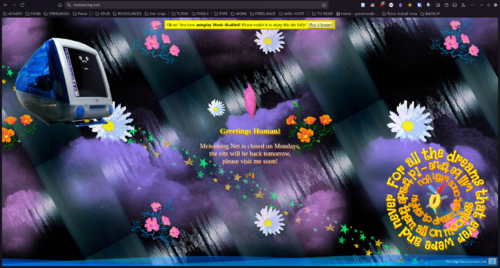
https://melonking.net (on a monday)


- ↑ See Magical Doremi, Sailor Moon, W.I.T.C.H. and Winx Club
- ↑ "Magical thinking was viewed as a prime index of the non-modern and non-Western, and theorists commonly attributed magic to marginal peoples, locations and eras." (Styers, R. in Making magic: religion, magic and science in the modern world New-York Oxford University Press, 2014 pp 14-17);
In the introduction of his book Magic, Jamie Sutcliffe describes multiple ways in which magic has been persecuted, mentioning "classificatory techniques of exclusion [...] that establishes power relations conducive to dominance", or the weight of Christian beliefs in invalidating magic, as well as referring to Silvia Federici's Caliban and the witch (2004) in order to highlight the persecutions against women, and more. - ↑ This can be about hands on the keyboard, eyes scrolling the screen, posture, and more?
Future
The project
My project's aim is to place the body, the physical as a central element. Thanks to the investigation led in the written research, I should uncover and draw inspiration from a range of practices that either involve the body into the craft of the web or the materiality of the code.
So far, I think about Olia Lialina's Summer, Raphaël Bastide's workflow on making being a script[1] or hosting a no computer web crafting workshop.
I am not yet sure about the form of that project, but I know what it will not be:
- it will not be a performance
- it will not be "just" a website
- it will not be an archive
- it will not be "just" a website
- it will not be a performance
...and what it might be:
- it might be a puzzle (but depicting what? is it a traditional puzzle or a metaphorical one?)
- it might be a collection of workshops that all end with a zine creation about the workshop itself (meta)
- it might be a puzzle (but depicting what? is it a traditional puzzle or a metaphorical one?)
I wish to use this project as a way of stepping out of my comfort zone: my first instinct was a website involving some CSS-print functionalities. These are exactly what I always go for. I'd like to uncover new possibilities.
Ideally, of course, the project will have a political stance.
- ↑ During a conversation, Raphaël explained his workflow for making being a script:
I wrote this essay during the first months of my daughter, so it was a period that was heavy emotionally, when I was very tired but was also in a context of care. The scale of care towards a baby is completely different, it's a completely new experience so the text relates that physical experience: first there's the writing rhythm of one page a day and then there's the telling of the physical performance of writing while carrying a baby that is transcribed in the text itself. I wrote being a script in a notebook, carrying the baby meant I couldn't draw or use a screen. The precision of movements was an obstacle so I used a notebook because they allow to "write badly" (this refers to the precision of movements, to the physical position). Then later I transcribed everything on a computer while keeping a flavour of the notebook. This transcription brought new things due to the situation evolving and the changes it brings. Building the sound program and the performance was a 3rd writing, now choices were linked to rhythm, to reconnecting to the body and how to activate the piece.
Prototypes
In order to frame the project and the research better, I started some prototypes:
- ✺ Invoke the web (from last year)
- Exercise during methods class: write an answer or alternative version of a text read and annotated during the past weeks. I had read Joan Carpenter's "Handmade web" together with Sevgi and we agreed 1) that the text looks like a recipe or a spell and 2) that the part where she is supposed to talk about the body is not extensive nor very relevant. So I made a parody of her text that takes the spell form literally and sums up every paragraph in a very reduced almost narrow-minded way, to highlight some absurdities made by the author (subjectively). https://hub.xpub.nl/cerealbox/~kiara/methods/handmade-web/
- ✺ Talisman web gallery (in progress)
- Inspired by my readings of SSOTBME: an essay on magic (Dukes, R.), 2000 and Talismans pour celles qui ne savent pas de quoi ils parlent (Haute, L.), 2020, I started a gallery of magical artifacts, starting with a talisman described by Ramsey Dukes in his book. https://hub.xpub.nl/cerealbox/~kiara/GradPrototypes/02_Talismans/
- ✺ XPUB webring workshop
- On November 3rd 2025, I hosted a workshop about webrings. We organised a fully magic morning together with Charlie, who first introduced the group to magic folklore, symbols and sigils. Drawing from that magic atmosphere, I invited everyone to build a webpage in 45mn about anything they wanted, with the indication that everything had to be hand coded, meaning no JavaScript generated HTML or external framework. The result is extremely diverse and rich: https://hub.xpub.nl/cerealbox/~kiara/magic-webring/
- ✺ Try Out Night - December 1st 2025
- This was the first public moment of the year, for it I offered to visitors the possibility to wander in the webring, but also a way to express themselves and for me to gather material: I displayed cards on which I asked people to put down what the word "magic" brings to their minds. The aim was to collect spontaneous responses to enrich my own vision.

