User:Lor.ensō/Final presentation: Difference between revisions
No edit summary |
|||
| (21 intermediate revisions by the same user not shown) | |||
| Line 1: | Line 1: | ||
<big>Welcome to the official assessment presentation page of Lorenzo Quint.</big> | |||
<big>This page will guide you on my XPUB journey of the last two years. It's a curation that hopes to bring context and a half. It might be overwhelming. The format will go back in time, traverse through virtuals / methods / drawings and other shapes of annotations.</big> | |||
<big>There might be some detours out of our control, but if you hold on tight we will make it to the end. Enjoy the ride and let yourself be guided from A to B. //comment: ''It is very possible that I won't show everything I share here at the actual presentation. But since you are reading this and I am writing this and delivering this on a deadline that is 11 days before my actual assessment, I wanted to show the processes that make sense. There will be a lot of redirecting going on.''</big> | |||
== your individual contributions to the special issues == | |||
=== <code><big>SPECIAL ISSUE 22 - ''Byte Noise: Sound you see me? Sound you don't'' (w/ Senka)</big></code> === | |||
[[File:SI22_Launch_image_Byte_Noise_1.jpg|left|frameless|662x662px]] | |||
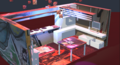
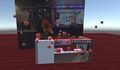
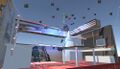
In this work, I collaborated with Senka. As we both come from a practice that involves 3D (world) building and net-art as media for our story telling, we decided to combine my Unity3D skills and their Blender skills to make a virtual world based on everything that does happen but is not visible at RADIO WORM. Combining these with an essay we made in opposition of the request that we as a class would deliver and experiment Protocols for Active Archiving. In this project, we didn't provide the answer but merely raised different questions. This became a media installation that was projected on the tv screen that is at Wunderbar. on the screens we showed our (Senka&mine) collective fused poetic essay to deliver the message back to Radio Worm. We based our aesthetics on both the command/fish etc terms (data streams), the vessel of radio worm and the colors of WORM in general. | |||
This is my [[LorenzoQuestionnairerasure for the Wormpocalypse (Wordhole)|'''''<u>text that I wrote.</u>''''']] | |||
<img src="https://www.lorenzoquint.nl/bytenoise.gif" width="800px"/>{{User:Lor.ensō/Lorenzo's Byte Noise project process page}} | |||
'''<big>SPECIAL ISSUE 23 - HOW DID WE GET HERE? /DOOR/PORT/</big>''' | |||
This was a collaboration with Mania and Victor. Our shared part in this work was that Victor designed the [https://pzwiki.wdka.nl/mw-mediadesign/images/thumb/d/da/Access-token-webjourney.jpg/900px-Access-token-webjourney.jpg?20240330175040 access token] to our 'feminist data center' as we presented our Special Issue at Varia. We address how our information gets to our interfaces, acknowledging the fact that it's not this romantic cloud system but an infrastructure that delivers information via satellite, glass fibre and other spots. When we designed the entrance to the special issue, we wanted to play with the idea of limited access to grant people information. Victor made the access token (img), directing to Mania's introduction and data walk (which also encapsulates our conversations about fibre cables sprouting up the street during the establishment of our collective project. Mania's project then redirects to my project /port. The port to information. | |||
''A port is a virtual point where network connections start and end.'' | |||
[[File:Slash_door_.png|thumb|940x940px|<big>as we provide access, we provide a knocking on [https://hub.xpub.nl/chopchop/~lorenzo/door.html the door] that gives acesss to the port, where everything comes together</big>]] | |||
[[File:Slash_port.png|thumb|936x936px|<big>/port, an access point to describe all the jargon and references that was shown at the special issue event at varia. In this project, I played with the pre-, summary and detail html tags.</big> | |||
<big>I used the aesthetic of the command prompt which is an interface we use(d) during our time at XPUB. My practice during my bachelors included a lot of research and interests in access of information, since media literacy, dis and misinformation were of catastrophic effect on people's understanding and gullibility. Access is key in my projects. So I wanted to make a index-like page that is a collection of all our word definitions, etymology, jargon and other linguistical madness.</big>]] | |||
<big>'''SPECIAL ISSUE 24 - POINTS OF INACCESS ROTTERDAM [POINXS 010]'''</big> | |||
This Special Issue was a crucial precursor to my graduation project. As someone who has lived in Rotterdam his entire life, the city critique and topics have been interesting. During this trimester we were given a lot of different ways to look critically at Rotterdam. Over the years I already gathered some criticism and this Special Issue gave me some first hands-on ways to deal with it. | |||
[[File:POINXS SCREENIE.png|frameless|943x943px]]This resulted In '''''<u>[https://issue.xpub.nl/24/poinxs/ POINXS]:</u>''''' A critical counter map looking at city marketing/planning versus the city living and experience. It's a parody on postcard surreality and apps/websites portraying cool and flashy 2D/3D imagery without the complicated dimensions of the city without showing what's behind the scenes. | |||
Rotterdam is 'back on the map'. | |||
POINXS questions that map and looks at a city that has become less livable and affordable and reports the bugs from a hill that leads to a dead end pavement, via private transport to wheelchair inaccessible hotspots with ambitions to become a multi-user platform for reporting other people's POINXS. | |||
For this Special Issue, we made a flyer / map containing our content for the Special Issue at UBIK. We made memes and parodies on commercial | |||
<gallery> | |||
File:Heresanimageofthetree.jpg|In this meme I use an [https://jmbsigns.com/cdn/shop/products/What_Matters_Most_In_Life.jpg?v=1421516321 older meme] with the knowledge obtained in VONK on Nudging theory. This one didn't make the map / folder. | |||
File:Roffamem1lorenzo.jpg|This meme is a part of my research in how Rotterdam looks virtually. This is a precursor to Renderdam. It shows Rotterdam from flight / truck / marine / train simulators. Going from games into simulation was a big part in my research. | |||
File:Roffamem2lorenzo.jpg|This is a meme based on inaccesibility in cultural hip and happening hotspots. It's a place you can go and also has the option to be inside with i.e. wheelchair / mobility scooter. But it also has a cool rooftop bar and that is where it gets uncomfortable. Station Bergweg might not have intended to be inaccessible but it sure takes away access and affordance in multiple layers. | |||
</gallery> | |||
== the development of your reading/writing practice across the 2 years, == | == the development of your reading/writing practice across the 2 years, == | ||
<big>'''SPECIAL ISSUE 23 / PUBLIC TRANSPORT'''</big> | |||
During the second special issue of our first year, we did some research into text-based games and since the dynamic of a lot of of those games go on a step by step basis, I felt inspired and made somewhat of a story based on a true narrative of mobility concerning my mother and my brother. This was somewhat of a draft but became crucial as the steps are a big part in my '''Counter Planner''' <blockquote>1. "Public transport: From A to B via Metroline E and Tram 7." | |||
A personal observation based on the limitations concerning accessibility, usability concerning healthcare, public transport. | |||
Since XPUB is focused on making things public, I'm thinking about some stuff. | |||
Public Transport, How do you make Transport Public? Or more public | |||
I'm just thinking about the idea of the public service for the transport from an accessible / disability point of view. This case is quite personal but also inspirational from my critical thinking designartresearchblabla point of view. | |||
So, let's say my mother wants to go to my brother. What needs to be done? For this ''method'' I'm using the google maps standard*/ ** | |||
# Go out of the house | |||
# Unlock the scootmobile | |||
# Uncover the scootmobile | |||
# Put the cover inside | |||
# move the bicycle | |||
# position the basket and possible bags | |||
# start scootmobile | |||
# go to end of street | |||
# wait for traffic lights / or if you're lucky it's green but it's always in favour of the cars. | |||
# once you crossed the street, go to the elevator | |||
# check in at port ** | |||
# push the button | |||
# wait for elevator | |||
# possibly wait for people to exit the elevator | |||
# enter the elevator*** | |||
# wait until you are at the platform | |||
# exit elevator to right side(need to confirm this) | |||
# wait for the metro | |||
# search for the good entrance without the metal poles in the middle ^ | |||
# be in metro for one stop | |||
# reach central station | |||
# pull back to exit metro | |||
# go back or forward to elevator | |||
# push button and wait for elevator / if you are lucky it'll be there already | |||
# enter the elevator *** | |||
# wait til you reach centraal station begane grond | |||
# go back or forward to exit elevator | |||
# check out at port ** | |||
# ride towards third tram platform | |||
# enter third tram platform | |||
# wait for tram 7 towards woudestein? (need to be confirmed) | |||
# in the meantime, guess on what half of the platform the tram will stop | |||
# inevitably ride or race through crowd to reach the middle / center of tram**** | |||
# enter tram in transit ^ | |||
# position yourself | |||
# wait until you reach you reach your destination | |||
# try to get out of the tram | |||
# check out as well | |||
# you can finally breathe again | |||
# enjoy your visit | |||
# when it is time to leave, leave* | |||
# go back to the tram | |||
# search for the right port on the other side of the street | |||
# inevitably ride or race through crowd to reach the middle / center of tram**** | |||
# step / check in | |||
# it might be possible that there is a parent and a baby carriage in the space that is also meant for wheelchair and rollator | |||
# wait in discomfort | |||
# person with baby carriage needs to get out, instead of going to another exit, this person insists to get out the door they came in, they lift the scootmobile and you are in even more discomfort | |||
# you need to wait some more time | |||
# finally you are at Rotterdam Centraal | |||
# struggle to get out of the tram once again** | |||
# head to the metro port | |||
# check in and somehow also drive towards the elevator*** | |||
# push the button of the elevator | |||
# position yourself in the metro at the place with no metal poles in the middle | |||
# wait one stop | |||
# get out the metro | |||
# go to elevator | |||
# go up | |||
# go out | |||
# go home | |||
# place all the stuff back | |||
# recover | |||
<nowiki>*</nowiki>before you go, think about leaving at least 10-15 minutes in advance | |||
<nowiki>**</nowiki> might need someone else to do it because it closes again in a certain timeframe | |||
<nowiki>***</nowiki> this means the elevator works | |||
<nowiki>****</nowiki> there might be a parent with child, cyclist, person in wheelchair, other person in scootmobile there | |||
^ take into consideration the doors are literally timeframes so you better have someone with you to hold the door | |||
Example: -------- | |||
The Rotterdam Electric Tram has multiple Entrances -> Ports | |||
Port asin the doors | |||
Port asin checkin / outs | |||
[] PORT 1 | |||
[] PORT 2 | |||
[] PORT 3 | |||
== '''''<<<<< <big>(_□___□▯▯__□__▯▯_□__▯▯_□_)>>>>>></big>''''' == | |||
DRIVER | BEGIN | MIDDLE | END | |||
| FRONT | CENTER | BACK | |||
[PORT1] | [PORT2] | [PORT3] | |||
check I / O | I / O | I / O | |||
FOOTABLE | FOOTABLE | FOOTABLE | |||
KIDABLE | KIDABLE | KIDABLE | |||
| WHEELABLE | | |||
FOR CONTEXT | |||
CENTRAAL STATION TRAM STOP | |||
<big>(_□___□▯▯__□__▯▯_□__▯▯_□_) / (_□___□▯▯__□__▯▯_□__▯▯_□_)</big> | |||
_______________________________________________________________________________________ | |||
<big>(_□___□▯▯__□__▯▯_□__▯▯_□_) / (_□___□▯▯__□__▯▯_□__▯▯_□_)</big> | |||
_______________________________________________________________________________________ | |||
<big>(_□___□▯▯__□__▯▯_□__▯▯_□_) / (_□___□▯▯__□__▯▯_□__▯▯_□_)</big> | |||
_______________________________________________________________________________________</blockquote> | |||
'''<big>SPECIAL ISSUE 24 / Benchmarking.</big>''' | |||
During the third special issue. I was playing around with idea of the city being a machine. Previous trimester and this one, I was interested in how ideas of i.e terminal and port are both visible in a city especially as Rotterdam has a terminal that up and downloads goods I came to realize this as well when I was playing a game called EuroTruck Simulator 2 that visualizes the transport of goods through terminals and ports. Ports of access in information. At some points I started looking at other crossreferential words as I tried to develop my own methodology. This resulted in a thought experiment called Benchmarking. <blockquote> | |||
== BENCHMARKING == | |||
<code>''what does it mean to benchmark''</code> | |||
<code>dictionaries will tell that it is</code> | |||
<code>1. a standard or point of reference against which things may be compared.</code> | |||
<code>"the pay settlement will set a **benchmark for** other employers and workers"</code> | |||
<code>2. ideal - a test designed to evaluate or compare the performance of computer hardware or software.</code> | |||
<code>"we thought we'd run some benchmarks on the smartphone"</code> | |||
<code>3. '''Benchmark is a surveyor's mark, cut on a rock, stone, wall or a building showing the height of that mark above sea level'''. Contours are lines shown in brown, joining places of equal height above the sea level. Heights of inaccessible areas are shown by contours drawn in broken lines called form lines.</code> | |||
<code>4. or building and used as a reference point in measuring [altitudes]</code> | |||
<code>5. ==evaluate (something) by comparison with a standard.==</code> | |||
<code> =="we are **benchmarking** our performance **against** external criteria"==</code> | |||
<code>----------------------------------------------------------------------------------------------------------</code> | |||
<code>In these definitions, it all comes down to defining standards and legitimizing / testing.</code> | |||
<code>When I would look for a certain hard or software, I need to check either consumer platforms such as tweakers, reviewers on video platforms.</code> | |||
<code>What do I mean with it?</code> | |||
<code>I'm intrigued by the idea of sitting / being / loitering somewhere and look for the compatibility of platforms. Be it physical or mental. The accessibility meets disability in where the bar is set and the threshold is put. The threshold is both a place to fit a tool that grants access as it is a bar to closes access.</code> | |||
<code>When walking around, make a pitstop at a bench. Just sit there in the middle part. Look forward. Make yourself comfortable and take an unlimited time to see evaluate the premise. What does the neighborhood look like, what is the demographic. How much is it designed? Is it possible for anyone to be there?'</code> | |||
<code>''`Make a list of the specs.`''</code> | |||
<code>''`Is there anything that could be tweaked?`''</code> | |||
<code>''`Be your own tracking device`''</code> | |||
<code>''`In a smart city, be a smart civilian, look at the surroundings`''</code> | |||
<code>''`from your own point of critique, make notes`''</code></blockquote> | |||
=== Questions / thoughts I wrote down during trimester were of huge influence on my thesis / research towards the final work. === | |||
<blockquote>''Is the city a circuit? The resemblance between a city and a computer, its interactions. Traversing as information'' | |||
''I also was [and still am!] frustrated with yuppy/gentrification in the city'' | |||
''Why do people like Susan Bijl bags? Is it to be part of something cool? Is it about being part of a group of people that cares more about the image of being an urbanite and is it a leisure class / flaneuring thing? [most probably affirmative]'' | |||
'' | ''Is a big city open enough for people with disabilities? [most probably not yet~~]'' | ||
''counter-flaneuring: To swim against the current and walk into a figure that is showing off their status in the middle of the street.''</blockquote> | |||
----<blockquote>'''CybeRdam2077 - PolderPunk?''' | |||
< | 27-05-24 We have visited VONK <nowiki>https://www.vonkrotterdam.nl/</nowiki> | ||
The innovation center of Rotterdam Municipality. | |||
NeoRotterdam, the idea of Rotterdam being so smart and innovative that it turns into a cybernetic dock station. | |||
Since monday I have been thinking about the correlations between my spare time interests and the xpub topics. On monday, I was triggered or intrigued by the idea of future of Rotterdam. At VONK [the innovation center] they presented us with the three principles of the city, at least, the three principles they presented | |||
''- Nudging'' | |||
''- Controlling the traffic through soft and hardware that connects to the city sensors center.'' | |||
''- Rotterdam 3D /ARVRXR -> Looking at the city from / on a virtual perspective. "Gaaf zeg hey" as any person into tech and gadget and modern stuff would say.'' | |||
< | </blockquote>The moment I saw the building and the modern gamification of the city, it reminded me of Night City in broad daylight. Night City is the place where Cyberpunk takes place. It is very interesting to think about innovation, about the smartness of the city where I grew up. The city seems to be dangling in between<blockquote> | ||
'''Cyberpunk:''' ''a genre of science fiction set in a lawless subculture of an oppressive society dominated by computer technology.'' and | |||
'''Solarpunk:''' ''a literary and artistic movement that envisions and works toward actualizing a sustainable future interconnected with nature and community.'' | |||
</blockquote><blockquote>the suffix -punk refers to the punk asin steampunk ('''a subgenre of science fiction that incorporates retrofuturistic technology and aesthetics inspired by, but not limited to, 19th-century industrial steam-powered machinery'''.) | |||
But to a Dutch degree, I always feel that a lot 'we' try to mimic or make our own, becomes a very watered down overly negotiated version of the actual thing. I'm talking about the Polder Model. | |||
''The polder model is a method of consensus decision-making, based on the Dutch version of consensus-based economic and social policymaking in the 1980s and 1990s. It gets its name from the Dutch word for tracts of land enclosed by dikes.'' | |||
Therefore, looking at the citymarketing / citybuilding / cityplanning idea of Rotterdam as some sort of PolderPunk starting to develop in 2025. | |||
This kind of future city gives me some sort of future fictional idea. In a perfect world. | |||
I'm afraid of this perfect world. | |||
< | <nowiki>https://www.rotterdam.nl/_next/image?url=https%3A%2F%2Fbackend-dvg.rotterdam.nl%2Fsites%2Fdefault%2Ffiles%2Fstyles%2Fcontent_large%2Fpublic%2F2023-06%2Fartist-impressions-Hofplein-Aerial-Render.jpg%3Fh%3D8f74817f%26itok%3DwizvRIkp&w=828&q=75</nowiki> | ||
=CITY AS A MACHINE = | |||
''Programmer and tech writer Paul McFedries explains this thinking:'' | |||
''The city is a computer, the streetscape is the interface, you are the cursor, and your smartphone is the input device. This is the user-based, bottom-up version of the city-as-computer idea, but there’s also a top-down version, which is systems-based. It looks at urban systems such as transit, garbage, and water and wonders whether the city could be more efficient and better organized if these systems were ‘smart.’'' | |||
< | <nowiki>https://placesjournal.org/article/a-city-is-not-a-computer/</nowiki> | ||
This idea came to mind because of the connections of both defintions of a port / terminal / transport / uploading and downloading / docking etc | |||
[[File:Pasted image 20240606134032.png|795x795px]] | |||
''From Gyz La Rivière's ROTTERDAM 2040'' </blockquote> | |||
< | <center></center><center></center> | ||
'''<big>STRUCTURELESS INSPIRED WRITINGS</big>''' | |||
[[File:IMG-20250214-WA0020(1).jpg|thumb]] | |||
===== | === IMPORTANT MENTIONS === | ||
=== DEFAULT ALPHA === | |||
=== CARE COLLECTIVE === | |||
=== SMOOTH CITY === | |||
=== SITUATIONIST === | |||
=== XYZ+T === | |||
'''''BureauraticCareCreative license''''' | |||
This publication is free for fair use under the conditions that the reader takes into account sensitivities of this document are only used if the context is completely understood. Words may not be shuffled, however, they are open for free interpretation. Media literacy is important and therefore the information may not be pulled out of its contexts and nuances but reviewed from the source and the intentions. If the reader wants to do this, they are free to request approval of the writer of this thesis, keep in mind that responding time could take 6-8 weeks with possible extensions. If the reader does not understand the text because of difficult words, the reader is free to ask for clarity. Since information should be readable, shareable as we need to raise fundaments over knowledge gaps and a common understanding can be made. | |||
== | == the development of your prototyping practice across the 2 years, == | ||
I think this a bit difficult to say. My prototyping feels a bit abstract as it was always processing information. I think my collections and making drawings were also part of prototyping. | |||
This will become some sort of image essay with short descriptions of what I feel my prototyping has been about (?) | |||
[[File:Worm(radio) visual prototype in Unity.png|center|frameless|300x300px]] | |||
Starting off with the trusted environment making virtual spaces. | |||
[[File:Poem of erasure- protocols for passive hoarding.jpg|center|frameless|434x434px]] | |||
And starting with using the wiki codeblock languages as a way to write in a new setup where text is marked up by the code and therefore the code editor becomes a collaborator. | |||
[[File:Mapping out the words in obsidian.png|center|frameless]] | |||
In order to get myself organised and also to think about ways to 'map' words. Getting familiar with [[Obsidian]] | |||
<gallery> | |||
File:Keywordcloud.jpg | |||
File:Screenshot 2024-03-30 173238.jpg | |||
File:WhatsApp Image 2024-03-30 at 17.35.34 928d192fS.jpg | |||
</gallery> | |||
Playing with ways to make the seamful word quilt. (which resulted in /PORT) | |||
[[File:INTERACTIVE CLOTH.jpg|center|frameless|573x573px]] | |||
Making a drawing during the collective quilt session in the beginning of SI23 | |||
<gallery> | |||
File:Contrast electric box.jpg | |||
File:Contrast box 2 .jpg | |||
File:Glass fiber meets cloud infrastructure.jpg | |||
File:Perfect garden .jpg | |||
File:Sprouts .jpg | |||
File:Another colossal electricity cabinet .jpg | |||
</gallery>Going on a lot of walks and messaging Mania about how information / electric infrastructures entered the city nature environments. | |||
<gallery> | |||
File:You may not have a purpose when you do nothing.jpg | |||
File:Do Nothing.jpg | |||
File:How to seem like you know what you are doing.jpg | |||
File:Img-1 iiyama.jpg | |||
File:Go stand against the wall! You should be ashamed.jpg | |||
File:Oh it's the cable.jpg | |||
File:Two screens did work.jpg | |||
File:Maybe I should be less dependent than I think I am on these things.jpg | |||
</gallery> | |||
Being lost during the [[User:Lor.ensō/Lorenzo's Projects that May/Mayn't|Projects that may or may not likely to be have made happen't]] | |||
< | <gallery> | ||
File:WhatsApp Image 2024-05-06 at 12.38.06 4a19dab6.jpg | |||
File:WhatsApp Image 2024-05-06 at 12.38.06 cd5f4280.jpg | |||
File:WhatsApp Image 2024-05-06 at 12.38.06 e5dbd77e.jpg | |||
File:WhatsApp Image 2024-05-06 at 12.38.06 4fbd6cd2.jpg | |||
</gallery>Benchmarking in practice. Sitting somewhere whilst being on a walk, making notes on what goes on in the environment, what could be needed in the area or doesn't speak for itself? | |||
[[File:WhatsApp Image 2024-05-15 at 11.32.53 4cd4be77.jpg|frameless|400x400px]] | |||
Making a visual out of a route I walked but keeping out the context of the location. | |||
< | <gallery> | ||
File:Pasted image 20240606130822.png | |||
File:Pasted image 20240606130533.png | |||
File:Pasted image 20240606130223.png | |||
File:WhatsApp Image 2024-06-06 at 21.48.15 a40eeec4.jpg | |||
File:WhatsApp Image 2024-06-07 at 14.30.58 c89a7042.jpg | |||
File:WhatsApp Image 2024-06-06 at 21.48.14 84d83e91.jpg | |||
File:WhatsApp Image 2024-06-06 at 21.48.15 1b35e596.jpg | |||
File:IMG-20240615-WA0009.jpg | |||
File:IMG-20240615-WA0008.jpg | |||
File:IMG-20240615-WA0011.jpg | |||
File:WhatsApp Image 2024-06-20 at 12.00.12 e4895242.jpg | |||
File:PXL 20240625 120805412.jpg | |||
File:IMG-20240626-WA0007.jpg | |||
File:IMG-20240626-WA0010.jpg | |||
File:Screenshot 2024-06-23 110641.jpg | |||
File:WhatsApp Image 2024-06-17 at 10.06.41 5815b490.jpg | |||
File:PXL 20240924 074442873.jpg | |||
</gallery>Looking at Rotterdam 2040 / going on more walks / looking at streets, institutions, starting to see POINXS | |||
< | <gallery> | ||
File:PXL 20240924 104151219.jpg | |||
File:PXL 20240924 104134822.MP.jpg | |||
File:Questionmarkeyes.jpg | |||
File:Contexture sketch pun and writing, my favorite.jpg | |||
</gallery>Posted my Renderdam meme online with the caption: I want to live in Renderdam. People reacted. The name started to exist. | |||
my first annotated drawing. | |||
<gallery> | |||
File:2D KAFKA AND ESCHER.jpg | |||
File:Raw unity visual to shape a bureaucratic maze.png | |||
File:Dull maze of bureaucracy .png | |||
File:ATOB.png | |||
</gallery>Making a drawing in unity. | |||
| Line 251: | Line 445: | ||
== your thesis (only a brief overview for context, as this has been assessed separately in depth), == | |||
=== RENDERDAM - THESIS ON CITY COUNTER-TEXTURES === | |||
Renderdam: a thesis on city counter-textures focuses on personal situations relating to city planning. It is written with grief, care and other intense emotions which a readable in thesis. | |||
It goes deep into the character of Rotterdam, its representation and things I went to [[User:Lor.ensō/thesis-outline|in the ''<u>'''thesis-outline'''</u>'']]. | |||
Part of intro: <blockquote>''Trigger warning: the topics are about health, diseases, disabilities, accessibility. It concerns drastic to emotional topics and scenarios. It’s emotionally driven with knowledge gained through a thicker skin.'' | |||
''The thesis comprises a series of chapter.'' | |||
''Each chapter comprises annotations of a drawing.'' | |||
''Each drawing focuses on one or more of these aspects related to accessibility:'' | |||
''Traveling through Rotterdam with my brother who is in a wheelchair, has made me more aware of the architectural, cultural and bureaucratic limits of our movements. In this thesis, I (de)construct and criticize Rotterdam. I will reflect on the city in contrast to the utopian postcard images that I experience in the city. I develop a "counter-mapping" practice in relation to the issue of accessibility in Rotterdam. This will take the form of the transcription of a series of drawings which I made whilst writing the thesis. I will also use my knowledge and experience in world building with 3D software (Unity3D, Cinema4D, Unreal Engine).'' | |||
''The text will be structured by the following themes, each of which represents one of the multiple obstacles to getting around.'' | |||
'''''Socially''''' | |||
''Personal, Affordable, Family, Housing'' | |||
'''''Accessibly''''' | |||
''Disability, Information provision, infrastructures'' | |||
'''''Bureaucratically''''' | |||
''Protocols of local municipal / governments'' | |||
'''''Architecturally''''' | |||
''Buildings, ways, pavements, roads, streets'' | |||
'''''Virtually''''' | |||
''Imagery, impression, media, software, simulation, games'' | |||
'''''Culturally''''' | |||
''budget cuts, false iconism, counterculture, grassroots, community, festivals/gigs/events''</blockquote> | |||
example of annotated drawing: | |||
[[File:Hecticity of getting around.jpg|left|frameless|424x424px]] | |||
<small>'''This drawing is a cacophony of the examples I give in this chapter.'''</small> | |||
----<small>'''''I<sub>n the top right, I push my brother from street level, to pavement, over the ramp inside onward towards inside.</sub>'''''</small> | |||
----<small>'''''B<sub>elow the hall there is a front door view of where my aunt and uncle live. Which is a multi-threshold construction of tiles, bricks and pavements, leading to a narrow door which isn't wide enough to fit my brothers wheelchair.</sub>'''''</small> | |||
----<small>'''''I<sub>n the centre of the image. Is a sketched version of the \ app-interface based on the ride booking/reservation screen. Above this screen is a sketch of the Rotterdam Municipality logo with the word of WMO (law for societal support) and the number 6-8, indicating the weeks it can take before you know if you qualify for TREVVEL</sub>.'''''</small> | |||
----<small>'''''O<sub>n the right side of the interface. A sketch based on the front door situation of my Nephew's recently bought house. (Looked at above from Google Earth) Where we met up to meet his kid and showing us through the house. My brother couldn't get in because of, once again construction of tiles, bricks and pavements. With another social threshold that could have been helped, had we the knowledge of entrance, since we do have ramps to get past this. Wouldn't know if he would fit inside, though.</sub>'''''</small> | |||
----<small>'''''O<sub>n the bottom left, there is the possibility of a back door of my aunt and uncle's place. Which we didn't use in the end.</sub>'''''</small> | |||
----<small>'''''T<sub>he A to B line in bright green hovers over the different thresholds. To show what bizarre detours have to be done to get complete the route, not even mentioning the delays.</sub>''''' </small> | |||
excerpt from following text: <blockquote> | |||
''In this chapter I aim to show the preconceptions that are often there about the multiple obstacles which become invisible when people are unaware. When people do not see it. It does not exist. I am zooming in from the big picture to a personal experience. I ask the question:'' | |||
=== ''How does one maneuver, or get around 'town'?'' === | |||
''Starting with myself: As I mentioned in the introduction, I can not ride a bike, so I either walk, take public transport, take a cab or carpool with someone. My brother can not walk, he is in a wheelchair or mobility scooter, so public transport mostly isn't an option. He can be transported from bed to wheelchair, from bed to mobility scooter, from wheelchair to a car.'' | |||
''It is mostly the case he gets around with something called Trevvel. He maneuvers in his mobility scooter for longer distances, and for shorter distances he uses his electric wheelchair. One would assume that this fixes a lot of problems, which is true but still he meets a lot of obstacles on the way.''</blockquote> | |||
Spoiler end tag; | |||
''Rotterdam will always persue in revealing its cracks. A week before delivering the thesis, someone stole the ramp we use and for now stole my brother’s access to my mother’s house. It’s a bit of grim passage to end the thesis with. But it renders a better image of the city than Renderdam will ever show.'' | |||
''These issues become invisible. When people do not see them, they do not exist.'' | |||
== your final work and research in the second year, == | |||
My final work has evolved quite a lot. I started thinking about the municipality again. | |||
As a form of field research I took part on two external trips. | |||
'''<u>''in September, I went to GRONINGEN''</u>''' | |||
Together with Mania and Anita I went to Groningen. To see if my project would be of use for our counter tourist excursion; It was good to see that the gemeente Groningen does a lot in regards to accessibilty and it was bizarre that such an older city really on first hand was accessible. The three of us were there for three days. The deadline of the project was due in end of september. With some hesitation of that I didn't feel my project would be in a proper shape in that time. I decided to opt out. Painful but wise decision. I couldn't assess points of inaccess based on 2-3 weeks time without being / living there. It was painful but I'm grateful for the opportunity. | |||
A side project I did was [[Spiritual media psychosis]], a publication still waiting to happen but based on our online conversation. [[File:Render pamphlet.jpg|thumb|I was very much inspired by the text I got from Martino about xyz+t by https://volumetricregimes.xyz/index.php?title=The_Industrial_Continuum_of_3D]] | |||
<gallery mode="slideshow"> | |||
File:1.png | |||
File:2.png | |||
File:3.png | |||
File:4.png | |||
</gallery>I presented a colloquium where I asked people to cooperate in a [https://pad.xpub.nl/p/prototyping-colloquium-lorenzo location satisfactory research] this was a try-out to gather info and start a potential infrastructure for counter mapping. | |||
[[File: | [[File:The setup for the public moment.jpg|thumb|none|639x639px|During the FIRST public moment, I tried to play and gather ideas from people and talk about the city. In this stage of the project I was aimless. There was a clear disbalance in my setup; The screen became a spectacle and people thought I was doing a promotional coverage for Rotterdam. ]] | ||
After the first public moment, I was going back and forth on what I wanted to do and what I wanted to cover. | |||
<code>''Does it fit within our wishes''</code> | <code>''Does it fit within our wishes''</code> | ||
| Line 371: | Line 578: | ||
<code>''What value is there morally to be found''</code> | <code>''What value is there morally to be found''</code> | ||
<code>'' if the revenue exceeds the needs of the demanding people''</code> | <code>'' if the revenue exceeds the needs of the demanding people''</code> | ||
=== '''<big>[[User:Lor.ensō/SELF-(RE)DIRECTION/A-CANE-STICKYNOTE-NOTHERBODY/DIARY/ETC|<u>in December I went to GENT(click on title to see my findings)</u>]]:</big>''' === | |||
I was invited by Martino to go to Constant's work session. The link is descriptive but here I found importance of local context with all due respect to their approach. It helped me sharpen my project. | |||
Towards the project proposal / trimester 3 & 4 assessment. I was focussing on making a game that would render a better vision of the city. | |||
I had A LOT of ideas and I gathered a lot of information. | |||
The project started to take on shapes, after the project proposal presentation, we made an agreement that I would take a step back think some things over based on their very valid critique. | |||
=== So I changed the project. It used to be called contextures, but it was a bit too much to explain. So the overall title became '''''<u><code>Renderdam</code></u>'''''. Which are the virtual version of Rotterdam in many shapes forms and interfaces. === | |||
Contextures was a word as a con or now counterversion of the context of the city and also referring to the 3D textures and the multiple meanings of textures. | |||
The process was a research in developing counter-mapping and counter-planning. | |||
=== <code>''Through testing and visualizing the thresholds of online and offline surfaces and interfaces.''</code> === | |||
=== <code>''In the most simple example. It is about getting from A to B and getting things done, based on personal stories.''</code> === | |||
=== I used <code>multiple outcomes as form experiments to find and or combine i.e. annotations(recording/written), drawings, Unity3D, (web) interfaces.</code> === | |||
Annotations have been a succesful element in my work. The drawing and portraying of personal situation gave a honest counter argument to the false optimism of the city. | |||
The development of the project was in redefining what Renderdam is. | |||
'''''Renderdam is a search in developing counter outcomes in relation to their aimed media, through analysis and tests of online and offline surfaces and interfaces. With getting from A to B, based on personal stories as well as getting things done.''''' | |||
<blockquote>To exemplify my project, one of my works in progress revolves around how to visualize a waiting space. Having in mind the actual waiting time, space and 'space' as in the state of mind that occurs when becoming dependent of an instance. A visual mix of where Kafka meets Escher. | |||
<code>Another experimentation I'm (counter)planning, puts the procedures of applying for something at the Gemeente in the mould of online planners/maps. Trying to figure out blackbox-code behind the i.e. Google Maps, 9292ov and trying to put the procedural steps of getting something done in the text areas of a planned route. At the same time looking at what is used to localize problems or data in Rotterdam with <nowiki>https://www.3drotterdam.nl/</nowiki> <nowiki>https://www.buitenbeter.nl/</nowiki> <nowiki>https://meldr.rotterdam.nl/</nowiki>. Experimentation with physical maps and software like Leaflet.js in combination of the previously mentioned experiments will then bloom into the all encompassing counter-planner that will narrate the stories time critiquing Rotterdam's Make It Happen.</code></blockquote> | |||
excerpt from my [[User:Lor.ensō/projectproposal|project proposal]] page : | |||
==== Why do you want to make it? ==== | |||
<blockquote> | |||
I am having mixed feelings about Rotterdam, the city I was born and raised in. A city that has been suffering the second city syndrome for a while and is on the list of poorest, least healthy. Having some sort of bad reputation based on multiple elements. Then resulting into trying to develop a better city, getting on the list of cool cities. Developing gentrification and seeming to be more (inter)nationally appealing cities. | |||
Rotterdam, Make It Happen** is a campaign that focuses on developing the city but rather than focusing on the problems that the city has from the national housing crisis, poverty rates, social care conditions, narco-capital problems. My specific focus is on accessibility and this the red thread that goes through multiple dimensions. | |||
This project is my experiment to develop an infrastructure based on constructive city criticism but also reflection. In this, the human element in the precalculated environment is the centerpiece. The human touch as reminder of the (in)humane complications. I'm in confusion by the idea of vision / images of the city through virtual representation. Mostly, because I feel that is an image that lacks multiple layers of complex contexts.</blockquote> | |||
===== How do you plan to make it? ===== | |||
<blockquote> | |||
I plan to experiment with multiple media. From annotating map, to drawing comic style interventions, to online maps and adding the points from A to B | |||
See it as a third evolution in the series of PUBLIC TRANSPORT where I show a 63 step travel from a to b and back again, combined with POINXS.</blockquote> | |||
== RENDERDAM == | |||
[[File:PXL 20240924 104151219.jpg|thumb]] | [[File:PXL 20240924 104151219.jpg|thumb]] | ||
When I see the announcements of new promising areas, the showcases of both private and public investors and instances. The hollow imagery of the promise misses the filling: The cities contexts and needs. Instead of that, Rotterdam™ or ***R***™ creates a representation based on these contextless imagery. Rotterdam is being and worn as costume and the city undergoes a virtual *seeming* metamorphosis or rather **stagnation** and casts into Renderdam. | When I see the announcements of new promising areas, the showcases of both private and public investors and instances. The hollow imagery of the promise misses the filling: The cities contexts and needs. Instead of that, Rotterdam™ or ***R***™ creates a representation based on these contextless imagery. Rotterdam is being and worn as costume and the city undergoes a virtual *seeming* metamorphosis or rather **stagnation** and casts into Renderdam. | ||
| Line 378: | Line 640: | ||
I am in a constant battle with new and old buildings. The old Rotterdam buildings are built with the idea that everything of the inhabitants body is working (both the human is functioning = working and its body can function without any disabilities) _properly. | I am in a constant battle with new and old buildings. The old Rotterdam buildings are built with the idea that everything of the inhabitants body is working (both the human is functioning = working and its body can function without any disabilities) _properly. | ||
SURREAL POSTCARDS | SURREAL POSTCARDS | ||
| Line 384: | Line 646: | ||
Renderdam is the rendered version of Rotterdam. A research project based on accessibility in and around the city. There are multiple thresholds in the provided interfaces that often limit the movements to either go from A to B or to get things done. In contrast, a lot of toxic positivity is found: '''Rotterdam, make it happen''' and '''The city of tomorrow, we build today.''' The futuristic image smoothens out the struggles based on i.e. accessibility, disability and affordance. | |||
Renderdam is a collection of outcomes in analysis and critique around limited movements, innovation, marketing, artist impressions, personal stories and annotated drawings. | |||
But that's | |||
[[File:COUNTER PLANNER PROTOTYPE V1.png|thumb]] | |||
[[File:Interface counterplanner.png|center|frameless]] | |||
[[File:9292parody.png|left|thumb|1014x1014px]] | |||
== plans for final publication and grad show (with the understanding that you will continue to work on this after the assessment) == | |||
[[File:HYPER REALISTIC SPATIAL SKETCH OF RENDERDAM EXPO.png|center|thumb|973x973px|'''''<u><big>HYPER REALISTIC VISION OF INTERIOR DESIGN FOR THE EXHIBITION.</big></u>''''' ]] | |||
3 MOODBOARDS | |||
# making it happen but not as quick | |||
# renderdam relating to futurist dystopia popculture | |||
# critical annotations | |||
[[File:Moodboardev2.png|thumb]] | |||
COUNTERPLANNER [RASPBERRY PI + TOUCH SCREEN] | |||
[[File:Counterplanner dev1.png|thumb]] | |||
POSTCARDS | |||
[[File:Postcard stand badabing badaboom.png|thumb]] | |||
[[ | |||
Renderdam is the rendered version of Rotterdam. A research project based on accessibility in and around the city. There are multiple thresholds in the provided interfaces that often limit the movements to either go from A to B or to get things done. In contrast, a lot of toxic positivity is found: '''Rotterdam, make it happen''' and '''The city of tomorrow, we build today.''' The futuristic image smoothens out the struggles based on i.e. accessibility, disability and affordance. | |||
Renderdam is a collection of outcomes in analysis and critique around limited movements, innovation, marketing, artist impressions, personal stories and annotated drawings. | |||
The presentation at buitenplaats brienenoord is going to be somewhat of a Renderdam Counterdesk. Consisting of the following elements. | |||
'''RENDERDAM Counterplanner''' | |||
The CounterPlanner is a parody on routeplanners like 9292OV, Google Maps.and also surfaces, interfaces and mechanisms of institutions like Trevvel. It is also a critique on neoliberal [automated] bureaucracy in relation to Rotterdam's Make It Happen slogan. The outcome of the work is not necessarily that nothing ever gets done. But it is merely about the limited moving capacity of when you are dependent on either wheelchair, mobility scooter, social taxi instances or policies of a (local) government concerning laws like WLZ or WMO. It emphasizes of the urgent needs of people like my brother and mother. The counterplanner does not have a space to fill in the A to B's. It uses a 'choose your own adventure'-layer which limited options. | |||
The content of the counterplanner are a collectiong step-by-step storylines that reveal the u-turns and alternative routes that are needed to move in a reality of limited options and movement space, rendering a lot of spaces that seem public into an inaccesible liminal space / backroom. The information is based on true stories and carry a lot of depth. | |||
'''RENDERDAM Critical Post Cards''' | |||
The Renderdam Critical Post Cards are a way of showing what I call '''''Contextures''''' | |||
a portmanteau of the following words | |||
Con = "an instance of [deceiving] or [tricking] someone. / [persuade](someone) to do or believe something by lying to them." (''Oxford''). | |||
Context "the circumstances that form the setting for an event, statement, or idea, and in terms of which it can be fully understood." (''Oxford''). | |||
Textures "the feel, appearance, or consistency of a surface or substance."(''Oxford''). | |||
By these renders I mean: the images the city presents of itself. They do not represent the context of the city and give a false promise to potential buyers, visitors and inhabitants. | |||
Of course there is no trust to be found in the artist impressions and postcard surrealities that are plastered on top of the wasteland from which the new buildings will emerge. | |||
The drawings I made for my thesis '''''Contextures,''''' | |||
are drawings that reflect on developments in the city They have annotations which I will shorten, for the postcards are a6 or a5 size. | |||
The front will be the picture, the back will contain one or two paragraph-summaries of the annotation, redirecting to the thesis website. | |||
Next to that, a tikkie-donation QR code will also be part of the postcards. [?] | |||
'''RENDERDAM CounterBanner''' | |||
The Renderdam Counter Banner is a poster-size image that drags the visitor into the renderdam universe. It asks the viewer multiple questions and has statements on how to position yourself in the future. To what degree is renderdam is tool for innovation and where does it use the same tool to demolish? | |||
The City of Rotterdam casted into the virtual mould of hollow representation. Setting a scene based on future promise. The design of this promise is then turned into realization as the inhabitants of the city turn into their 2D predecessors in the announcement of the real estate company. | |||
As this idea / interpretation of Rotterdam is realizing and takes shape from its virtual concepts. The streets turn into a design rather than the opposite. As I mentioned before in PolderPunk 2077. I see a lot of resemblance in certain games. | |||
To me it's starting to feel that the commodification of the impression is more important because that brings revenue. Rather than realizing the value of the actual citizens. This idea of the new cool Rotterdam is of course not entirely negative. Considering the fact that its popularity rose in the last ~15 years. | |||
The problem (I have) with this new angle is that it provides an image that lacks context. The lack of poverty (in Dutch context), proper (social) housing and *many other problems*. The idea of this metropolitan megacity is of course very attractive for outsiders. (Sub)cultures are well celebrated even though the spaces where they manifest are in constant argument about their existential rights. I'd like to crosslink/refer this argument with mine, because both have to do with municipal zoning plans. | |||
Latest revision as of 11:16, 10 June 2025
Welcome to the official assessment presentation page of Lorenzo Quint.

This page will guide you on my XPUB journey of the last two years. It's a curation that hopes to bring context and a half. It might be overwhelming. The format will go back in time, traverse through virtuals / methods / drawings and other shapes of annotations.

There might be some detours out of our control, but if you hold on tight we will make it to the end. Enjoy the ride and let yourself be guided from A to B. //comment: It is very possible that I won't show everything I share here at the actual presentation. But since you are reading this and I am writing this and delivering this on a deadline that is 11 days before my actual assessment, I wanted to show the processes that make sense. There will be a lot of redirecting going on.
your individual contributions to the special issues
SPECIAL ISSUE 22 - Byte Noise: Sound you see me? Sound you don't (w/ Senka)

In this work, I collaborated with Senka. As we both come from a practice that involves 3D (world) building and net-art as media for our story telling, we decided to combine my Unity3D skills and their Blender skills to make a virtual world based on everything that does happen but is not visible at RADIO WORM. Combining these with an essay we made in opposition of the request that we as a class would deliver and experiment Protocols for Active Archiving. In this project, we didn't provide the answer but merely raised different questions. This became a media installation that was projected on the tv screen that is at Wunderbar. on the screens we showed our (Senka&mine) collective fused poetic essay to deliver the message back to Radio Worm. We based our aesthetics on both the command/fish etc terms (data streams), the vessel of radio worm and the colors of WORM in general. This is my text that I wrote.
<img src=" " width="800px"/>
Lorenzo's Wiki Entry
Description of work: These 3D renditions of the Radio Worm studio contrast the empty studio with all the invisible audio data, the endless stream of radio shows, stored on Worm's hard drive. Since this is the most important space for the community of radio makers, we created this snapshot of it while thinking about the question 'What do we do with all this invisible digital data and how do we prevent it from getting "dusty"?'
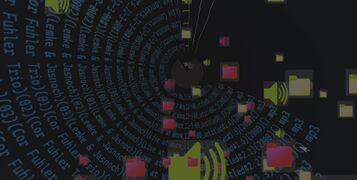
screenshot for the manual 1
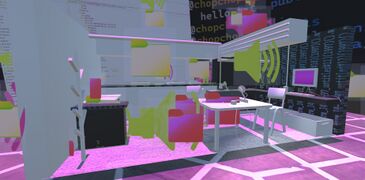
screenshot for the manual 2


Unityworking with Maria X / Senka


SPECIAL ISSUE 23 - HOW DID WE GET HERE? /DOOR/PORT/
This was a collaboration with Mania and Victor. Our shared part in this work was that Victor designed the access token to our 'feminist data center' as we presented our Special Issue at Varia. We address how our information gets to our interfaces, acknowledging the fact that it's not this romantic cloud system but an infrastructure that delivers information via satellite, glass fibre and other spots. When we designed the entrance to the special issue, we wanted to play with the idea of limited access to grant people information. Victor made the access token (img), directing to Mania's introduction and data walk (which also encapsulates our conversations about fibre cables sprouting up the street during the establishment of our collective project. Mania's project then redirects to my project /port. The port to information.
A port is a virtual point where network connections start and end.


SPECIAL ISSUE 24 - POINTS OF INACCESS ROTTERDAM [POINXS 010]
This Special Issue was a crucial precursor to my graduation project. As someone who has lived in Rotterdam his entire life, the city critique and topics have been interesting. During this trimester we were given a lot of different ways to look critically at Rotterdam. Over the years I already gathered some criticism and this Special Issue gave me some first hands-on ways to deal with it.
 This resulted In POINXS: A critical counter map looking at city marketing/planning versus the city living and experience. It's a parody on postcard surreality and apps/websites portraying cool and flashy 2D/3D imagery without the complicated dimensions of the city without showing what's behind the scenes.
Rotterdam is 'back on the map'.
POINXS questions that map and looks at a city that has become less livable and affordable and reports the bugs from a hill that leads to a dead end pavement, via private transport to wheelchair inaccessible hotspots with ambitions to become a multi-user platform for reporting other people's POINXS.
For this Special Issue, we made a flyer / map containing our content for the Special Issue at UBIK. We made memes and parodies on commercial
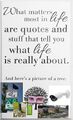
In this meme I use an older meme with the knowledge obtained in VONK on Nudging theory. This one didn't make the map / folder.
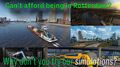
This meme is a part of my research in how Rotterdam looks virtually. This is a precursor to Renderdam. It shows Rotterdam from flight / truck / marine / train simulators. Going from games into simulation was a big part in my research.
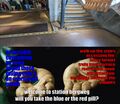
This is a meme based on inaccesibility in cultural hip and happening hotspots. It's a place you can go and also has the option to be inside with i.e. wheelchair / mobility scooter. But it also has a cool rooftop bar and that is where it gets uncomfortable. Station Bergweg might not have intended to be inaccessible but it sure takes away access and affordance in multiple layers.


the development of your reading/writing practice across the 2 years,
SPECIAL ISSUE 23 / PUBLIC TRANSPORT
During the second special issue of our first year, we did some research into text-based games and since the dynamic of a lot of of those games go on a step by step basis, I felt inspired and made somewhat of a story based on a true narrative of mobility concerning my mother and my brother. This was somewhat of a draft but became crucial as the steps are a big part in my Counter Planner
1. "Public transport: From A to B via Metroline E and Tram 7."
A personal observation based on the limitations concerning accessibility, usability concerning healthcare, public transport.
Since XPUB is focused on making things public, I'm thinking about some stuff.
Public Transport, How do you make Transport Public? Or more public
I'm just thinking about the idea of the public service for the transport from an accessible / disability point of view. This case is quite personal but also inspirational from my critical thinking designartresearchblabla point of view.
So, let's say my mother wants to go to my brother. What needs to be done? For this method I'm using the google maps standard*/ **
- Go out of the house
- Unlock the scootmobile
- Uncover the scootmobile
- Put the cover inside
- move the bicycle
- position the basket and possible bags
- start scootmobile
- go to end of street
- wait for traffic lights / or if you're lucky it's green but it's always in favour of the cars.
- once you crossed the street, go to the elevator
- check in at port **
- push the button
- wait for elevator
- possibly wait for people to exit the elevator
- enter the elevator***
- wait until you are at the platform
- exit elevator to right side(need to confirm this)
- wait for the metro
- search for the good entrance without the metal poles in the middle ^
- be in metro for one stop
- reach central station
- pull back to exit metro
- go back or forward to elevator
- push button and wait for elevator / if you are lucky it'll be there already
- enter the elevator ***
- wait til you reach centraal station begane grond
- go back or forward to exit elevator
- check out at port **
- ride towards third tram platform
- enter third tram platform
- wait for tram 7 towards woudestein? (need to be confirmed)
- in the meantime, guess on what half of the platform the tram will stop
- inevitably ride or race through crowd to reach the middle / center of tram****
- enter tram in transit ^
- position yourself
- wait until you reach you reach your destination
- try to get out of the tram
- check out as well
- you can finally breathe again
- enjoy your visit
- when it is time to leave, leave*
- go back to the tram
- search for the right port on the other side of the street
- inevitably ride or race through crowd to reach the middle / center of tram****
- step / check in
- it might be possible that there is a parent and a baby carriage in the space that is also meant for wheelchair and rollator
- wait in discomfort
- person with baby carriage needs to get out, instead of going to another exit, this person insists to get out the door they came in, they lift the scootmobile and you are in even more discomfort
- you need to wait some more time
- finally you are at Rotterdam Centraal
- struggle to get out of the tram once again**
- head to the metro port
- check in and somehow also drive towards the elevator***
- push the button of the elevator
- position yourself in the metro at the place with no metal poles in the middle
- wait one stop
- get out the metro
- go to elevator
- go up
- go out
- go home
- place all the stuff back
- recover
*before you go, think about leaving at least 10-15 minutes in advance
** might need someone else to do it because it closes again in a certain timeframe
*** this means the elevator works
**** there might be a parent with child, cyclist, person in wheelchair, other person in scootmobile there
^ take into consideration the doors are literally timeframes so you better have someone with you to hold the door
Example: --------
The Rotterdam Electric Tram has multiple Entrances -> Ports
Port asin the doors
Port asin checkin / outs
[] PORT 1
[] PORT 2
[] PORT 3
<<<<< (_□___□▯▯__□__▯▯_□__▯▯_□_)>>>>>>
DRIVER | BEGIN | MIDDLE | END
| FRONT | CENTER | BACK
[PORT1] | [PORT2] | [PORT3]
check I / O | I / O | I / O
FOOTABLE | FOOTABLE | FOOTABLE
KIDABLE | KIDABLE | KIDABLE
| WHEELABLE |
FOR CONTEXT
CENTRAAL STATION TRAM STOP
(_□___□▯▯__□__▯▯_□__▯▯_□_) / (_□___□▯▯__□__▯▯_□__▯▯_□_)
_______________________________________________________________________________________
(_□___□▯▯__□__▯▯_□__▯▯_□_) / (_□___□▯▯__□__▯▯_□__▯▯_□_)
_______________________________________________________________________________________
(_□___□▯▯__□__▯▯_□__▯▯_□_) / (_□___□▯▯__□__▯▯_□__▯▯_□_)
_______________________________________________________________________________________
SPECIAL ISSUE 24 / Benchmarking.
During the third special issue. I was playing around with idea of the city being a machine. Previous trimester and this one, I was interested in how ideas of i.e terminal and port are both visible in a city especially as Rotterdam has a terminal that up and downloads goods I came to realize this as well when I was playing a game called EuroTruck Simulator 2 that visualizes the transport of goods through terminals and ports. Ports of access in information. At some points I started looking at other crossreferential words as I tried to develop my own methodology. This resulted in a thought experiment called Benchmarking.
BENCHMARKING
what does it mean to benchmarkdictionaries will tell that it is
1. a standard or point of reference against which things may be compared.
"the pay settlement will set a **benchmark for** other employers and workers"
2. ideal - a test designed to evaluate or compare the performance of computer hardware or software.
"we thought we'd run some benchmarks on the smartphone"
3. Benchmark is a surveyor's mark, cut on a rock, stone, wall or a building showing the height of that mark above sea level. Contours are lines shown in brown, joining places of equal height above the sea level. Heights of inaccessible areas are shown by contours drawn in broken lines called form lines.
4. or building and used as a reference point in measuring [altitudes]
5. ==evaluate (something) by comparison with a standard.==
=="we are **benchmarking** our performance **against** external criteria"==
----------------------------------------------------------------------------------------------------------
In these definitions, it all comes down to defining standards and legitimizing / testing.
When I would look for a certain hard or software, I need to check either consumer platforms such as tweakers, reviewers on video platforms.
What do I mean with it?
I'm intrigued by the idea of sitting / being / loitering somewhere and look for the compatibility of platforms. Be it physical or mental. The accessibility meets disability in where the bar is set and the threshold is put. The threshold is both a place to fit a tool that grants access as it is a bar to closes access.
When walking around, make a pitstop at a bench. Just sit there in the middle part. Look forward. Make yourself comfortable and take an unlimited time to see evaluate the premise. What does the neighborhood look like, what is the demographic. How much is it designed? Is it possible for anyone to be there?'
`Make a list of the specs.`
`Is there anything that could be tweaked?`
`Be your own tracking device`
`In a smart city, be a smart civilian, look at the surroundings`
`from your own point of critique, make notes`
Questions / thoughts I wrote down during trimester were of huge influence on my thesis / research towards the final work.
Is the city a circuit? The resemblance between a city and a computer, its interactions. Traversing as information
I also was [and still am!] frustrated with yuppy/gentrification in the city
Why do people like Susan Bijl bags? Is it to be part of something cool? Is it about being part of a group of people that cares more about the image of being an urbanite and is it a leisure class / flaneuring thing? [most probably affirmative]
Is a big city open enough for people with disabilities? [most probably not yet~~]
counter-flaneuring: To swim against the current and walk into a figure that is showing off their status in the middle of the street.
CybeRdam2077 - PolderPunk?
27-05-24 We have visited VONK https://www.vonkrotterdam.nl/The innovation center of Rotterdam Municipality.
NeoRotterdam, the idea of Rotterdam being so smart and innovative that it turns into a cybernetic dock station.
Since monday I have been thinking about the correlations between my spare time interests and the xpub topics. On monday, I was triggered or intrigued by the idea of future of Rotterdam. At VONK [the innovation center] they presented us with the three principles of the city, at least, the three principles they presented- Nudging
- Controlling the traffic through soft and hardware that connects to the city sensors center.
- Rotterdam 3D /ARVRXR -> Looking at the city from / on a virtual perspective. "Gaaf zeg hey" as any person into tech and gadget and modern stuff would say.
The moment I saw the building and the modern gamification of the city, it reminded me of Night City in broad daylight. Night City is the place where Cyberpunk takes place. It is very interesting to think about innovation, about the smartness of the city where I grew up. The city seems to be dangling in between
Cyberpunk: a genre of science fiction set in a lawless subculture of an oppressive society dominated by computer technology. and
Solarpunk: a literary and artistic movement that envisions and works toward actualizing a sustainable future interconnected with nature and community.
the suffix -punk refers to the punk asin steampunk (a subgenre of science fiction that incorporates retrofuturistic technology and aesthetics inspired by, but not limited to, 19th-century industrial steam-powered machinery.)
But to a Dutch degree, I always feel that a lot 'we' try to mimic or make our own, becomes a very watered down overly negotiated version of the actual thing. I'm talking about the Polder Model.
The polder model is a method of consensus decision-making, based on the Dutch version of consensus-based economic and social policymaking in the 1980s and 1990s. It gets its name from the Dutch word for tracts of land enclosed by dikes.
Therefore, looking at the citymarketing / citybuilding / cityplanning idea of Rotterdam as some sort of PolderPunk starting to develop in 2025.
This kind of future city gives me some sort of future fictional idea. In a perfect world.
I'm afraid of this perfect world.
https://www.rotterdam.nl/_next/image?url=https%3A%2F%2Fbackend-dvg.rotterdam.nl%2Fsites%2Fdefault%2Ffiles%2Fstyles%2Fcontent_large%2Fpublic%2F2023-06%2Fartist-impressions-Hofplein-Aerial-Render.jpg%3Fh%3D8f74817f%26itok%3DwizvRIkp&w=828&q=75
CITY AS A MACHINE
Programmer and tech writer Paul McFedries explains this thinking:
The city is a computer, the streetscape is the interface, you are the cursor, and your smartphone is the input device. This is the user-based, bottom-up version of the city-as-computer idea, but there’s also a top-down version, which is systems-based. It looks at urban systems such as transit, garbage, and water and wonders whether the city could be more efficient and better organized if these systems were ‘smart.’
https://placesjournal.org/article/a-city-is-not-a-computer/
This idea came to mind because of the connections of both defintions of a port / terminal / transport / uploading and downloading / docking etc
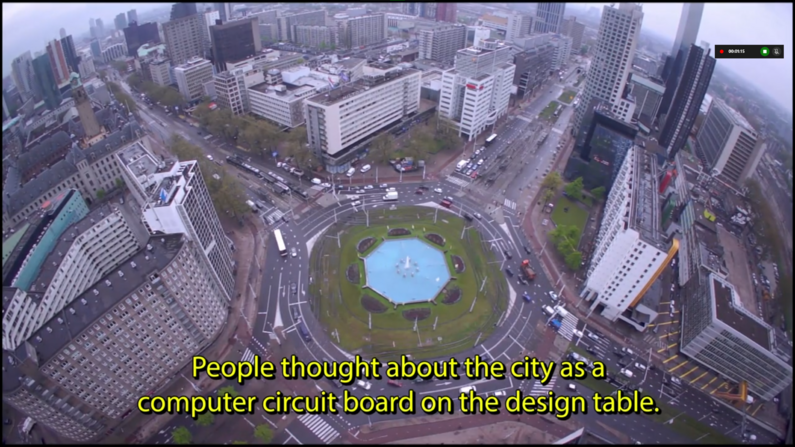
From Gyz La Rivière's ROTTERDAM 2040

STRUCTURELESS INSPIRED WRITINGS
.jpg)
IMPORTANT MENTIONS
DEFAULT ALPHA
CARE COLLECTIVE
SMOOTH CITY
SITUATIONIST
XYZ+T
BureauraticCareCreative license
This publication is free for fair use under the conditions that the reader takes into account sensitivities of this document are only used if the context is completely understood. Words may not be shuffled, however, they are open for free interpretation. Media literacy is important and therefore the information may not be pulled out of its contexts and nuances but reviewed from the source and the intentions. If the reader wants to do this, they are free to request approval of the writer of this thesis, keep in mind that responding time could take 6-8 weeks with possible extensions. If the reader does not understand the text because of difficult words, the reader is free to ask for clarity. Since information should be readable, shareable as we need to raise fundaments over knowledge gaps and a common understanding can be made.
the development of your prototyping practice across the 2 years,
I think this a bit difficult to say. My prototyping feels a bit abstract as it was always processing information. I think my collections and making drawings were also part of prototyping.
This will become some sort of image essay with short descriptions of what I feel my prototyping has been about (?)
_visual_prototype_in_Unity.png)
Starting off with the trusted environment making virtual spaces.

And starting with using the wiki codeblock languages as a way to write in a new setup where text is marked up by the code and therefore the code editor becomes a collaborator.

In order to get myself organised and also to think about ways to 'map' words. Getting familiar with Obsidian


Playing with ways to make the seamful word quilt. (which resulted in /PORT)

Making a drawing during the collective quilt session in the beginning of SI23


Going on a lot of walks and messaging Mania about how information / electric infrastructures entered the city nature environments.


Being lost during the Projects that may or may not likely to be have made happen't


Benchmarking in practice. Sitting somewhere whilst being on a walk, making notes on what goes on in the environment, what could be needed in the area or doesn't speak for itself?

Making a visual out of a route I walked but keeping out the context of the location.


Looking at Rotterdam 2040 / going on more walks / looking at streets, institutions, starting to see POINXS


Posted my Renderdam meme online with the caption: I want to live in Renderdam. People reacted. The name started to exist.
my first annotated drawing.


Making a drawing in unity.
your thesis (only a brief overview for context, as this has been assessed separately in depth),
RENDERDAM - THESIS ON CITY COUNTER-TEXTURES
Renderdam: a thesis on city counter-textures focuses on personal situations relating to city planning. It is written with grief, care and other intense emotions which a readable in thesis.
It goes deep into the character of Rotterdam, its representation and things I went to in the thesis-outline.
Part of intro:
Trigger warning: the topics are about health, diseases, disabilities, accessibility. It concerns drastic to emotional topics and scenarios. It’s emotionally driven with knowledge gained through a thicker skin.
The thesis comprises a series of chapter.
Each chapter comprises annotations of a drawing.
Each drawing focuses on one or more of these aspects related to accessibility:
Traveling through Rotterdam with my brother who is in a wheelchair, has made me more aware of the architectural, cultural and bureaucratic limits of our movements. In this thesis, I (de)construct and criticize Rotterdam. I will reflect on the city in contrast to the utopian postcard images that I experience in the city. I develop a "counter-mapping" practice in relation to the issue of accessibility in Rotterdam. This will take the form of the transcription of a series of drawings which I made whilst writing the thesis. I will also use my knowledge and experience in world building with 3D software (Unity3D, Cinema4D, Unreal Engine).
The text will be structured by the following themes, each of which represents one of the multiple obstacles to getting around.
Socially
Personal, Affordable, Family, Housing
Accessibly
Disability, Information provision, infrastructures
Bureaucratically
Protocols of local municipal / governments
Architecturally
Buildings, ways, pavements, roads, streets
Virtually
Imagery, impression, media, software, simulation, games
Culturally
budget cuts, false iconism, counterculture, grassroots, community, festivals/gigs/events
example of annotated drawing:

This drawing is a cacophony of the examples I give in this chapter.
In the top right, I push my brother from street level, to pavement, over the ramp inside onward towards inside.
Below the hall there is a front door view of where my aunt and uncle live. Which is a multi-threshold construction of tiles, bricks and pavements, leading to a narrow door which isn't wide enough to fit my brothers wheelchair.
In the centre of the image. Is a sketched version of the \ app-interface based on the ride booking/reservation screen. Above this screen is a sketch of the Rotterdam Municipality logo with the word of WMO (law for societal support) and the number 6-8, indicating the weeks it can take before you know if you qualify for TREVVEL.
On the right side of the interface. A sketch based on the front door situation of my Nephew's recently bought house. (Looked at above from Google Earth) Where we met up to meet his kid and showing us through the house. My brother couldn't get in because of, once again construction of tiles, bricks and pavements. With another social threshold that could have been helped, had we the knowledge of entrance, since we do have ramps to get past this. Wouldn't know if he would fit inside, though.
On the bottom left, there is the possibility of a back door of my aunt and uncle's place. Which we didn't use in the end.
The A to B line in bright green hovers over the different thresholds. To show what bizarre detours have to be done to get complete the route, not even mentioning the delays. excerpt from following text:
In this chapter I aim to show the preconceptions that are often there about the multiple obstacles which become invisible when people are unaware. When people do not see it. It does not exist. I am zooming in from the big picture to a personal experience. I ask the question:
How does one maneuver, or get around 'town'?
Starting with myself: As I mentioned in the introduction, I can not ride a bike, so I either walk, take public transport, take a cab or carpool with someone. My brother can not walk, he is in a wheelchair or mobility scooter, so public transport mostly isn't an option. He can be transported from bed to wheelchair, from bed to mobility scooter, from wheelchair to a car.
It is mostly the case he gets around with something called Trevvel. He maneuvers in his mobility scooter for longer distances, and for shorter distances he uses his electric wheelchair. One would assume that this fixes a lot of problems, which is true but still he meets a lot of obstacles on the way.
Spoiler end tag;
Rotterdam will always persue in revealing its cracks. A week before delivering the thesis, someone stole the ramp we use and for now stole my brother’s access to my mother’s house. It’s a bit of grim passage to end the thesis with. But it renders a better image of the city than Renderdam will ever show.
These issues become invisible. When people do not see them, they do not exist.
your final work and research in the second year,
My final work has evolved quite a lot. I started thinking about the municipality again.
As a form of field research I took part on two external trips.
in September, I went to GRONINGEN
Together with Mania and Anita I went to Groningen. To see if my project would be of use for our counter tourist excursion; It was good to see that the gemeente Groningen does a lot in regards to accessibilty and it was bizarre that such an older city really on first hand was accessible. The three of us were there for three days. The deadline of the project was due in end of september. With some hesitation of that I didn't feel my project would be in a proper shape in that time. I decided to opt out. Painful but wise decision. I couldn't assess points of inaccess based on 2-3 weeks time without being / living there. It was painful but I'm grateful for the opportunity.
A side project I did was Spiritual media psychosis, a publication still waiting to happen but based on our online conversation.


I presented a colloquium where I asked people to cooperate in a location satisfactory research this was a try-out to gather info and start a potential infrastructure for counter mapping.

After the first public moment, I was going back and forth on what I wanted to do and what I wanted to cover.
Does it fit within our wishes
for what we want Rotterdam
to appear to be?
What value is there morally to be found
if the revenue exceeds the needs of the demanding people
in December I went to GENT(click on title to see my findings):
I was invited by Martino to go to Constant's work session. The link is descriptive but here I found importance of local context with all due respect to their approach. It helped me sharpen my project.
Towards the project proposal / trimester 3 & 4 assessment. I was focussing on making a game that would render a better vision of the city.
I had A LOT of ideas and I gathered a lot of information.
The project started to take on shapes, after the project proposal presentation, we made an agreement that I would take a step back think some things over based on their very valid critique.
So I changed the project. It used to be called contextures, but it was a bit too much to explain. So the overall title became Renderdam. Which are the virtual version of Rotterdam in many shapes forms and interfaces.
Contextures was a word as a con or now counterversion of the context of the city and also referring to the 3D textures and the multiple meanings of textures.
The process was a research in developing counter-mapping and counter-planning.
Through testing and visualizing the thresholds of online and offline surfaces and interfaces.
In the most simple example. It is about getting from A to B and getting things done, based on personal stories.
I used multiple outcomes as form experiments to find and or combine i.e. annotations(recording/written), drawings, Unity3D, (web) interfaces.
Annotations have been a succesful element in my work. The drawing and portraying of personal situation gave a honest counter argument to the false optimism of the city.
The development of the project was in redefining what Renderdam is.
Renderdam is a search in developing counter outcomes in relation to their aimed media, through analysis and tests of online and offline surfaces and interfaces. With getting from A to B, based on personal stories as well as getting things done.
To exemplify my project, one of my works in progress revolves around how to visualize a waiting space. Having in mind the actual waiting time, space and 'space' as in the state of mind that occurs when becoming dependent of an instance. A visual mix of where Kafka meets Escher.
Another experimentation I'm (counter)planning, puts the procedures of applying for something at the Gemeente in the mould of online planners/maps. Trying to figure out blackbox-code behind the i.e. Google Maps, 9292ov and trying to put the procedural steps of getting something done in the text areas of a planned route. At the same time looking at what is used to localize problems or data in Rotterdam with https://www.3drotterdam.nl/ https://www.buitenbeter.nl/ https://meldr.rotterdam.nl/. Experimentation with physical maps and software like Leaflet.js in combination of the previously mentioned experiments will then bloom into the all encompassing counter-planner that will narrate the stories time critiquing Rotterdam's Make It Happen.
excerpt from my project proposal page :
Why do you want to make it?
I am having mixed feelings about Rotterdam, the city I was born and raised in. A city that has been suffering the second city syndrome for a while and is on the list of poorest, least healthy. Having some sort of bad reputation based on multiple elements. Then resulting into trying to develop a better city, getting on the list of cool cities. Developing gentrification and seeming to be more (inter)nationally appealing cities.
Rotterdam, Make It Happen** is a campaign that focuses on developing the city but rather than focusing on the problems that the city has from the national housing crisis, poverty rates, social care conditions, narco-capital problems. My specific focus is on accessibility and this the red thread that goes through multiple dimensions.
This project is my experiment to develop an infrastructure based on constructive city criticism but also reflection. In this, the human element in the precalculated environment is the centerpiece. The human touch as reminder of the (in)humane complications. I'm in confusion by the idea of vision / images of the city through virtual representation. Mostly, because I feel that is an image that lacks multiple layers of complex contexts.
How do you plan to make it?
I plan to experiment with multiple media. From annotating map, to drawing comic style interventions, to online maps and adding the points from A to B
See it as a third evolution in the series of PUBLIC TRANSPORT where I show a 63 step travel from a to b and back again, combined with POINXS.
RENDERDAM
When I see the announcements of new promising areas, the showcases of both private and public investors and instances. The hollow imagery of the promise misses the filling: The cities contexts and needs. Instead of that, Rotterdam™ or ***R***™ creates a representation based on these contextless imagery. Rotterdam is being and worn as costume and the city undergoes a virtual *seeming* metamorphosis or rather **stagnation** and casts into Renderdam.
ANTITECTURE
I am in a constant battle with new and old buildings. The old Rotterdam buildings are built with the idea that everything of the inhabitants body is working (both the human is functioning = working and its body can function without any disabilities) _properly.
SURREAL POSTCARDS
Renderdam is the rendered version of Rotterdam. A research project based on accessibility in and around the city. There are multiple thresholds in the provided interfaces that often limit the movements to either go from A to B or to get things done. In contrast, a lot of toxic positivity is found: Rotterdam, make it happen and The city of tomorrow, we build today. The futuristic image smoothens out the struggles based on i.e. accessibility, disability and affordance.
Renderdam is a collection of outcomes in analysis and critique around limited movements, innovation, marketing, artist impressions, personal stories and annotated drawings.
But that's


plans for final publication and grad show (with the understanding that you will continue to work on this after the assessment)

3 MOODBOARDS
- making it happen but not as quick
- renderdam relating to futurist dystopia popculture
- critical annotations

COUNTERPLANNER [RASPBERRY PI + TOUCH SCREEN]

POSTCARDS

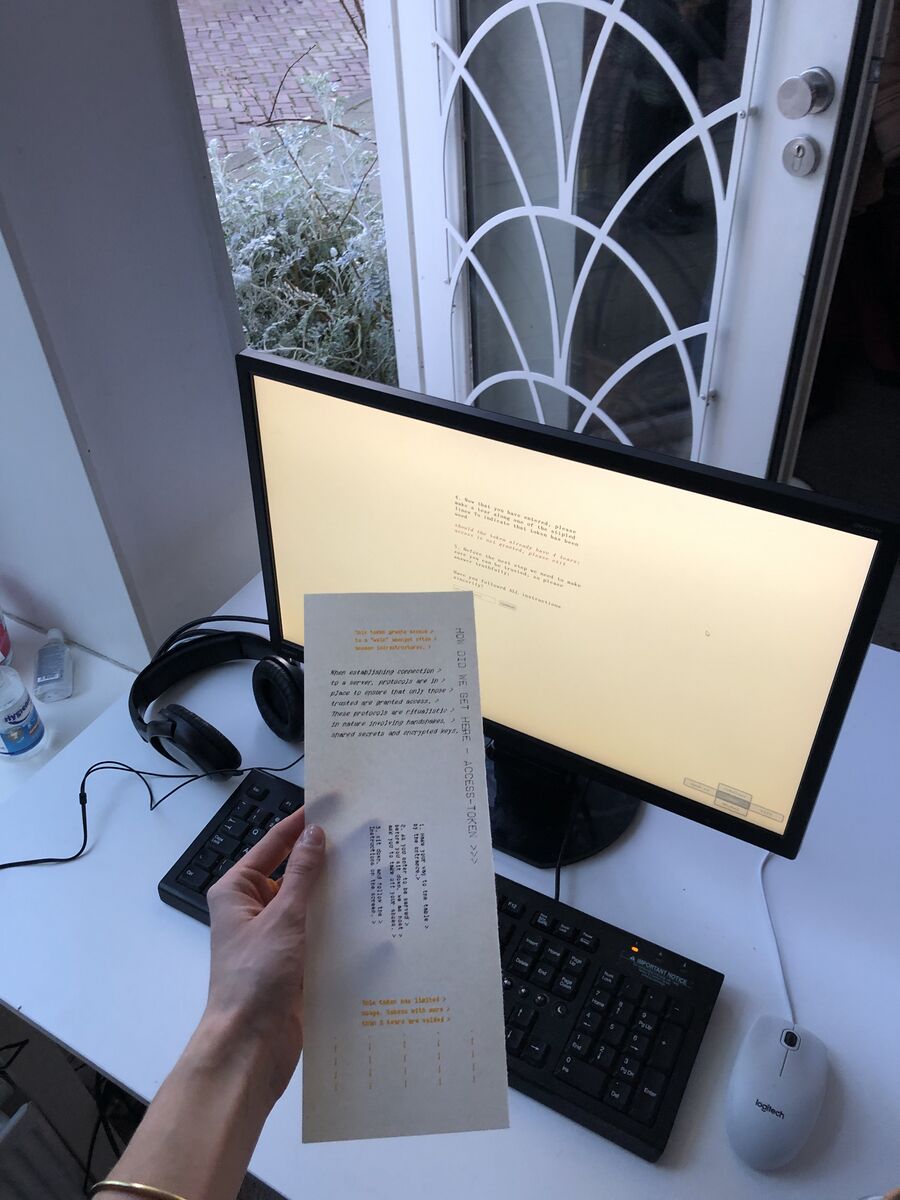
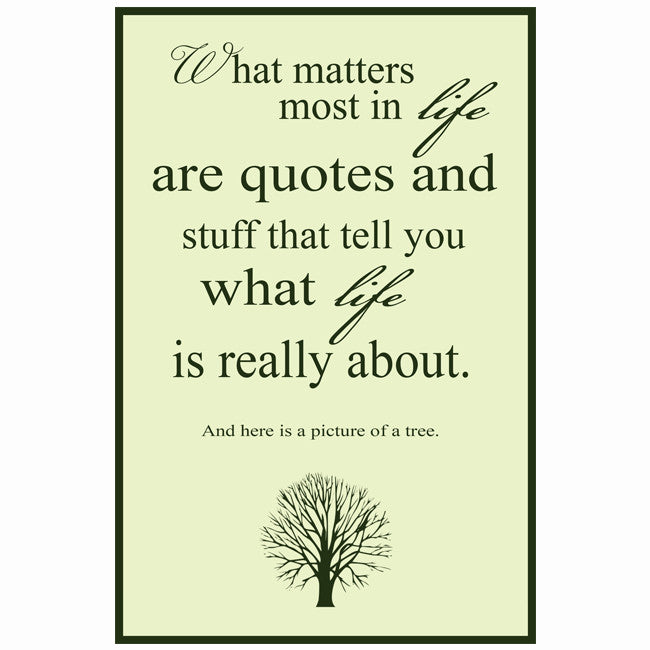
Renderdam is the rendered version of Rotterdam. A research project based on accessibility in and around the city. There are multiple thresholds in the provided interfaces that often limit the movements to either go from A to B or to get things done. In contrast, a lot of toxic positivity is found: Rotterdam, make it happen and The city of tomorrow, we build today. The futuristic image smoothens out the struggles based on i.e. accessibility, disability and affordance.
Renderdam is a collection of outcomes in analysis and critique around limited movements, innovation, marketing, artist impressions, personal stories and annotated drawings.
The presentation at buitenplaats brienenoord is going to be somewhat of a Renderdam Counterdesk. Consisting of the following elements.
RENDERDAM Counterplanner
The CounterPlanner is a parody on routeplanners like 9292OV, Google Maps.and also surfaces, interfaces and mechanisms of institutions like Trevvel. It is also a critique on neoliberal [automated] bureaucracy in relation to Rotterdam's Make It Happen slogan. The outcome of the work is not necessarily that nothing ever gets done. But it is merely about the limited moving capacity of when you are dependent on either wheelchair, mobility scooter, social taxi instances or policies of a (local) government concerning laws like WLZ or WMO. It emphasizes of the urgent needs of people like my brother and mother. The counterplanner does not have a space to fill in the A to B's. It uses a 'choose your own adventure'-layer which limited options.
The content of the counterplanner are a collectiong step-by-step storylines that reveal the u-turns and alternative routes that are needed to move in a reality of limited options and movement space, rendering a lot of spaces that seem public into an inaccesible liminal space / backroom. The information is based on true stories and carry a lot of depth.
RENDERDAM Critical Post Cards
The Renderdam Critical Post Cards are a way of showing what I call Contextures
a portmanteau of the following words
Con = "an instance of [deceiving] or [tricking] someone. / [persuade](someone) to do or believe something by lying to them." (Oxford).

Context "the circumstances that form the setting for an event, statement, or idea, and in terms of which it can be fully understood." (Oxford).

Textures "the feel, appearance, or consistency of a surface or substance."(Oxford).
By these renders I mean: the images the city presents of itself. They do not represent the context of the city and give a false promise to potential buyers, visitors and inhabitants.
Of course there is no trust to be found in the artist impressions and postcard surrealities that are plastered on top of the wasteland from which the new buildings will emerge.
The drawings I made for my thesis Contextures,
are drawings that reflect on developments in the city They have annotations which I will shorten, for the postcards are a6 or a5 size.
The front will be the picture, the back will contain one or two paragraph-summaries of the annotation, redirecting to the thesis website.
Next to that, a tikkie-donation QR code will also be part of the postcards. [?]
RENDERDAM CounterBanner
The Renderdam Counter Banner is a poster-size image that drags the visitor into the renderdam universe. It asks the viewer multiple questions and has statements on how to position yourself in the future. To what degree is renderdam is tool for innovation and where does it use the same tool to demolish?
The City of Rotterdam casted into the virtual mould of hollow representation. Setting a scene based on future promise. The design of this promise is then turned into realization as the inhabitants of the city turn into their 2D predecessors in the announcement of the real estate company.
As this idea / interpretation of Rotterdam is realizing and takes shape from its virtual concepts. The streets turn into a design rather than the opposite. As I mentioned before in PolderPunk 2077. I see a lot of resemblance in certain games.
To me it's starting to feel that the commodification of the impression is more important because that brings revenue. Rather than realizing the value of the actual citizens. This idea of the new cool Rotterdam is of course not entirely negative. Considering the fact that its popularity rose in the last ~15 years.
The problem (I have) with this new angle is that it provides an image that lacks context. The lack of poverty (in Dutch context), proper (social) housing and *many other problems*. The idea of this metropolitan megacity is of course very attractive for outsiders. (Sub)cultures are well celebrated even though the spaces where they manifest are in constant argument about their existential rights. I'd like to crosslink/refer this argument with mine, because both have to do with municipal zoning plans.